
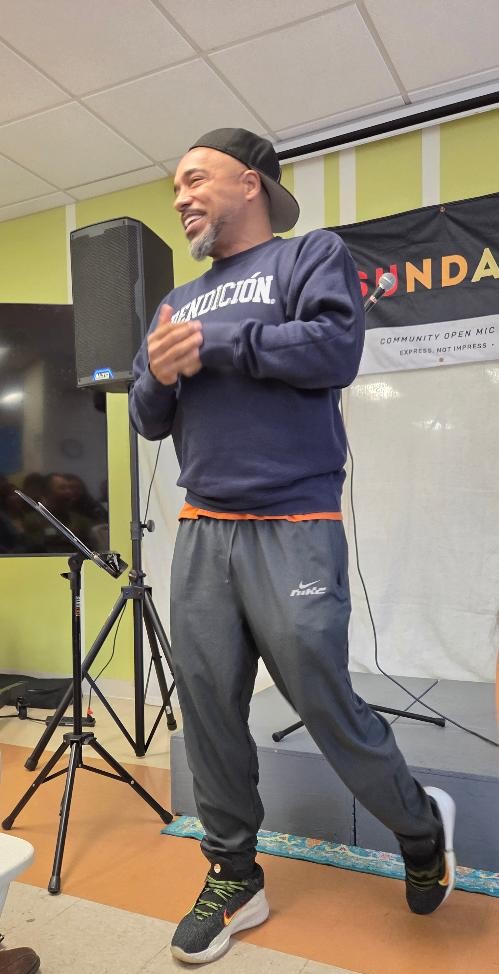
The “Caution! Writers at Play” a literary festival by Sunday Jump, began right on time at 10 am. The first annual, held on Sunday in Historic Filipinotown, at the Pilipino Workers Center, opened with Keynote speaker, Shihan Van Cleif.
The festival is the brainchild of poets Eddy Gana and Stephanie Sajor, two founders of Sunday Jump, an L.Á. based Filipino American community arts organization, and performance poet Christian Perfas aka “Soul Stuf.” Perfas envisioned the festival as “a half-day community gathering bringing together emerging and established poets and writers in Los Ángeles” featuring “workshops, panels, and performances” as stated on Sunday Jump‘s Instagram post promoting the festival.
During his open mic feature, poet and founder of the long-running Long Beach-area open mic The Definitive Soapbox, Antonio Cortez Appling expressed gratitude for the festival centering LGBTQIA+, Black, Indigenous, and writers of color. He emphasized the importance of celebrating the rich diversity in the city and community that the rest of the country doesn’t know about or understand.
But as Keynote speaker Shihan Van Cleif opened the festival, he spoke similarly, reflecting both the festival’s emphasis on building career connections and building community. He spoke about being a spoken word, performance poet from New York, who has spent the last three decades involved in the Los Ángeles poetry scene. He spoke about how he’s been able to build a career out of poetry, chronicling how he came to poetry, fell in love with it, the process of playing with language to express his truths, how he met poets Dante Basco, Devan “Poetri” Smith and “Brutha” Gimmel Hooper and co-founded together Da Poetry Lounge, the largest and longest running weekly spoken word open mic in the United States. He spoke about how he was able to support his family from his poetry career, first by attending open mics to perform, make connections, and find his poetry family. To build community for others to have easy, welcoming access to speak their truth and find their poetry family.
Once the Keynote ended, attendees shifted to a room down the hall to participate in a workshop taught by Long Beach poet Ravina Wadhwani. Her workshop asked attendees to explore who they are—the act of writing to understand themselves better—and included three prompts that engage attendees in that act of exploration. The third prompt provided several options such as: write a poem using elements of your childhood from the previous prompt.
Wadhwani, a first gen South Asian poet and therapist born and raised in the U.S. Virgin Islands, is a big proponent of the idea of writing as healing, “that honors the intersection of creative writing, mindfulness education and mental health,” according to her author website. She’s used writing and poetry as a tool for understanding her identity, by processing trauma, moving through experiences of struggle and growth to heal from the effects of oppression people of color experience in America. That’s the lens through which she taught and structured her workshop.
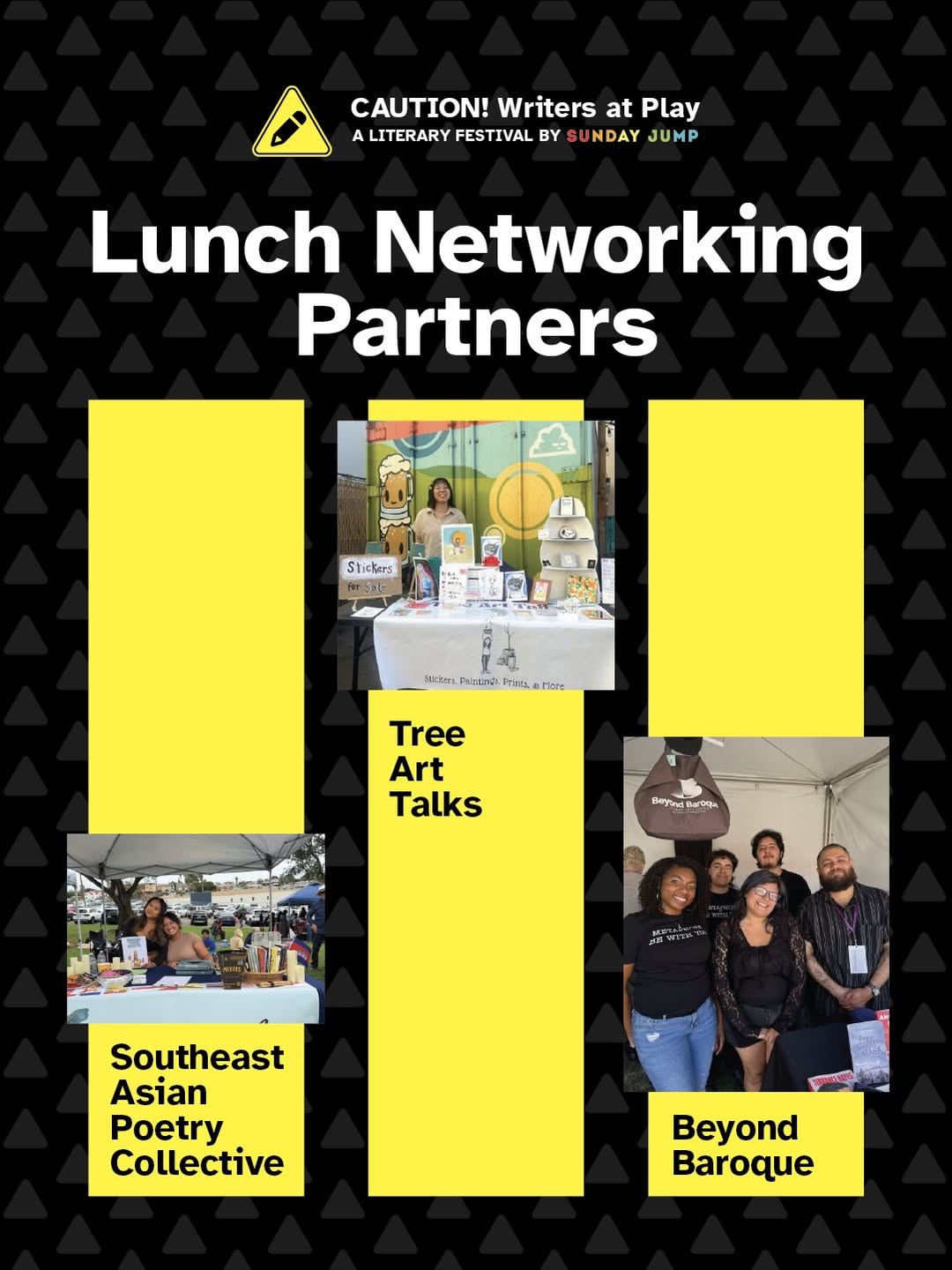
A few key local presses and literary organizations tabled at the festival: World Stage Press, Riot of Roses Publishing House, Beyond Baroque Literary Arts and the Southeast Asian Poetry Collective. Plus, Hustle Diva and Tree Art Talks that provided a space to create zines.
Following the workshop was a publishing panel moderated by Christian Perfas that featured World Stage Press, Riot of Roses, Hustle Diva and Neelanjana Banerjee from Kaya Press, publishing “the most challenging, thoughtful, and provocative literature being produced throughout the Asian and Pacific Island diasporas,” according to its website.
World Stage Press, founded by poets Hiram Sims and Conney Williams, was “founded to amplify underrepresented voices” and to continue the legacy of The World Stage in Leimert Park, “by publishing poetry, fiction, and essays that reflect diverse lived experiences,” according to its website. “As a publishing arm of Community Literature Initiative, World Stage Press poets uplift local and global storytelling and keep the spirit of community-based literature alive.”
Riot of Roses, founded in 2021 by poet Brenda Vaca, was founded to amplify the stories of historically marginalized voices. “We publish books that heal and liberate” it says on the press’s website. “Xicana owned. Mujerista focused. For the people.”
And Hustle Diva, an “articulation artist: author, 22-year editor & publishing coach, empowerment poet” and “Certified Life Coach” it says on her Instagram.
These panelists discussed the manuscript submissions process, the business side of writing that writers are too often left on their own to navigate. They stressed the importance of always adhering to their and any press’s, submission guidelines.
Once the panel concluded, it was time to network and build community. Lunch was provided, participants struck up conversations and I ran into poet, author and teacher James Coats. Soft spoken, tall, he teaches creative writing workshops in Riverside, often working with young writers. His most famous workshop is the social justice workshop Be the Change, monthly on zoom, every first Wednesday of the month. Earlier this year at Riverside’s Mayor’s Ball for the Arts, he received the Literary Arts award for his “compelling writing, thoughtful storytelling and dedication to enriching [the Riverside] community through the power of the written word,” according to the Riverside Arts Council.
The main feature of the festival was the open mic showcase, where festival attendees got to speak their truths before the showcase features, Antonio Cortez Appling, Matthew Cuban, Maylie Macias and Jade Phoenix spit their verse.
But before the open mic showcase, the last workshop took place. Taught by Black genderqueer film-poet PAGES Matam, it was “a writing and editing workshop on understanding how to ask better questions in order to create more authentic and resonant work,” according to Sunday Jump’s Instagram post about the workshop. He invited attendees “to reconnect with the heart of [their] writing by revisiting the intention, emotion, and purpose behind every word.”
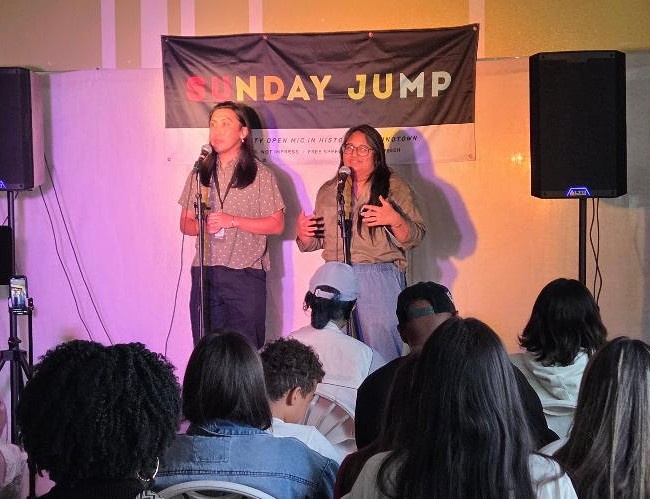
To begin the open mic, Gana and Sajor performed a poem together as the duo Steady, a poetry duo they created before they founded Sunday Jump in 2012. Among the open mic participants were Beyond Baroque’s Programs Manager Iván Salinas, Hustle Diva and World Stage Press’s Krissa Agabon. I even read a poem myself.
As the festival neared its end, the showcase features took the stage. Besides Antonio Cortez Appling, who read second, Maylie Macias kicked things off. Macias, a Git Lit Player and youngest poet, read a poem by a former Get Lit Player, then read her response to that poem. The Get Lit Players, she explained, are Get Lit’s award-winning performance troupe of youth poets ages 13-19. In order to become a Player, teens have to register for auditions that take place once a year.
Third was Jade Phoenix, a Filipinx, trans femme “performance poet and actress, an informative and engaging cultural producer of film and media, that uses her platform and art to shift the conversations and dialogue, around trans women/femme and gender non-conforming people of color in the arts, academia, and film,” it says on her website.
To close out the festival, Christian Perfas delivered a single poem he had memorized. But before that, Matthew Cuban finished out the showcase features with a set of poems and energy that brought an intensity to the room. One was an impassioned political poem speaking truth and defiance to the racism and silencing, especially of people of color, that continues to spread, sinking its teeth deeper into the fabric of America. Another was an unserious, fun poem, that Cuban said is the type of poem poets need to write more of. Poets can’t be serious and deep all the time.
From the diverse ways poets and attendees shared their truths to the attendees’ engagement in learning how to build a career as a writer, the festival delivered what Perfas and Sunday Jump envisioned, making this festival a home for BIPOC and LGBTQIA+ writers for the day.
Even after the festival concluded, attendees lingered to socialize and network.


