
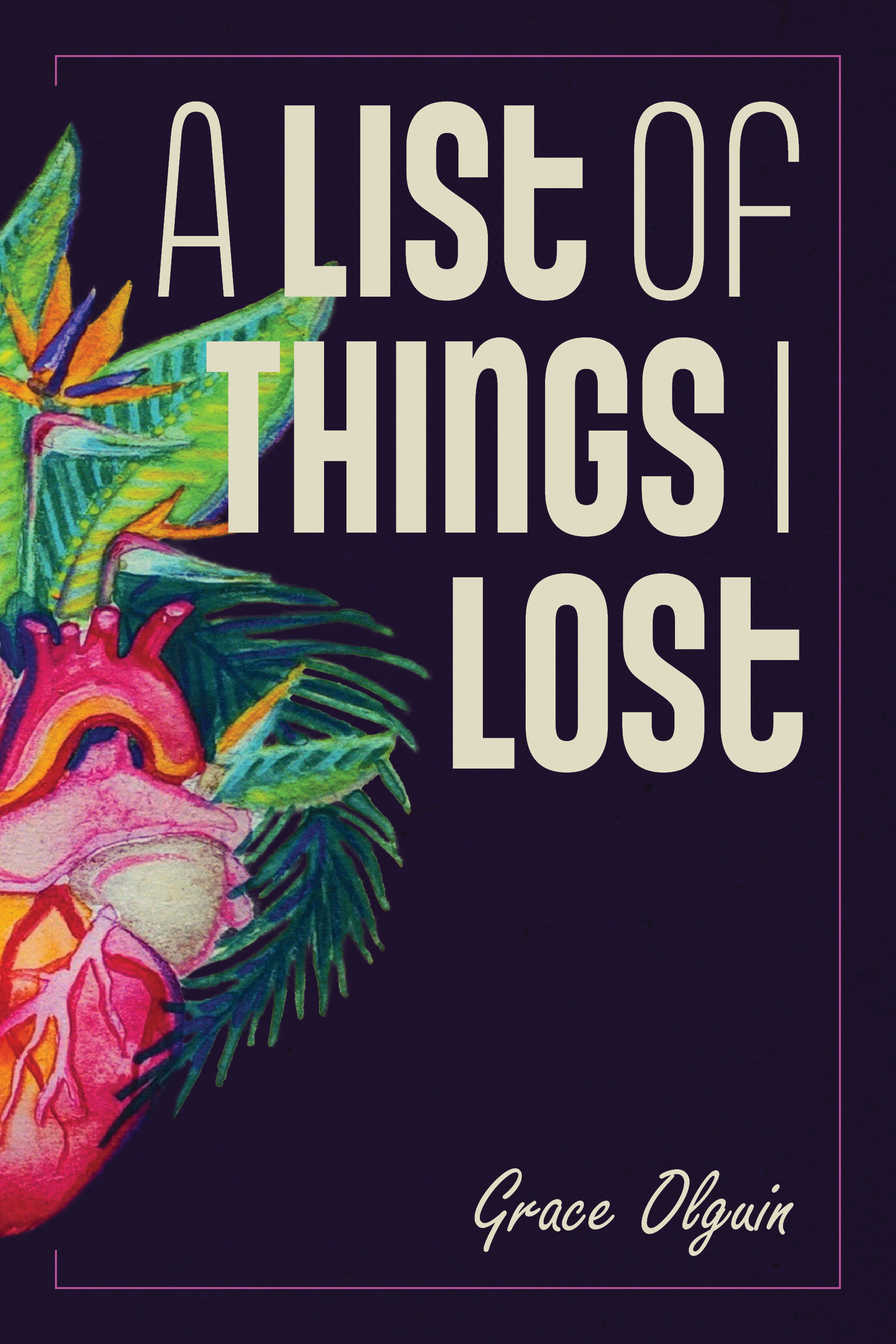
As I opened the pages of A List of Things I Lost for the first time, I had no clue what to expect from poet Grace Olguin. The first thing that caught my attention was a striking fluorescent red heart placed next to the title. The front cover features half a heart beautifully adorned with flowers set against a sleek black matte background. The other half of that same heart rests quietly on the back cover. Only when the book is fully open and you spread the pages wide do the two halves unite to form one complete, vibrant heart.
This is far more than a clever design choice. It is profoundly symbolic and inviting. Holding the open book in my hands felt like opening Olguin’s own chest and gazing directly into her heart, now resting vulnerably in the palm of my hands. In this moment, Grace Olguin offers her readers something rare and generous: an intimate gift and a front row seat to the most personal corners of herself, her heart, and her art.
Before I had even begun reading a single poem, the thoughtful presentation had already pulled me in completely and committed me to the full journey through her poetic universe. Published in 2025 by World Stage Press, A List of Things I Lost is Olguin’s impressive debut poetry collection. A SoCal/Los Ángeles native who currently lives in Long Beach, Grace Olguin has deep ancestral roots in Aguascalientes, Mexico. Her Mexican American heritage permeates her poems, shaping their themes of loss, identity and resilience.
In a compact yet impactful 61 pages, Olguin presents 36 poems that exhibit exceptional versatility. She moves with confidence across different poetic forms, including haiku, concrete poems, prose and free verse. Olguin’s poetic diversity becomes a strength because it mirrors the complexity of her emotional terrain. For example, the stark precision of her haiku balances beautifully with the expansive freedom of her free verse, so each poem feels both independent and an important component of a unified concept.
From the very first poem I could tell that Grace has hip-hop in her veins. You can feel her words flow if you read them at a certain cadence. It took me a few times reading it before it stuck. Coming from a hip-hop background myself, I can see an M.C. when I read one. It is so embedded within the writing that it must be second nature. This is evident in “The Art of Flow” when Olguin writes, “Write to rest in the gaps of silence, write solutions to stop the violence.” I admire the way she blends classic poetic forms like here, where she uses a nine-syllable isosyllabic rhyming couplet but with the sharp rhythmic precision and ease of hip hop rhyming.
In the same poem, Olguin writes with honesty and insight, “Only in the end will I know what I’m saying,” which accurately highlights the intuitive, sometimes mysterious nature of true artistic creation.
She also compares and describes the simple yet magical act of, “putting pen to paper like light to space.” This is only the first poem in her collection, and we have already uncovered so much.
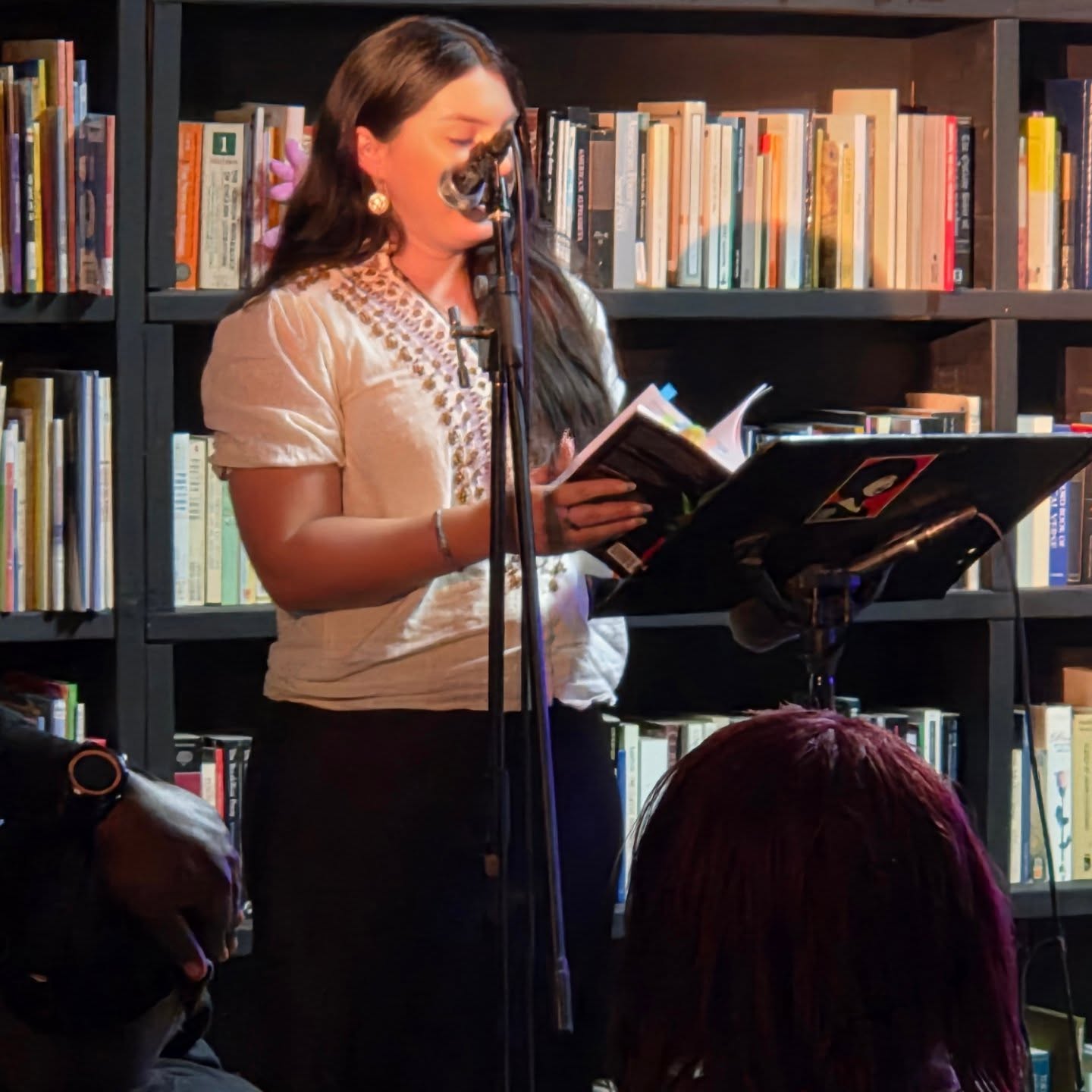
In the poem, “Girl Eats World,” Grace’s Mexican side begins to show along with her poetic side.
Grace uses multi-sensory vivid imagery when she describes the process of toasting a chile pepper on the stove or a comal when she describes, “Un plato de mole con un chile toreado, picando el aire, tosiendo un pulmon, and bare hands flipping over jagged edges for char marks.” She essentially describes the process of toasting a chile pepper over an open flame, flipping it over with bare hands and coughing up a lung while doing it and doing it until the chile pepper gets the proper black char burns. The sensory imagery in the poem consists of taste and smell blended with metaphor and synesthesia. Unlike her first poem, this one is mostly free verse and contains no rhyme or meter. It has an almost conversational spoken-word feel.
Further into her book, I notice that Grace Olguin refuses to be confined to any single category or school of poetry. Her work flows effortlessly between different rules, techniques, form, emotional depth, and aesthetic approaches. These constant gifts don’t just create variety; they are very engaging for the reader. This manner of poetry seems to lure the reader deeper into the totality of the book, using each poem as emotional bait that draws the reader further into its emotional landscape.
In her poem “Intermittent Shame,” Grace delivers a much different style of poem both in content and visually. Unlike the first two poems, this one is written in prose form, having stanzas that range from two to five lines in length. Not only is this poem visually different from the rest but the subject matter is a reclamation of the divine feminine, in an almost confessional tone, when she says,
I suppose as a woman, I’m expected to become one flesh…
A body to grow bodies in. a mother to children.
Womb of gold. Until then abstinent. Or a kept woman. More like
intermittent-celibate. How would you know?
Even the title, “Intermittent Shame,” suggests that shame isn’t gone but is no longer constant or defining.
In this poem Grace reclaims her strength by questioning the anticipated roles that a woman is expected to assume. First, she lays down the expectations like a list and then shatters them with her own imperfect, autonomous reality. Grace displays a strong tone empowered unapologetically by womanhood in which she asserts her strengths and shatters what society’s expectations of a woman are and of woman’s subdued sexuality.
In her poem, “Lights Away from Home,” she shifts into free verse, noting how “the constellations are upside down on this side of the world,” revealing that the world she’s traveled to and now inhabits is completely different from the one she left.
Plus, it seems that another aspect of Olguin’s work is her use of positive affirmations as she writes in the same poem: “My dreams are not dreams right now. They are the contents of my life.” I appreciate it when a poet is kind enough to share positivity along with the hard truths that are contained within their poetry.
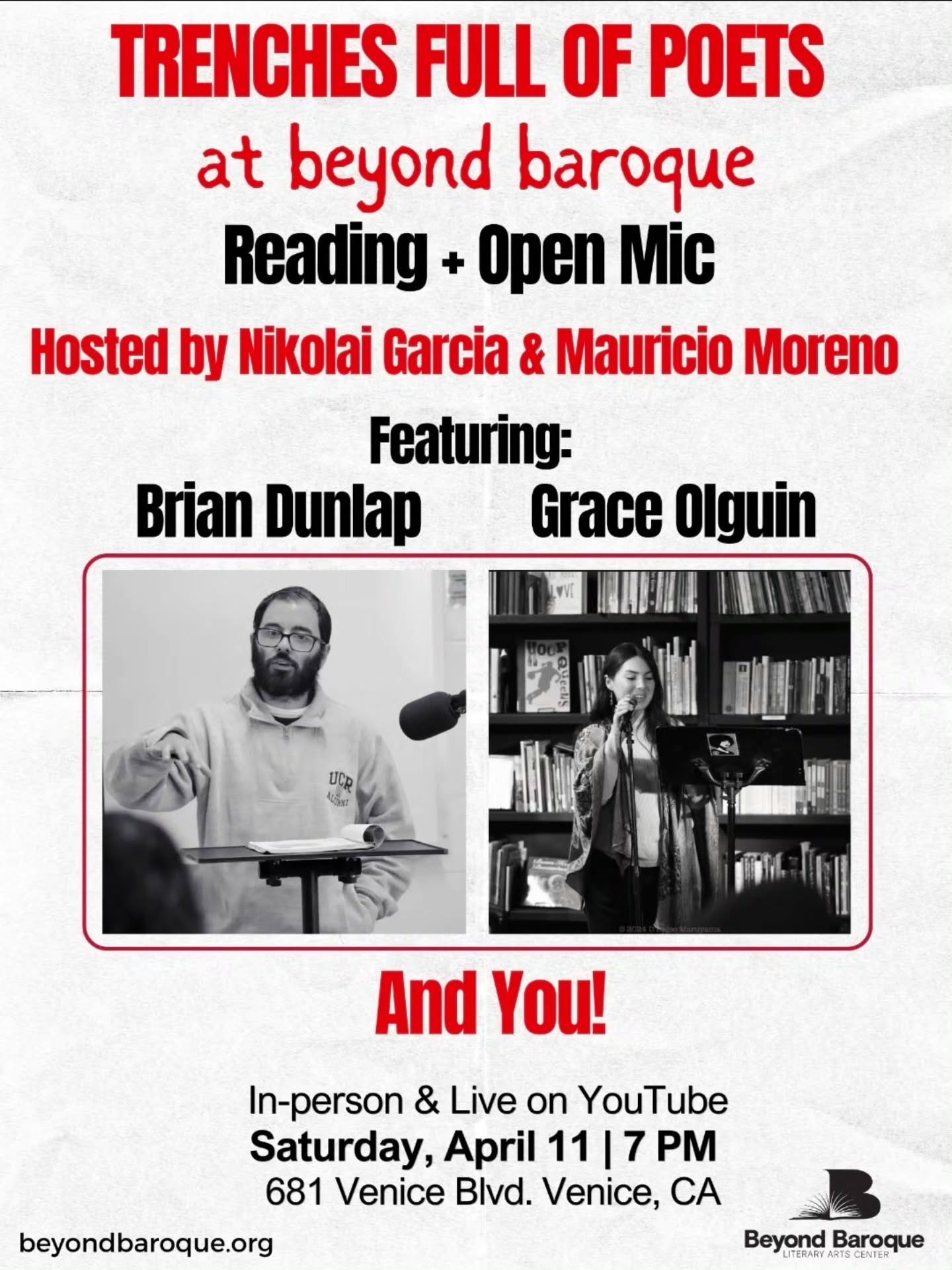
Another affirmation in Olguin’s poem is, “The surface is not always as smooth as it appears to be,” reveals her evolving understanding of life and herself. This is just the type of wisdom that reminds readers to pay attention to all parts of life and to all parts of ourselves, even the little parts that are easy to miss, that reveals to us that things are not always as they seem to be.
Poetic qualities like this makes a reader’s experience less like that of a witness and more like that of a participant. There is a moving forward, lived-in progression that the reader gets to witness Olguin experiencing.
In the poem “Amorphous,” Olguin appears to offer a subtle self-portrait of her own poetics when she describes “the art of coming to pieces, but with intention.” This single line feels like a perfect key that unlocks the entire book. Her poetry often embraces fragmentation and brokenness, yet every shard and piece is placed with purpose and care, carrying symbolic weight and emotional resonance within the larger picture. Olguin uses fragmentation precisely to mirror the process of coming undone and reassembling from the rigid prescriptive roles imposed on her as a woman and from the constraining archetypes of womanhood.
This intentional quality shines especially brightly in “Time Moves Slow,” a poem artfully divided into fourteen distinct sections, each one representing a month, and what Olguin beautifully refers to as “divine alignment.” The structure itself mirrors the slow, patient, and sometimes painful unfolding of time, memory, healing, and personal growth.
At its emotional core, the collection deeply explores themes of love, loss, connection, and the complicated spaces that exist between them. In the standout poem “I Want Late Night Drives to the Shoreline,” Olguin crafts intimacy through precise tactile imagery like when she writes “I breathe you in, you hold my hand, hold out my palm your wings expand,” have steady, physical cadence.
The poem moves between short simple phrases and longer flowing lines creating a pulse that mimics a quiet late-night drive. The rhythm is anchored by the repetition of soft intentional verbs like “breathe” and “hold.” At the same time the poem uses simple declarative sentences which slow the pace, inviting the reader to linger on each moment.
Grace describes shared time “like an interlude to refresh my life, like morning dew.” This wise perspective transforms the experience of loss that comes with missing a significant other when she says, “Distance interrupts us,” into something sacred, meaningful, and utterly worth cherishing when exclaiming, “we treat our time together like a retreat.” Thus, intimacy is anchored in these subtle, embodied rhythms which pull the reader close, making the fleeting moments of connection feel real and relatable.
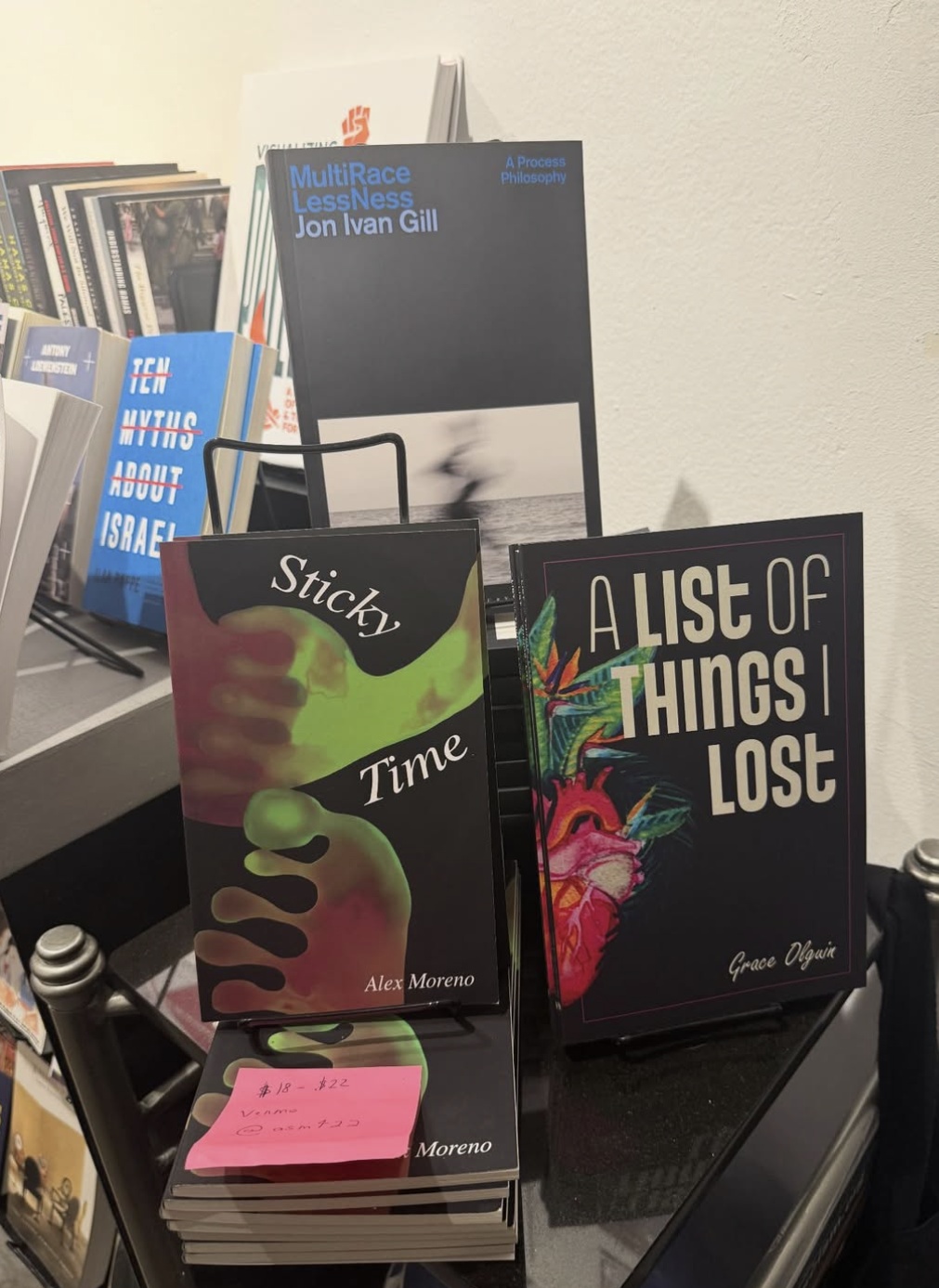
Olguin’s vulnerability becomes even more evident through her desire for connection and meaning, as seen in poems like “Thoughts,” where she confesses, “All I want is sweet love. All I want is a deep hug.” This longing for intimacy extends into the poem “Dentro de lo Que Cabe #1,” in which Grace writes, “Which route to walk with a fork on the road/Except forward?/God is everywhere.” These poetic confessions reveal a desire to live a meaningful and fulfilling life while still acknowledging our flaws, weaknesses, and potential for self-sabotage.
Thus, the Catholic religious framing does not limit “Dentro de lo Que Cabo #1”; instead, it universalizes the speaker’s vulnerability, transforming her struggle toward self-understanding and acceptance into one of the collection’s defining moments and affirming that she is more than just “this shell of a woman” she thought she was at the outset of the collection.
Grace’s culture comes up again in her poem, “Titita Used to Take Us to Pick Tunas.” Through vivid childhood memories of her Titita, she captures a vivid depiction of family tradition, resourcefulness, and Mexican life. Lines such as, “Recuerdas feeding the flowers, eggshells” and the line that says she uses “Jalapeno cans as macetas,” capture the beauty and ingenuity of everyday rituals. These elements not only bring the poem together but also keep Olguin tied to her Mexican heritage.
Olguin also establishes herself as a serious thinker and insightful social commentator. In “Man with Coin,” she builds an entire poem from a series of piercing, thought-provoking questions that challenge dominant societal values: “What if we valued our self-worth more than our net worth?” and “What if human rights were greater than property rights?”
These inquiries reveal Olguin’s intellectual depth and moral clarity, showing how she uses her vulnerabilities as a starting point for larger ethical reflections. Rather than allowing personal confession to remain private, she transforms it into a lens for social critique with questions like, “What if minimum wages were designed to help individuals rise above the poverty line?” The political dimension never feels separate from the rest of her self-revelation; instead, it emerges naturally from her lived experience and cultural roots, demonstrating that Olguin is not satisfied with writing only surface-level or purely personal poetry, but instead uses the form to thoughtfully interrogate the larger world around her.
As I reached the final pages of A List of Things I Lost, I came away with a clear realization: this collection succeeds on many levels at once. It is simultaneously personal and universal, deeply emotional, and intellectually engaging, fragmented in form yet remarkably cohesive in spirit. In the end, Grace Olguin has created something that feels like a genuine blueprint of contemporary human experience in all its beauty, pain, and complexity.

