

The title of this book, He Dances in His Wheelchair, instantly alerts the reader to a perspective: like the famous Zen koan of one hand clapping, the image of someone dancing in a wheelchair sounds like a paradox. It is also the viewpoint of someone with imagination and compassion, who sees that “dancing” can be an emotional activity.
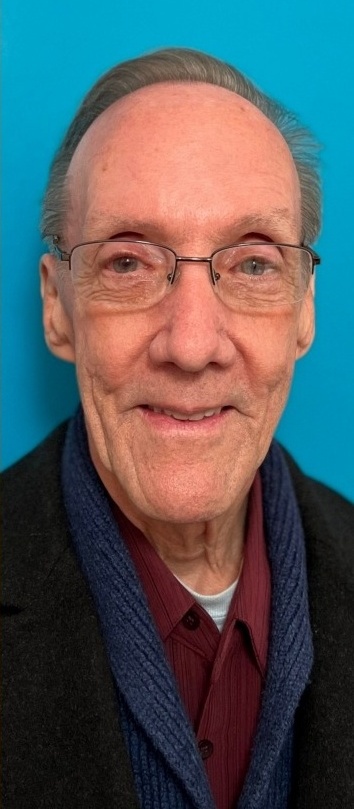
In 27 pages of poetry, Charles Becker writes about his relationship with his partner, Aubrey, who lives with him in the retirement community of Laguna Hills, California, and gets around in a wheelchair. Aubrey is a Black Creole; Becker is white. The narrative of two men from different racial backgrounds, in a same-gender relationship, one abled and one disabled, is a more progressive view than what we’ve had in the past when it comes to romance in poetry. But like all couples, they have their ups and downs, and it is the “ups” that are especially celebrated here, as Becker describes the events of the lovers’ daily lives and how they find joy in everything from music and the way Aubrey “dances” to his favorite songs, to positive perceptions about Aubrey’s wheelchair.
The opening poem is called “This First” and gives us some back story about Becker himself:
           Days
           back then
           my early loves
           so young
           they surrounded
           and changed me
           even as I thought
           I knew what I was doing
           They with Nebraska and hippie
           smiles in tow
           flawed lifelines across their palms
           stunned outlooks
           changed the future
           by needing me.
Becker is recalling a youth spent in the time of the 1960s-1970s “counter-culture,” a time in which people often enjoyed freedom without realizing the long-term effects. He now sees that the lovers of his past helped develop into the man he is today. Their freedom and lack of inhibition challenged his assumption that he knew all about who he was. The counter-cultural creed to “do your thing” included an embracing of all kinds of human sexuality. Possibly this is how Becker came to understand his sexual orientation. Yet the lovers also had “flawed lifelines.” Something about their freedom predicted their doom. While their love, the exchange of ideas, the sharing of emotions, the recognition of pride in their identity, molded the young Becker and shaped the life he would lead, the fate of these men was inescapable. They would pass on
from “the virus haunting their bodies,” apparently AIDS. Despite trying to still enjoy themselves, despite trips to Mexico to find medications:
           I held their hands
           They held my heart
           And then they died.
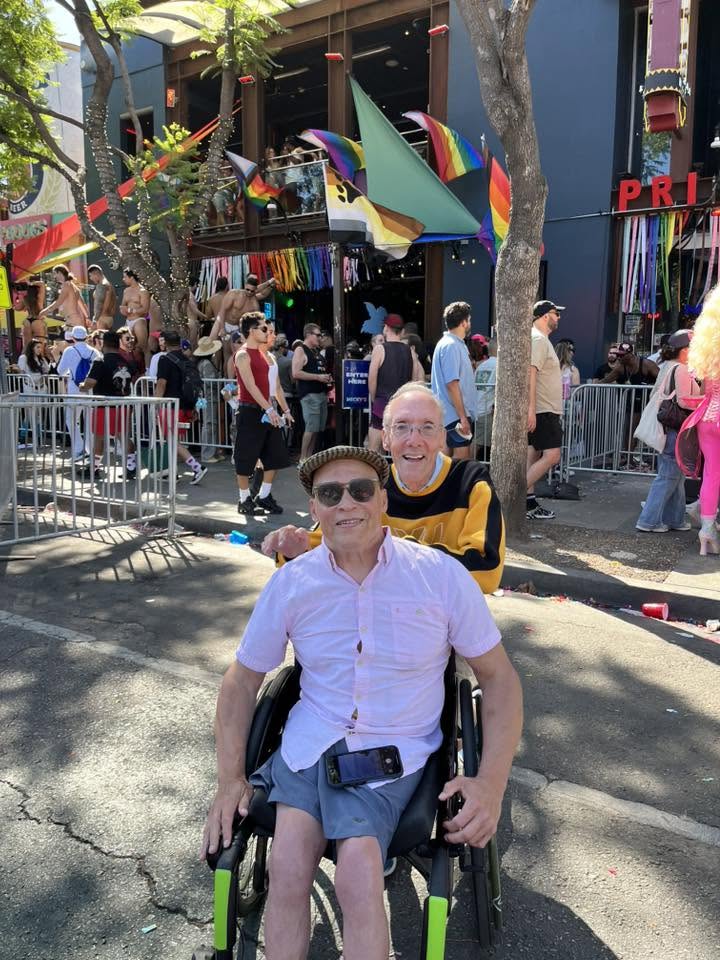
It would seem that the fear of losing a loved one has long haunted the poet but in his new relationship with Aubrey, who has another kind of physical ailment, Becker is shaking off the negative remembrances and finding a “second spring” in the love and sensuality that the two men share. This new joy bursts out of him even when he is wheeling his lover around:
           Most days
           now
           when I push too fast
           too slow
           he pumps with his arms
           races downhill
           laughs at my worries
           throws his head back
           and upper body dances
           to the rhythm of Al Green
           in the middle of the sidewalk.
In the poems that follow, Becker speaks of intimacies with Aubrey. The physical descriptions are sometimes erotic and personal to the point where a reader could struggle with the feeling of interrupting the lovers. This is not Becker’s intent, however. He is simply enjoying Aubrey’s pleasure, even as he shakes up the inner taboos people have about what kind of bodies are sexual. In “The Portrait and the Artist,” he praises Aubrey’s “triangular knuckles” and wrists precisely because they have been “made powerful/by the grip of his crutches.”
In a prose poem called “Throuple” (like a couple but actually three individuals), Becker humorously adds Aubrey’s wheelchair as the third “person “in their relationship!
“I know you stare at him and wait for him all night, every night, vigilant and true. He reaches out to touch you, make sure you’re still there by the side of the bed, even as he holds my hand and whispers my name into the settled nighttime air.”
The wheelchair is described as “erotic” and “mysterious and salacious as porn.” Can a wheelchair be erotic? Becker describes the chair as having a “supple young body,” an analogue to the image he has of Aubrey. The chair also has a “masculine way of giving and being of service.” It carries weight, as a strong man might carry another man. And yes, Aubrey “dances” in the chair.
Becker also addresses Aubrey’s racial background in several poems. He describes aesthetic and sensual enjoyment in the colors he sees in Aubrey, from the “blacks and dark blues” of his hair, and eyes
           rich like chocolate
           made with yellows and greens
           like Bayou cane sugar

But Becker is also aware that society’s response to Aubrey’s background creates issues for him that would exist even for a Black man who has mobility. In “In Our Hood,” he writes:
           he’s taught me
           how to get
           Black
           when pushed
           too far
           by prejudice.
           and ignorance.
And in “He Wants to Be,” he tells how Aubrey wants to be:
           like everyone else, like Huey Newton’s brother
           he preaches into the mirror, proud of kinfolk,
           ancestors, teachers from the motherland….
Aubrey, in other words, ultimately wants to belong to the communities he identifies with. As he “dances in his wheelchair” to Black musicians like Al Green and Jill Scott, he expresses the desire to identify with all the people of the Black diaspora, just as people from other diasporic communities identify with and take pride in their own kinfolk, ancestors, and heritage.
Additionally, race, sexual orientation, and physical ability are both human conditions and identities. So, Aubrey is living with three identities that have their own society-defined limitations: the weight of his heritage as a Black man, carrying the emotional toll of past physical and mental abuse, and the realization that other people may look upon Becker and Aubrey’s relationship with skepticism and disdain for being an interracial relationship. Still, there is a similar yet different stigma surrounding the two men being together: living in a world that still judges same-gender relationships. And, there is the fact that a conventionally “abled” man can enjoy a full relationship, even a sexual relationship, with a man who has to use a wheelchair.
To Becker, the fact that he and Aubrey are living with the complexities of Aubrey’s identity is a triumph of love and understanding. He is prepared to live and love despite what others may think about him and Aubrey. When he ends the poem “In Our Hood” with an observation he makes while taking Aubrey for a ride in his wheelchair, and people smile and nod, thinking Becker is the “caretaker,” Becker nods back and knows: “No, he’s my lover.”
He is even more than that. Becker uses imagery that paints Aubrey as a “prophet and priest” to Becker’s “seeker and monk.” This complementary dynamic aligns with Becker’s lifelong desire to learn and grow from his life experiences. Yet, Becker acknowledges that Aubrey has “work to do,” to “push” stories of his heritage through his physical self. He is lauded for having the inner strength—a way of being in the world—that inspires and soothes Becker as Becker spills his concerns and his satisfactions onto the written page.”
In contrast, the later poems deal more with Becker’s concerns for the future: how Aubrey will be able to continue to live and thrive, how Becker himself is aging, how society deals with them. His final poem, “Trees This Night,” expresses a fear for what may be coming. Becker, in the poem, holds on to a tree trunk outside a hospital where Aubrey is being treated. The tree gives him security because, as long as he holds on to the tree, he feels he will not “blow away.” But he fears that:
           the next time
           or the next
           when I look up
           even higher
           the he
           the we
           I always wanted
           might be
           Gone.
Possibly Charles Becker will give us a full-length collection of poems about himself and Aubrey. We are intrigued enough by the descriptions of Aubrey to want to hear his voice as well as Becker’s and to hear more about their meeting, the development of their relationship, and the ups and downs that inevitably exist in all relationships of any kind.


