
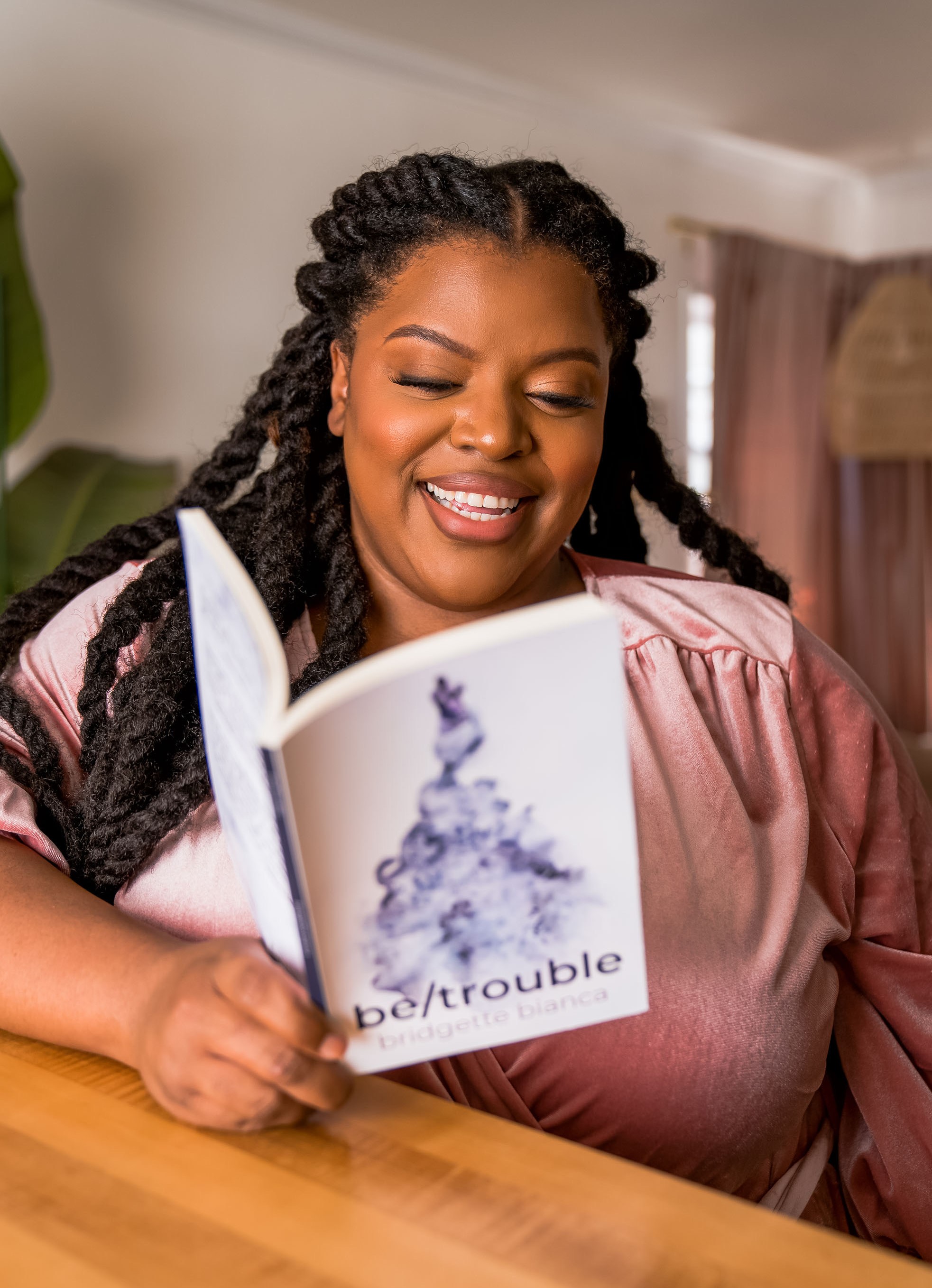
When I first met poet and Santa Monica College professor, bridgette bianca, she maybe had a half dozen poems to her name. Poems she read like an experienced spoken word poet—projecting a warm, full voice, smoothly emphasizing emotions that drew me in and lifted her words off the page into the reality she spoke of as a big Black woman in America. It was a reality of hard, necessary, neglected truths surrounding her, and Black women’s lives of violence and death among the country’s systemic racism. These poems were written through the love of her people and her community, taking the agency and power back from situations meant to strip them from her world.
Excerpt from “an exasperated black woman said fuck it i’ll do it.”
	this is my life

	i am sorry
	that you only realized
	the world was fucked up
	when your sisters voted
	with their white skin
	and not their pink pussies
bianca unapologetically took up space. Lively, expressive, serious, yet somehow warm. This, from a self-proclaimed introvert. A woman who needs to take quiet breaks alone to relax and recharge. From a woman who, in a Shoutout LA interview said, is continuously “inspired by the persistence of the people around me.”
Recently, I asked bridgette bianca about her influences on her writing, local and otherwise and how they’ve shaped her poetry.
Brian Dunlap: Who were the original influences on your writing? Poets, writers, maybe even musicians? Teachers? Why and how have they influenced your writing?
bridgette bianca: My first influence as a writer was Langston Hughes. I remember selecting Dream Keeper from my aunt’s bookshelf when I was just a little bb. And I was hooked from there. As I grew older and read his critical essays and memoir I just grew to love him more. My next influence also came as a child. Picture this—middle school bb very excited to work in her school’s library during a ‘service’ elective. I was in heaven. Made it a point to read every poetry book we had and one stuck with me—A Screaming Whisper by Vanessa Howard. It was a book written by a 15 year old girl in Harlem in 1975 and I connected with it immediately. Checked it out every couple of weeks. I don’t know what happened to Vanessa Howard, if she went on and continued to write or what. But I know she changed my life.
Dunlap: What local writers, past or present, have been influential to your writing and/or you’ve fallen in love with? In what ways have they been influential to your writing and/or in what ways have you fallen in love with their work?
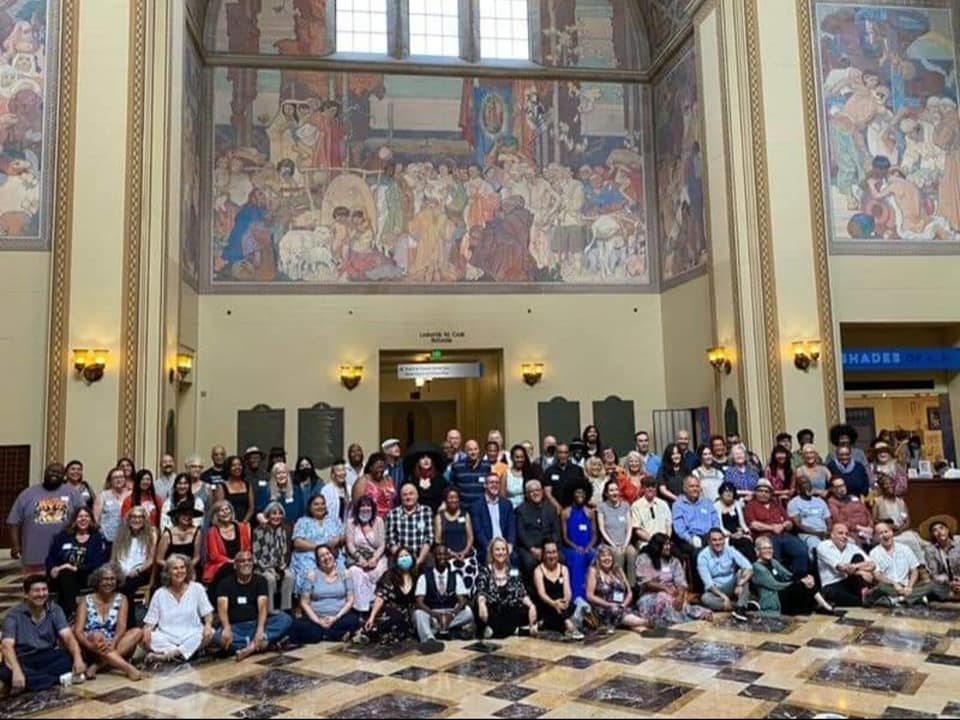
bianca: The A literary scene is truly a gift. Such a wealth of poets and writers and such a rich history. I’m inspired every time I go to a reading or just sit in the company of writers like the folks who come out to the Anansi Writers’ Workshop at the World Stage or to Rapp Saloon’s First Fridays in Santa Monica. I’m so grateful to create and share alongside folks like Jessica ‘Yellawoman’ Gallion, Jaha Zianabu, and V. Kali.
Dunlap: What writers do you read today, whether poets, essayists, novelists or others? What draws you to their work?
bianca: This is so tough because I’m always reading something. I’m currently reading How We Do It: Black Writers in Craft, Practice, and Skill. It’s the first craft book I’ve ever read that spoke directly to me so I’m taking my time with it and taking notes. Poetry wise, I’m revisiting poets I call the Queen Mothers—Nikki Giovanni, Lucille Clifton, Mari Evans, Gwendolyn Brooks, Margaret Walker, and Sonia Sanchez. Not only their work but their lives and their wisdom. Outside of poetry, I always have my nose in a romance novel. I started reading them in 2020 as an escape but now I’m obsessed. Every year I read a couple hundred of them and I don’t know if I’ll ever stop. I especially love the work by authors like Christina C. Jones, Alexandria House, and Rebekah Weatherspoon.
Dunlap: From your engagement in the local literary community, what are your honest thoughts and opinions about this community, good, bad or otherwise? It’s issues. It’s positives and anything else?
bianca: I think there are a lot more positives than negatives. I’m grateful that, in a metropolitan area so large, that the literary community makes it feel smaller and more intimate. I could go to a different event every night and meet a different set of people and then somehow we might all find ourselves at Beyond Baroque one evening. When I came out of my MFA program, I didn’t know I could have that kind of community. The literary world I’d been exposed to looked and sounded nothing like me. And I was exhausted with adjusting myself to fit. So, I’m glad now that I know what’s out there. It is easy to be siloed, if you let it. Folks move in their own circles and don’t peek out enough sometimes. I cringe when I show up to feature somewhere and I’m the only Black poet or poet of color in the room because I’m the only Black poet they know. It’s a shame really. So I now have a policy—I won’t be the only poet of color at a show. I ask straight up if I have suspicions that I might be and make it clear my stance. Sometimes I turn down gigs and suggest other poets just because everyone deserves exposure and a chance to be seen and heard. It’s important we expand our scopes and see the vast array of poets here.


