
By Brian Dunlap
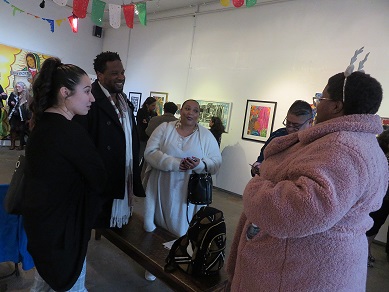
 Avenue 50 Studio was packed with poets, folding chairs and powerful and difficult-but necessary-words. It was the third Sunday in December and Santa Ana winds sent a chill through Highland Park. But the front room inside the gallery dedicated to local Latinx art, with an emphasis on Chicanx artists, was a safe space filled with familiar faces. It was the final La Palabra open mic of the year.
Host Angelina Sáenz decided to turn this edition of the open mic into a reading. She invited many of her former features back, from Matt Sedillo to Bridget Bianca, Nikolai Garcia, Lindsey Haley, Donna Spruijt-Metz, Chenel King, Luivette Resto, and Harry Gipson, to celebrate her two year anniversary hosting La Palabra.
As a single mother of two boys and an elementary school teacher, who grew up in the gang controlled streets of Echo Park in the second half of the 1980s, hosting La Palabra was Sáenz’ introduction to the Los Ángeles literary community. However, it was just over two years ago, while at a PEN America writing mentorship program, that she met Avenue 50’s literary program director Jessica Ceballos y Campbell who promptly invited her to be the next host. Without any hosting experience, Sáenz reluctantly said yes, certain that there were better choices than herself. Not uncommon with female writers and/or writers of color, at the same time she was taking her writing more seriously-later in life, after her family was well established and when she was growing more confident that her voice had value.
La Palabra was only the second open mic where I read my poems and when Sáenz took over for Karineh Mahdessian, I continued to find it a place where I could speak my truth. That third Sunday, La Palabra was definitely a safe space, where a room of mostly female writers of color were able to speak about their generational trauma caused by racism, sexism or both; speak about the quirks of their community’s culture (Chicanx, Latinx, Black, Los Ángeles) and be in the company of shared laughter because others could truly relate; push back against stereotypical portrayals or conceptions society has placed on them; and share overtly political poems about current issues (children in cages, the stark reality of the racist treatment of Chicanx’s). Dona Spruijt-Metz read a devastating poem about her mother’s experience surviving the Nazi concentration camps. Chenel King, a 2018 MFA graduate of Otis College of Art and Design, read three nature poems that intersect with a personal exploration of blackness.

Everyone listened in rapt silence, except for the occasional snap of fingers and an “un-huh” when a stark truth was spoken, or laughter when a cultural quirk was instantly understood and relatable. When they saw themselves and their stories reflected in other poets’ words. Even writers need to see themselves reflected back to themselves in other people’s work.
Jessica Ceballos y Campbell even made a chapbook for the reading as part of Avenue 50’s Accoutrements series, a program consisting of 16 bilingual chapbook publications curated as accompaniments to poetry readings, visual art exhibits and interdisciplinary events held at Avenue 50. This volume included most of the participating poets and turned out to be a great present to remember December’s La Palabra by. “Last” by Elvia Susanna Rubalcava from the chapbook reads in part:
the last moments
of sisterhood
with an unrelated twin-
I would have crushed back
the herd of medically-licensed hands
and sang you a song
of my love,
read you a bedtime story
of our Fat Kid Adventures…
The cold Santa Ana winds had been replaced by the warmth of familiar faces, of community being reaffirmed, of connecting on a human level. The perfect way to end the year.

 Los Angeles Literature