
By Feroz Rather
FROM: The Southeast Review
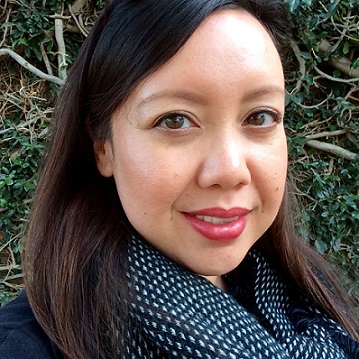 Born in San Francisco and raised in Vacaville, Michelle Brittan Rosado earned an MFA in Creative Writing from California State University, Fresno, and is currently a PhD candidate in Creative Writing & Literature at the University of Southern California. She is the author of Why Can’t It Be Tenderness, which won the Felix Pollak Prize in Poetry selected by Aimee Nezhukumatathil (University of Wisconsin Press, 2018). Her chapbook, Theory on Falling into a Reef, won the inaugural Rick Campbell Prize (Anhinga Press, 2016). Her poems have been published in the Alaska Quarterly Review, Indiana Review, Poet Lore, San Francisco Chronicle’s “State Lines” column, and The New Yorker, as well as several anthologies.
Love After Dentistry
by Michelle Brittan Rosado
With my mouth half-numb against yours,
the palm on my face might as well touch
anyone’s. I can’t feel your thumb pulling down
my bottom lip, index resting
under the chin, even though it’s a habit made familiar
to me now. I have to rely on sight
to know what you’re doing, your eyes closed
against the memory of another woman
for all I know. Beyond us and the wall
of the room, the grass stretches towards the end
of the yard. I could call up the fingers
of someone else; I’ve done it
before. It was a kind of test, the recollection
of the last man like a layer
over your movements so that, for a second,
the two of you blurred. And I would
do the work of finding you—the pressure
of your arm behind my back, your hip
on the inner side of my thigh—just to separate
your touch from his, and in this way
I could choose you over and over. Maybe
you’ve done the same, there may have been times
my body changed under your body, it’s possible
you did not know who I was until I returned
to you as myself, and whatever light
the day had left would uncover our faces
to each other. But this time I turn my head, run
my tongue over the raw surfaces of my mouth
for the first time, while the fence outside
the window arranges itself in parallel
lines. Here are new spaces, the hard
plaster sanded over, my own teeth.
From Why Can’t It Be Tenderness by Michelle Brittan Rosado. Reprinted by permission of the University of Wisconsin Press. © 2018 by the Board of Regents of the University of Wisconsin System. All rights reserved.
Much of your work is in the liminal and this quality of liminality suffuses, I suppose, your poems with the longing to extend yourself back and forth in history. Could you tell us how you see the contours, moral and geographical, that define this space for you? What is in the middle? What tensions transpire in the in-between?
As a Californian, I’m fascinated with being at the edges of things: the continent and the ocean, the border between countries, where the urban and the rural meet. One side of my family stretches back five generations in this state, while the other side lives across the Pacific in Malaysia, so traveling that expanse of the ocean several times in my life has also given me an appreciation for what lies between and what it takes to get from one place to another, one state of mind to another.
I appreciate that you speak of the in-between in terms of longing, because this is the feeling that makes the tension of liminality seem worthwhile to me. Longing is driven by desire and connection. Feeling in-between can be marked by sadness, but the root of this is really love. This is part of why I felt compelled to have “tenderness” in the title of the collection, as the word can imply woundedness, but at the same time it also suggests being gentle with that woundedness. We may not be “there,” wherever that is, but in language we can name it and seek it. In my poetry I’m always striving for that more aerial view—that wherever there’s disconnection we can also find desire and beauty surrounding it. Read Rest of Interview Here

 Los Angeles Literature