
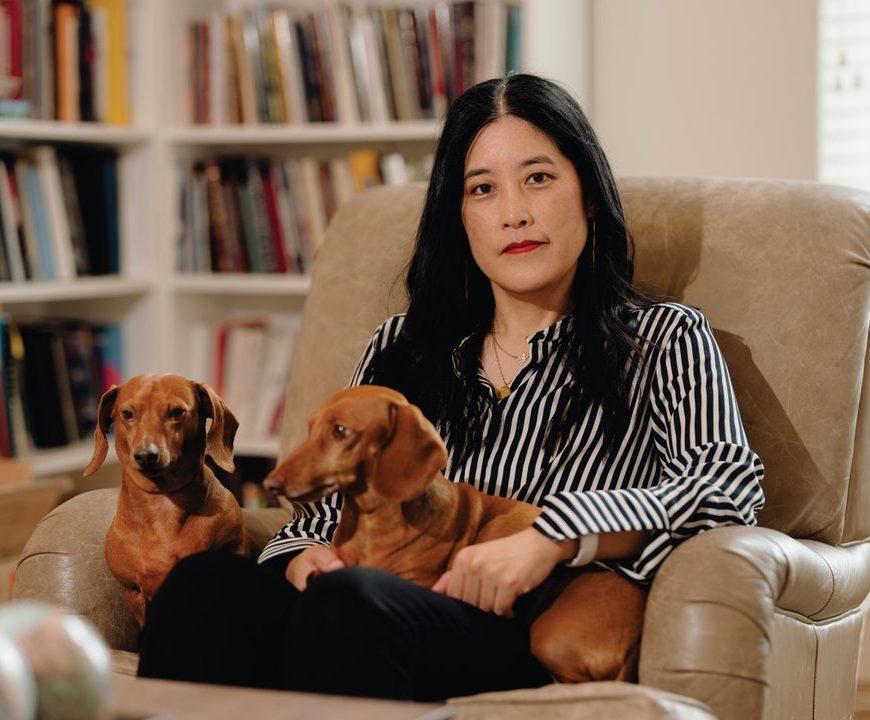
Victoria Chang’s Correspondence with Grief
Writer Victoria Chang writes about grief and loss in her new book “Dear Memory.” Continue reading Victoria Chang’s Correspondence with Grief
Writer Victoria Chang writes about grief and loss in her new book “Dear Memory.” Continue reading Victoria Chang’s Correspondence with Grief

By Rachel Martin and Reena Advani
FROM: Morning Edition

In her new book, Chinese American poet Victoria Chang writes, “Shame never has a loud clang. The worst part of shame is how silent it is.”
Continue reading “‘Dear Memory’ digs into the shame accompanying immigrant silence”By Peter Mishler
FROM: Lit Hub
 For the next installation in our interview series with contemporary poets, Peter Mishler corresponded with Victoria Chang. Victoria Chang’s books include OBIT (April 2020), Barbie Chang, The Boss, Salvinia Molesta, and Circle. Her children’s picture book, Is Mommy?, was illustrated by Marla Frazee and published by Beach Lane Books/Simon & Schuster. It was named a New York Times Notable Book. Her middle grade novel Love, Love will be published by Sterling Publishing in 2020. She has received a Guggenheim Fellowship, a Sustainable Arts Foundation Award, the Poetry Society of America’s Alice Fay Di Castagnola Award, a Pushcart Prize, a MacDowell Colony Fellowship, and a Lannan Residency Fellowship. She lives in Los Angeles and is the program chair of Antioch’s Low-Residency MFA Program.
Continue reading “Victoria Chang On The Self And Its Many Deaths”
By Victoria Chang
FROM: The Normal School
 Dear Daughter,
Sometimes I wish I didn’t try and fix everything from your childhood. Sometimes I wish I hadn’t tried so hard to help you memorize your math facts when you weren’t ready. Sometimes I wonder how many mistakes I am making now that will become clearer only later.
Continue reading “Dear Daughters, Dear Linda: Essays From ‘Terrible Crystals’”
by Kitty Anarchy
From: Los Angeles Review
 Victoria Chang’s poetry collection Barbie Chang looks at the complex realities of racism for third-generation children. Even as a child, the speaker, Barbie Chang, is not able to have normal friendships with anyone—she overhears a classmate’s mother advising her daughter against forging a friendship with her because it is not in her best interest in “Barbie Chang’s Daughter:” “the new girl’s / mom tells Barbie Chang / that her own daughter should not tie / herself down too fast.”

 Los Angeles Literature