
Naomi Hirahara’s Los Angeles
By Mike Sonksen
From: Los Angeles Review of Books
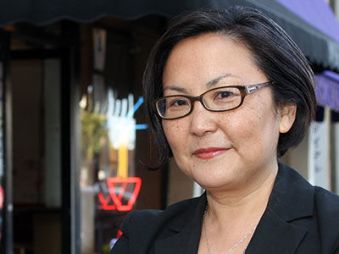 Editor’s note: Naomi Hirahara has been a pillar of the mystery community since she published her first Mas Arai novel in 2004. To commemorate her final Mas novel, I asked Mike Sonksen, a.k.a. Mike the Poet, bard and historian of contemporary Los Angeles, to go on a walk with Naomi and write a profile that would do her justice. It was a huge task, but I believe he succeeded.
¤
NAOMI HIRAHARA IS one of the most prolific Los Angeles writers of the last few decades. Best known for her Edgar Award–winning seven-book Mas Arai crime novel series, she has also authored several nonfiction titles on Southern California Japanese-American history. Her newest Mas Arai mystery title and the final one of the series, Hiroshima Boy, was just published by Prospect Park Books in March 2018, and in April her latest nonfiction title, Life After Manzanar, was published by Heyday.

 by Brian Dunlap
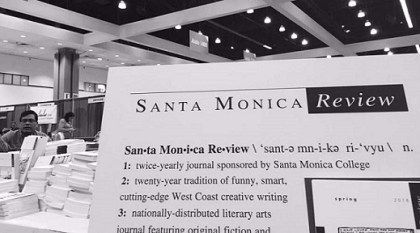 This year—fall 2018—marks the 30th anniversary of Santa Monica Review (SMR). The national literary arts journal published by Santa Monica College (SMC) showcases the work of established authors alongside emerging writers, with a focus on West Coast fiction and nonfiction; it happens to be the only nationally-distributed literary journal at a community college.
 It begins every Wednesday at 7:30 pm. Early arrivals step to the mic, sharing a poem in progress to receive much needed feedback. Then they provide feedback to others. V. Kali, author of Hymn (World Stage Press), sits next to the donation box and front entrance and welcomes attendees as they arrive. As host, V. has been a warm presence each week for years, her long beautiful natural hair a thing of legend. As the crowd grows, the list of open mic readers expands before the feature grabs everyone’s attention. Murmurs of “mmm hmm” and “that’s right” arise from the crowd. After, it’s the community-the open mic readers’-turn at the mic. It’s their chance to bring down the house.
 Hildegarde Flanner, born June 3?, 1899, Indianapolis, Indiana, U.S.—died May 27, 1987, Calistoga, California, was an American poet, essayist, and playwright known for her traditional poems that conjured images of nature and the California landscape and spoke to her Fpassion for the environment.
 Los Angeles Literature