
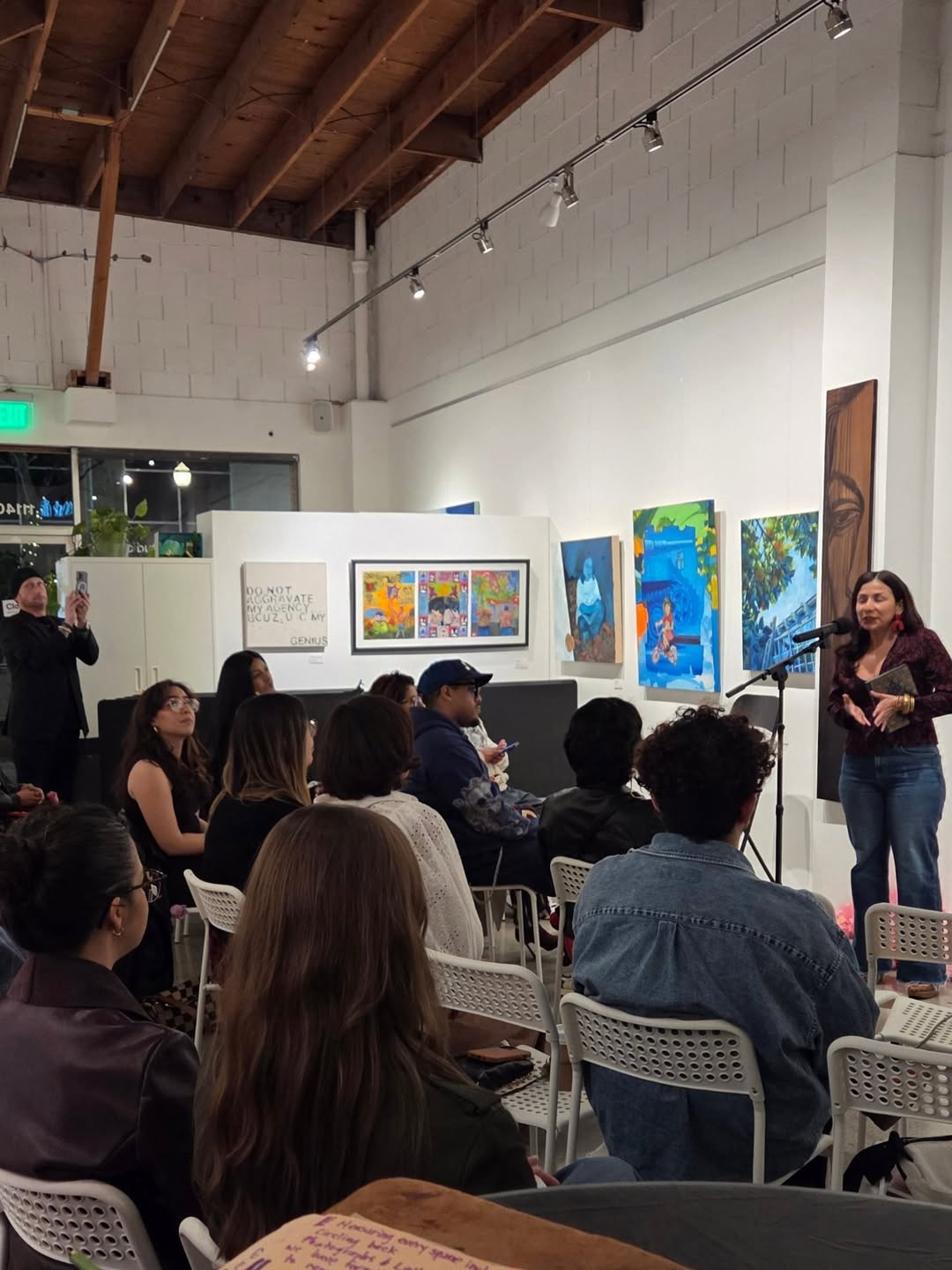
Poets and supporters filled Stay Studio’s gallery in Downtown Downey. Night had fallen, the temperature was mild, and a group of young friends were buying ice cream next door at the Creamistry.
That February Saturday, I was welcomed by poet and co-host Jean Pierre Rueda to his bi-monthly Latinx bilingual poetry series, Poesía for the People. Conversations overlapped from the mostly Latinx attendees, like the walla, walla, walla from a movie’s party scene, as laughter arose, bright and quick, from a small group of women.
It was my first time attending.
Stay Studio, Rueda explained to me, was the physical location of Stay Arts, a community arts organization made up of teaching artists from Southeast Los Ángeles County—a region that is predominantly Latinx. Their team reflects the same experiences and neighborhoods as the young students they teach in their youth classes and in the workshops they lead at local public schools. Hosting a bilingual community poetry reading at such a venue perfectly highlights the warm, safe community that Rueda and his co-host, Alegria, want to build and maintain.
Once the reading began, I instantly felt the importance and necessity that Poesía for the People provides, wrapped in the inescapable context of President Trump’s second term. The ICE raids, the rollback of DEI initiatives, the increased cost of living. Especially the terror from ICE raids that continue to destroy the lives, families and communities these bilingual Latinx poets come from.
As Rueda said later, in an Instagram DM, “Poesía for the People was born as an artistic response to the 2025 June raids” that tore across Southern California, “by Alegria Zuluaga, Solany Lara and I; organically growing into [the] bi-monthly reading series” it is today.
Waldo, the evening’s first poet, spoke directly to the difficult times we’re in, reading a poem in response to the ongoing ICE raids in Southern California. He captured the anger, frustration and fear that he, and by extension, the Latinx community, continues to experience. The atmosphere in the gallery shifted, settling into one of intimate, powerful, heavy relief, like Waldo had finally put into words what long needed to be said about ICE terrorizing their neighborhoods and who the agents truly are.
The evening was split into two sections, divided by a 15-minute intermission, where everyone in attendance broke out in conversation. It was a chance to connect with new poets and literary lovers while reconnecting with familiar faces. During the break, I met Alan Alatorre, a poet originally from Seattle who had spent the past year living in New York. He had moved to Simi Valley with his partner just a few months before and was still adjusting to living in such a car-centric region. He’d only realized upon arriving that Simi Valley was located on the northern outskirts of Southern California, quite a distance from the heart of the local literary community.
Later that evening, Alatorre would take the stage as part of the second set of featured readers, reading for the first time since his move.
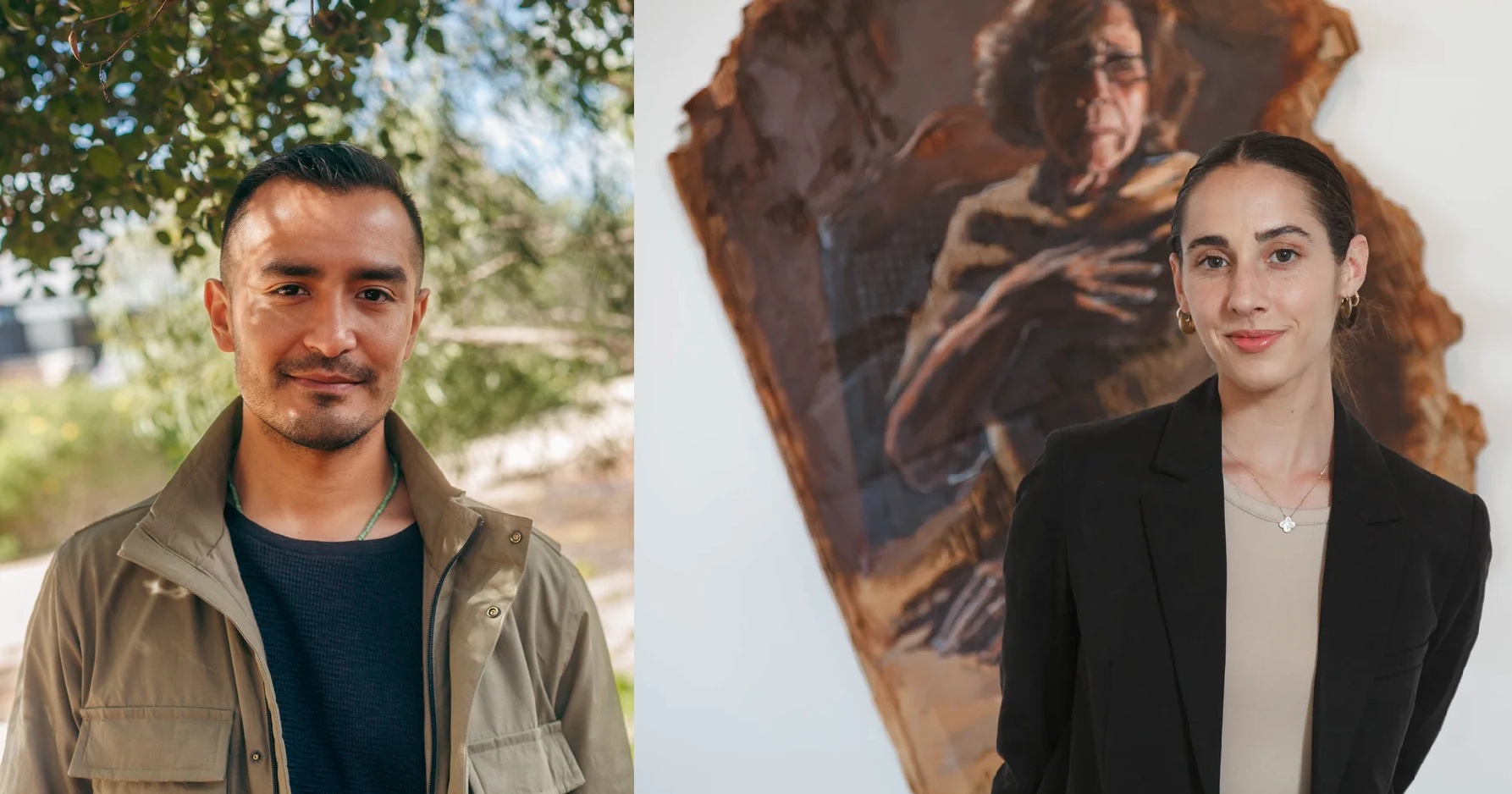
In the back of the gallery, the co-founders, Gabriel Enamorado and Julia Canty, had set up shop, selling alcoholic beverages as a way for attendees to support Stay Arts, while providing savory pastries from Porto’s for free, as a gesture of care and hospitality and community nourishment. As a compliment to the poetry that nourished the soul.
After Waldo kicked off the evening, other poets, such as Walter Vincent and myself, read biting political poems as well. Yet, other poets read confessional poems, explorations of self-acceptance, reflections on past relationships, and even a touch of erotica, such as the Poet Laureate of Pomona, Natalie Sierra, read from her book Beyond the Grace of God.
When the reading ended, Jean Pierre Rueda spoke briefly with me about Poesía for the People, the goals for the series, saying, he “hoped to inspire our Southern California communities through bilingual poetry and storytelling” in any language, “by bringing together award-winning authors, established poets and first-time readers under one roof in the city of Downey.” He then asked, with genuine interest, what I thought of the reading, as if he intended to use my feedback to evaluate the series’ impact and identify ways to improve it.
So far, audiences have filled Stay Studio, “great indicators,” Rueda said in the Instagram DM, “that communities will make time to show up for their members, collaborate with different artists and motivate audience members to share their own art.”
And I did some of that to, trading thoughts on poetry with Vincent: how to teach it, what young poets need to know, once the reading had concluded.
As Southeast Los Angeles County hosts far fewer literary events than most of Southern California, Poesía for the People proves how grassroots literary events can thrive here, fostering a sense of agency, reinforcing shared ideals, and helping to build networks that sustain this community and enable it to adapt in these challenging times.

 Los Angeles Literature