
In the world today, the rhetoric of immigration is not only scrutinized to fit a certain mold but used as an excuse to treat human beings as less than human. In the United States, the primary narrative around immigration has often been about people of color moving to America to take jobs away from whites and to take advantage of government programs, not as a necessary choice for survival. This popular rhetoric amplifies immigration as a threat to the social and economic hierarchy in this country, with no regard to the history of immigration, affecting not only those who immigrate but those who benefit from it.
By giving voice to those who have gone through the experience of immigrating, it is possible to start shifting the narrative. The decision to immigrate is not as simple as taking a flight or abandoning a whole life and family to come over. This simplistic way of thinking about immigration dehumanizes not only the story itself but the humans that need to make that decision. It takes away the humanity of those individuals and turns it into an us-versus-them rhetoric in which no side wins.
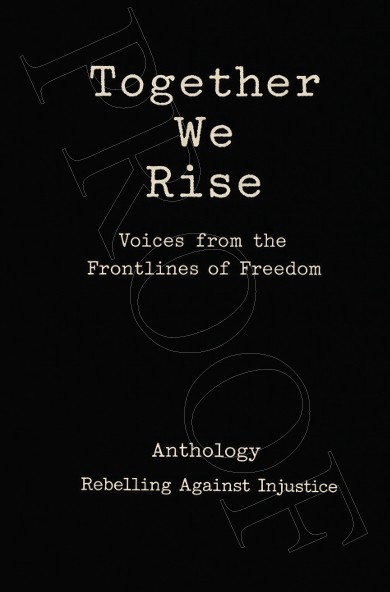
The purpose of the anthology Together We Rise: Voices from the Frontlines of Freedom, published by Los Ángeles’ Daxson Publishing, is to bring forth immigrant stories that emphasizes the humanity in us all. The essays, art and poetry of this anthology showcase stories of human beings going through traumatic experiences, trying to process what it means in their lives with the hope that at the end of the day, everyone else can see them as human beings, not as other. These stories are not statistics, not numbers, not just initials. They represent actual human beings with feelings and dreams. The world needs to see the immigrant as just another human being looking for better opportunities to construct a better future for them and for their family, because at the end of the day, we all just want to live.
As an immigrant myself, brought to this country from Mexico as a child, I can tell you that immigrating wasn’t the first choice for my parents, but it was the only safe one. They were looking to give us a better opportunity to get an education so we could escape the poverty they were stuck in. It was painful leaving the whole life I knew to move to a strange place where no one understood me because I did not speak the language, then made fun of me for speaking it with an accent when I did. For many years, I was seen as this strange creature that kept to herself for fear of embarrassment. It wasn’t lost on me that many adults saw me as just another statistic getting lost in the system.
We, immigrants (the majority), don’t come to this country to steal or cheat or even copy (assimilation is not the same). We come to rebuild our lives to the best of our abilities, we work hard to reach our goals, to be better and to show the world that we just want an opportunity to survive.

The editors of this anthology, Together We Rise: Voices from the Frontlines of Freedom, Cherise Cameron, Peter Lechuga and the Editor-in-Chief Erica Castro from Daxton Publishing, were kind enough to answer questions about how important this type of publication is during this time of increased violence and terror towards immigrants and people of color due to ICE raids, profiling and the attack on all things DEI, used to scapegoat and demonize immigrants in an effort to make America “white” again. Even though the editors of the anthology are not immigrants themselves, they have been involved in the literary community for many years through their work facilitating readings and publishing their own and other writers’ stories. They are not only artists, but teachers, and they have seen this misconstrued rhetoric used to put down marginalized voices from their own communities and others. Their involvement talks about their humanity, about how important it is for them to elevate these immigrant voices, so this narrative can change how the world perceives immigrants and the immigrant story.
Maria D. Duarte Ortiz: Why is it important to keep the stories of immigrants alive, specifically, in this political climate?
Cherice Cameron: Immigrant stories give a voice to communities and individuals. It is imperative that immigrant stories are told, especially in today’s political climate. It is easy for people to become dehumanized as statistics turn human beings into numbers in an attempt to negate personal experience in exchange for political power. Immigrant stories, those passed down from parent to child, those experienced firsthand, those being erased from history, are key components to developing a society where people can walk in equity.
Peter Lechuga: Right now, our Freedom of Speech is being threatened more aggressively than any other time I have experienced in my life. This [Trump] administration is focusing on education and trying to sanitize this country’s history, with a focus on erasing the stories of marginalized voices. We cannot let this happen because the immigrant story is the American story. Immigrants helped to build this country and have constantly been mistreated for it. Our goal with this anthology, [Together We Rise], is to focus on these unique voices to ensure that we are not silenced.
Erica Castro: History is written by the victors and so many stories of the marginalized are lost because these stories are not deemed important. There is nothing more important than preserving history and people’s experiences from their own truth. If these stories are not told, then they will get lost and they will never be known. It is our responsibility as artists to preserve the truth and to reflect moments in time, and it is our responsibility to honor the voiceless and preserve their stories.
Maria: What is the process in which you choose the right piece for the anthology?
Cherice: Pieces are chosen for the anthology based on a common theme. In this case, the theme focuses on injustices taking place in immigrant communities, giving voice to the voiceless, and speaking out regarding the state of the world. Qualities such as rhythm, form, impact, and how a piece fits into the overall arc of the theme are part of the process of putting the anthology together.
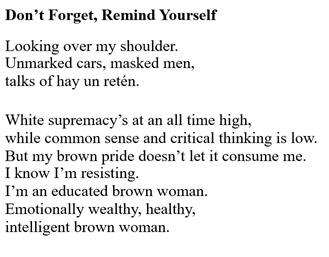
Peter: With the goal of this anthology focusing on the injustices occurring across the country, we [sought] work that focus[es] on these experiences. The importance of these stories is necessary to help bring to light what is really happening and not what mainstream media is telling the nation.
Erica: We [looked] at poems, stories, artistic works, and photography that paints a picture of the current times. Art that deals with immigration, Gaza, [and] the injustices of the government, as a way to stand against the government.
Maria: This is an individual question to get to know each other more: How did you start your career, either as an editor or writer?
Cherice: My first editing job was at the University of Idaho with FUGUE Literary Journal during my undergraduate and graduate studies. As a part of the poetry editing team, I was privileged to work with an exceptional group of people.
Experience working as an educator has provided a solid foundational knowledge in regard to writing styles, genre[s], and editing practices. Additionally, working with editors as I developed the manuscript for Gamut Eclectic & Mundane: Life Perspectives was decidedly positive. Their knowledge and insight was valuable throughout the process of publishing.
Editing for Daxson Publishing and Simply Youth Institute has, and continues to be, a creative and fulfilling line of work. I enjoy working with authors and being part of their journey to publication.
Peter: Books and writing have been my loves for as long as I can remember. I was first published in a national children’s poetry anthology at the age of seven. Since then, I have always written in various styles and levels of intensity. My love for poetry helped push me towards spoken word in my twenties and I have loved it since.
Erica: I started writing as a child, and during the pandemic, I wrote my first book. [T]he following year, I wrote a book of poems through CLI, Community Literature Initiative, and the year after, I wrote another book dealing with suicide grief. In 2024, I launched Daxson Publishing, and I have been publishing books to help people’s voices be heard.
Maria: What is the hope for this anthology? And by this, I mean, do we just want to keep immigrant stories alive because we are not going anywhere,or do we want to show that immigrants are also human beings and not mere statistics like the mainstream media portrays?
Cherice: There was a time when stories were spoken, sung, shared in community spaces, and passed generation to generation. I believe that this still goes on in some community circles and families. However, in many ways, storytelling, the passing of history to our children and to the world, is being lost, erased, banned, and in many cases blatantly being disseminated through false narratives.

Human experience must be shared, preserved, protected and respected. Recognizing and placing value on the experiences of fellow human beings will allow growth and understanding. It is through the sharing of collective experience that avenues of change based on truth, human dignity, freedom of expression, and basic human rights will be allowed to build a world where people can live free of discrimination.
Proceeds from the anthology will go to CHIRLA, The Coalition for Humane Immigrant Rights. CHIRLA’s mission includes supporting the advancement of civil rights and to work toward “full inclusion for all immigrants.”
Peter: My hope for this anthology is to show those on the fence how important immigrants are to this country and show them that no matter [their] citizenship status, all humans deserve empathy and opportunity. This country was made by immigrants on stolen land, and the absurdity of despising immigrants is truly baffling and nonsensical.
Erica: The goal for this anthology is to raise money for CHIRLA but also to help keep immigrant stories alive, [and] to give artists a voice and a platform to share their feelings of injustice.
Maria: As the environment becomes more hostile to not only immigrants but also to those who speak up, how do you think it will affect the publication of anthologies like this one?
Cherice: Unfortunately, a great deal of pressure is being put on media outlets, artists, musicians, and on those who speak out in favor of civil liberties. There is certainly a concern that people’s voices will be snuffed out due to the threatening nature of the current climate. I suspect that some anthologies may not be published due to safety and security concerns for authors. Reality must be faced head-on with a renewed effort to allow the marginalized to be heard, bring light to injustice in real time, and forge ahead to support human rights and human dignity.
Peter: I feel that some may be dissuaded [from] produc[ing] more works like this, but there will always be people who are resisting and willing to stand up against any threats of freedom of speech because it is our right. They may try to muzzle our mouths, but we can never be truly silenced. People will always fight.
Erica: I am not sure how it will affect this anthology, but I am hoping people resist and stand against the government by buying this anthology and gaining a deeper understanding of how people feel, and at the same time, hear the voice of the artists as well.
Maria: Do we have faith that free speech will not be penalized in the long run?

Cherice: Free speech has been fought for, and people have died to protect the right to live in a free and equitable country. The only way to ensure that freedom of speech will continue is to speak up, speak out, and speak the truth. Throughout history, an attempt has been made to quell the truth being spoken, sung, painted, photographed, danced, and whispered ear to ear. People continue to create. This anthology will be full of voices speaking their truth to the world.
Peter: I am unsure. This administration is doing everything it can to control the narrative and steal power from the people without any fear or repercussions for their actions. I truly believe in the resistance, but it’s hard to have faith when the president is a felon known for imposing his will on others without permission and has commanded his administration to take every illegal action to enforce his fascist policies.
Erica: It is hard to tell with the current state of affairs. It feels at some point that free speech is under attack, considering what Jimmy Kimmel had to go through, but we as a community have power, and just like people came together to stand for Jimmy Kimmel, we must fight back.
Maria: Is there a danger on over-popularized immigrant stories and that,over time,they are not as impactful as they should be?
Cherice: Immigrant stories need to reach a point of popularity that allows them to be easily obtained. How many people can sing a song based on a single chord, a drum riff, or a couple of notes of a melody? Immigrant stories must be as easily accessed and remembered as pop music. Humanization allows information to be received rather than tolerated, avoided, or minimized.
Peter: I don’t believe so. The immigrant story is the human story. We all change; we all move in different ways. Borders are man-made, imaginary lines are crossed daily.
Erica: I do not think so. I think it is the opposite. [T]here are not enough immigrant stories, and there are not enough stories of the marginalized. [T]hat is why I started Daxson Publishing.
Maria: What would you say to people that negate what is happening in brown communities?
Peter: Listen to your neighbors. Listen to their stories. Practice empathy. We are a community. Something that happens to some of us will eventually happen to all of us. These attacks will not stop at immigrants.
Erica: I would say that America is an immigrant country and that unless you are Native American, someone in your lineage was an immigrant, and it is hypocritical for people to be bashing immigrants.
Maria: In this society, have we lost the ability to empathize with our fellow human beings?
Peter: Not so much lost but not practiced and replaced by fear and misinformation. If we all listened to each other, it would immensely help in rebuilding our communities.
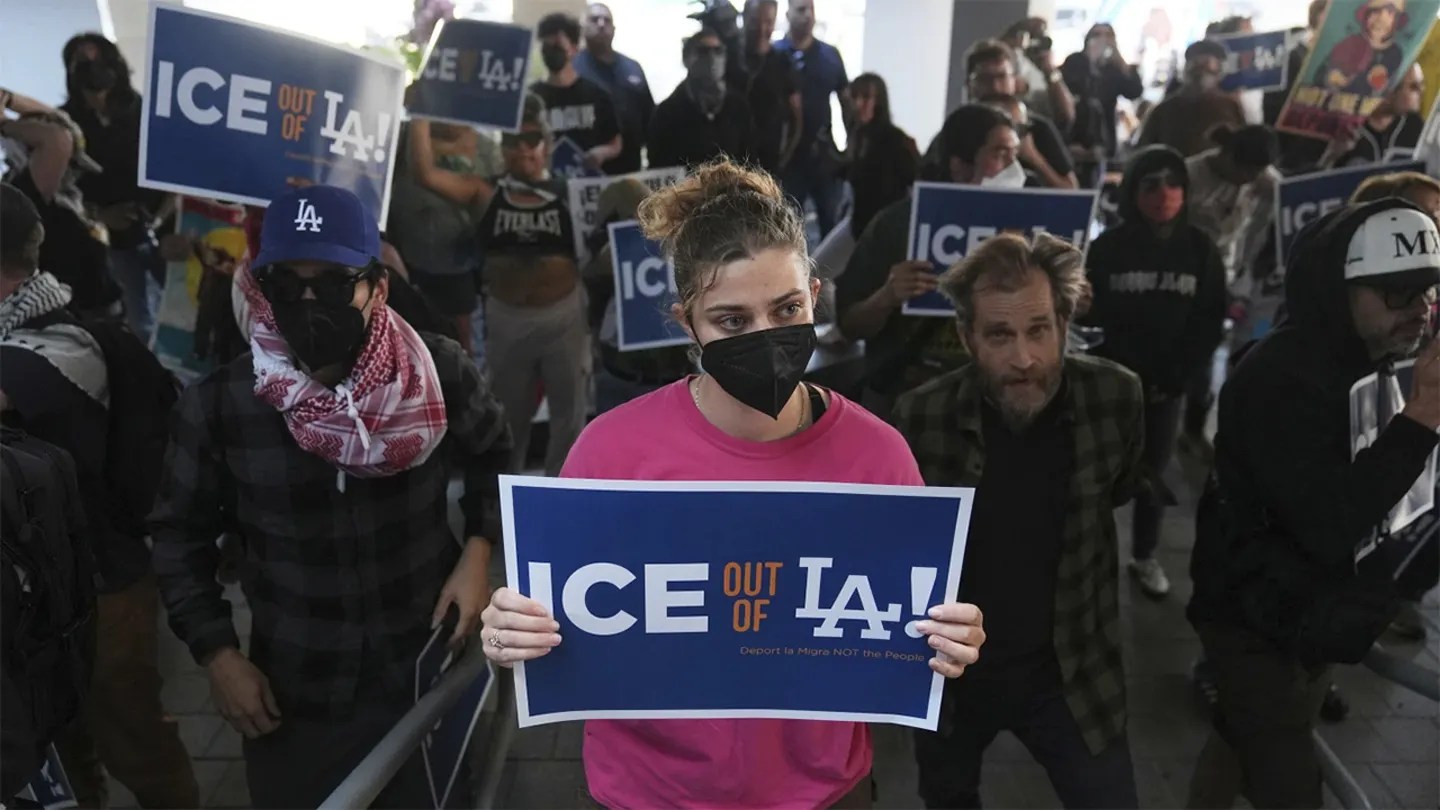
Erica: No, I do not think so. We can consider the protests and all the activists who are risking it all for the rights of the people. There are more people fighting for immigrants than those against them.
Maria: How much division do we really need in this country,when other communities are suffering, before people who are able to finally take action?
Peter: As I have stated earlier, we are all humans. We are all part of communities. Mainstream media and politicians have divided us because it is easier to manipulate some of us this way. They created this tribalism and it’s tearing us apart. We need to come back together and fight for the rights of all.
Erica: I think people are controlled by fear, and those that stand by and witness and do nothing are just afraid because it takes courage to stand up against the government, and it is understandable. However, we can help people in other ways. There was a Facebook group in my community of people helping others who could not get groceries, or by taking their kids to school, so I believe there are more good people than bad in the world, so we have to help in the [best] way that we can. For example, I am trying to help through publishing books; that is the best way I know how.
[Togeether We Rise: Voices From the Frontlines of Freedom] hopes to illustrate the part that media and this administration refuses to see: humanity still exists in us all, despite of which rhetoric we are listening to. These stories are not just immigrant stories; they are part of the DNA of being a human being because immigration doesn’t just happen from one country to another or from one town to another, nor are they recent stories, but blueprints of the story of the world.

 Los Angeles Literature