
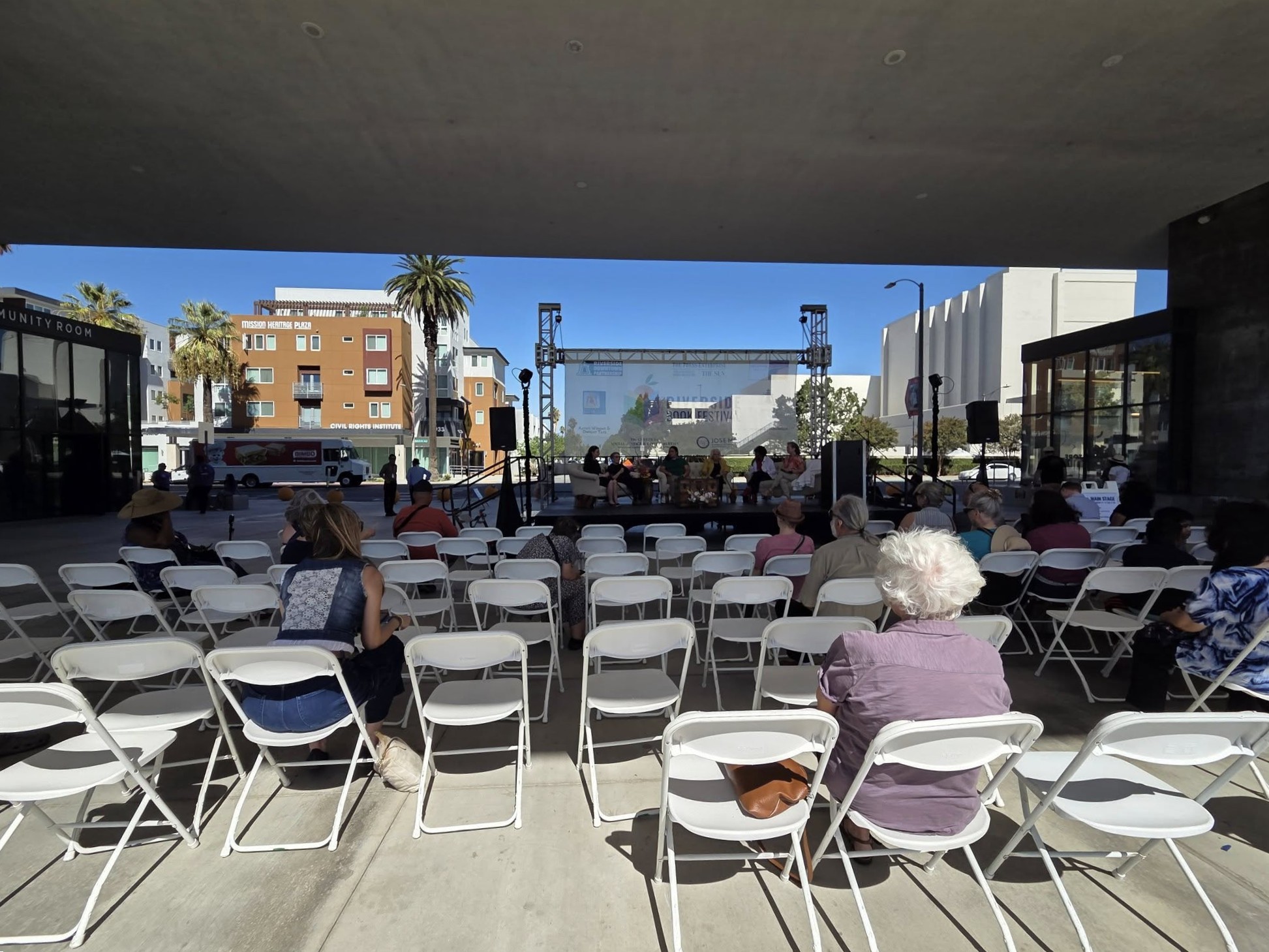
When I arrived at the First Annual Riverside Book Festival on October 11th, I heard voices emanating from the Main Stage discussing coalition building, fighting for the rights of people of color and LGBTQIA+ people. A panelist spoke of how they helped fight for a solidarity statement from the nearby city of Jurupa Valley in support of its LGBTQIA+ residents. The discussion was titled “Something from Nothing: Community Organizing from the Ground Up with RWCC.”
The stage was outside, on the walkway under the Riverside Main Library. It faced away from Mission Inn Ave, in downtown Riverside. A cloudless, 85 degree day.
In front of the main stage, in the library’s parking lot, exhibitor booths were set up in rows. Occasionally, there was an empty space in a row where another member of the community could have tabled it’s wares and built relationships. Yet, those that showed up included the California Writer’s Club – Inland Empire Branch, Diamond Valle Writer’s Guild, Blacklandia and Get Lit Books & Things, a Black owned bookstore in Moreno Valley barely a year old. And attendees paused from time to time to learn more about the vendors.
Among these rows sat the Local Authors’ Stage and the Children’s Stage.
Perusing the festival’s schedule of events, it was clear that the Riverside Book Festival fulfilled its intent, as it’s tagline reads: “Where books and community come together.” The main stage featured author’s such as Susan Straight, Riverside native and UC Riverside creative writing professor; Isabel Quintero, young adult author who grew up in Corona; and Tod Goldberg, who grew up in Palm Springs, still lives in the area and is a professor and Director of the UC Riverside – Palm Desert Low Residency MFA program.
The Local Authors’ Stage featured poets such as James Coats, Diosa Xochiquetzalcóatl, and David “Judah 1” Oliver, literary citizens and educators who write, teach workshops and host and organize events from Pomona to the Inland Empire (IE). Xochiquetzalcóatl, a multilingual xicana, indigenous, Mexicana poetiza, said she learned of the festival from a social media post and knew immediately that she wanted to participate because, “to finally have a literary festival in the IE is a dream come true.”
Presented by Inlandia Institute, a literary nonprofit established in 2009, located in Riverside, whose mission is to “recognize, support, and expand literary activity in all of its forms in the Inland Empire by publishing books and sponsoring programs that deepen people’s awareness, understanding, and appreciation of this unique, complex and creatively vibrant region,” the festival acts as the culmination of Riverside’s evolution into the arts and culture hub of the IE.
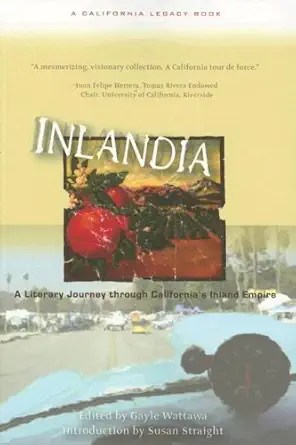
This evolution began most notably with the publication of the anthology Inlandia: A Literary Journey through California’s Inland Empire, published by Heyday Books in 2006. Reviews of the book appeared in the Los Angeles Times and the San Bernardino County Sun, where John Weeks, writing for the Sun, says, “there’s one book that belongs in all our homes…It’s a book about us. It tells our story.”
The IE is a region that has long been stereotyped, that the rest of Southern California has looked at as other, not like us, since it’s seen as lacking culture and sophistication, being more conservative, has always felt more rural, dismissed as just the area east of Los Ángeles. But Inlandia wanted to initiate change in the narrative about the region, to give voice, legitimacy and visibility to those who’ve made it home. And though not perfect, many of the writers included, from native Cahuilla elder, Kathrine Saubel, to Susan Straight, Keenan Norris and Kathleen Alcalá, were born and raised or lived a large part of their lives in the IE. For the most part, the IE was initiating the conversation about itself through art.
From this anthology, due in part to its success, with locals wanting more stories written by area residents and the “cultural programming that supported” the book, the Inlandia Institute was born.
Around the same time, in 2008, as part of the city’s general plan, the Arts and Culture Element marked a concerted and strategic effort to elevate the arts as a central part of the city’s identity and development, especially in downtown.
One of the first prominent steps was the renovation of the historic Riverside Fox Theater, turning the 1929 Spanish Colonial Revival style building into the centerpiece of their arts and culture initiative as the regional performing arts facility, the Fox Performing Arts Center.
In 2010, the University of California Riverside opened the UCR ARTSblock on the downtown promenade, moving the Sweeney Art Gallery from campus to join the university’s California Museum of Photography and the newly created Barbara and Art Culver Center of the Arts, that housed the Sweeney’s collection. And in 2018, they rebranded the ARTSblock as UCR Arts.
Plus, in June of 2022, the Riverside Art Museum opened The Cheech Marin Center for Chicano Art & Culture housed in the old Riverside Main Library building, showcasing actor and comedian Cheech Marin’s vast collection of Chicano art, and is “dedicated to…honoring and exploring [Chicana/o/x art’s] continued social, cultural, and political impact…” according to the center’s website.
Along with Riverside providing arts organizations and individual artists with grant funding, and ensuring arts opportunities in the city were better advertised to these artists and organizations, they set aside a section of downtown and branded it as The Arts & Culture District. According to the city’s website for the district, it’s “a hub that showcases artistic expression, cultural heritage, and community engagement. Whether you’re an art lover, a music enthusiast, or simply looking for something unique, this district offers an exciting mix of visual, performing, and cultural arts.”
And this year, 2025, Riverside has declared it the “Year of Arts & Culture.” A year that has “feature[d] special events, exhibitions, and performances that highlight the city’s rich artistic legacy and diverse creative voices.”
However, this growth in downtown’s art scene has been accompanied by the construction of lofts and luxury apartments, signaling that gentrification has taken hold and is spreading throughout the neighborhood.
The Inlandia Institute decided to organize a book festival for Riverside and the IE because they knew “the region was getting short shrifted in the larger literary community,” poet and former Executive Director of Inalndia, Cati Porter, said in an email. Even back when “the flagship Inlandia anthology was published” in 2006.
“There are tons of writers here, some quite famous (think Susan Straight…M.F.K. Fisher) or famous writers who’ve written about this place (think…John Steinbeck, Norman Mailer) but no one had ever brought them all together under the covers of one book. So, the book festival was a natural evolution of that idea.” Especially since, “in the almost [20] years since that book was published, more and more writers [have begun] writing about this place.”
Porter happens to be one such writer whose collection small animals is about, in part, maternal love, about raising teenagers in the IE.
Porter said Inlandia envisioned the book festival “as an inclusive, accessible book festival by and for the community—but one that draws visitors from afar to see their favorite authors,” Thought they weren’t as inclusive as they hoped because they “aimed for a large festival that incorporated all the different types of books one could imagine, from Mayan codices and audiobooks…and braille, and books for all kinds of readers,” the authors that did participate and sold their books ranged from Black to Chicanx, to white to young adult and children’s writers to poets to writers who wrote in one language to others that code switched, to young and old writers and others.
Yet, as with any successful first-year event, the Riverside Book Festival screamed of potential, of how it can improve to become a richer event, drawing a larger section of the local literary community to table and perform and to attract a larger crowd of the local book loving public.
First, make the application window to feature and table longer and well-advertised so more writers have a chance to read and a larger portion of the local literary community can table.
Continue to publicize the festival and improve the reach and frequency of the promotion. Ensure promotion begins 2-2 ½ months before the festival to increase the chance the public will attend.

Maintain the commitment to featuring local Inland Empire writers, and ensure a large percentage are writers of color and LGBTQIA+ writers (40%+). Continue to feature lesser known writers, providing them with the exposure—the community—for their voices and ideas to be heard, while including just enough big name writers to attract a crowd.
I spent most of my day at the Local Author’s Stage, a stage that felt more like a poetry stage than anything, as it seemed like one poet after another read. I stayed because I knew many of the poets who performed, but I hadn’t heard them read in a while. Were James Coats, Anabel Ramirez, David “Judah 1” Oliver and Diosa Xochiquetzalcóatl going to read new material? Was I going to enjoy Heather Takenaga, Janette Valenzo and Cynthia Stone’s poetry? Poets I never heard of before?
The poetry that was read was about husbands, love, political poems about immigration and the raids that are destroying many of our communities. A poem or two about place. Some infused with humor. Poet and festival volunteer, Heather Takenaga, shared half of her time for an impromptu open mic, where another audience member and I read. Cati Porter said the Inlandia Institute chose to hold the book festival in Riverside because, “Riverside is our home city. It’s where we were founded, where our home office is, where our primary base of support is…Does that [support] have anything to do with it being the ‘City of Arts & Culture?’ You bet.”

 Los Angeles Literature