

When a member of a close-knit community leaves us, we grieve and then we remember. Gathering the materials of remembrance can be tricky. We think we knew the person and some of us knew that person well, while others find themselves thinking: “Oh yes, I encountered him/her/them, but I wish I had known them better.”
For the writer who attempts to gather the materials of a remembrance, the task can be complicated. Even for the writer who knew the person, finding the particulars can feel like the task of that reporter in the film Citizen Kane, charged with finding out who or what Rosebud was.
I can say with candor that I knew Wyatt Underwood, Los Ángeles poet, mentor, and loving husband, only superficially. For me, and for many people who attended poetry readings during the last fifteen years or so, he was that white-haired, white-bearded man who sat quietly, usually accompanied by his wife Linda, listening to others and sooner or later, getting up to read his own work. Later on, Wyatt was a Facebook friend and I read his posts, which were often short poems.
The posts came less frequently during this last year. The announcement of his passing came this summer, on Facebook, courtesy of a friend. Wyatt Underwood was 83. He had been living in a senior home. Linda, also known as “Lindy” or “Linde,” was in a separate facility, diagnosed with Alzheimer’s.
This has been a difficult year for L.[Á]. poetry. A number of poets, some of whom I knew personally, have left us: Brenda Petrakos, Cathy Colman, King Daddy, Steve Goldman, Mauro Monteiro, Julia Stein, Jan Wesley, Mark Rhodes. Compared to some of these poets, Wyatt lived a long life. But it still did not seem like enough for those of us who wanted to know more about him, to have him be more than just that man who quietly takes everything in and then gives us his viewpoint in cleverly constructed stanzas.
Like that Kane reporter, I have turned to some members of the community to ask them who Wyatt Underwood was for them. There is no Rosebud mystery to uncover here, just snippets and tales and memories of a man’s life and legacy to our community.
James Evert Jones, who hosts readings at the Studio City and Northridge libraries, and has been a poet and poetry host since the 1990s, remembered how he chose Wyatt to “open” his various readings.
“There was a reading series at Barnes and Noble in Sherman Oaks, hosted by Ron Dvorkin,” Jones recalled. “I went there because I knew Ron and other poets who went there. Wyatt often sat in the back of the room. He would hand me his latest book [these were chapbooks that Wyatt produced himself] and I felt on the spot because I hardly knew him.
“Over the time that I knew him, he went from the back of the room to the left front set of the room. He and his wife, Lindy, were often together.”

When World Stage Press released a full-length book of Wyatt’s poems, 365.2015, poems that are personal and political, real and surreal, Jones realized that Wyatt had “matured quickly as a poet. I also noticed that he was becoming more assertive.”
Jones also realized that many people had a hard time being the first one to get up and read at open mics. It seemed like everyone needed an “icebreaker.” And it occurred to him that Wyatt, whom everyone noticed because he and Lindy were “a beautiful couple together,” might be the perfect person to be that icebreaker. “Someone who is more experienced, someone who is more assertive.” Thus, Wyatt Underwood became the designated open-reading opener at all of Jones’s “Expressions” events.
Hiram Sims, a poet who founded Community Literature Initiative, co-founded World Stage Press and established the Sims Library of Poetry in South Central Los Ángeles, was the publisher of Wyatt’s collection. He recalled Wyatt and Linda coming to events at the World Stage, like the Anansi Writers Workshop and being friendly and supportive. He also dazzled many people with his use of a computer tablet, typing rapidly, communicating and recording words as they happened (not really a surprise for those aware that he once worked in the unmanned exploration of space.)
But the big surprise, for Sims, was that the two men had such a rapport considering their very different backgrounds.
“I realized we were opposites,” said Sims. “He being an older white man and me being a young dude from South Central. I felt we were very visually opposite but there was something that we shared—this incredible love of poetry.
“It was like we were wearing the same garment.”
Sims expressed this in a poem for Wyatt called “A Singular Garment of Destiny.”
From the poem:
	Let the world see us, Wyatt
	And who the hell ever thought bikers write poetry
	Or that South Central saggy pants hoodlums could
	Fall in love with pentameter, but we do, and we did
	Drive into this murky narrative arch invested vestibule
	Of rhythm and finger-painting with pronouns

	Let the world see us Wyatt
	And I bet MLK dreamed about us in jails
	While writing famous letters
	Making no mention of the poets,
	You and me buried 150 pages deep in anthologies together
	Wondering who will discover us side by side and know
	The generations that divided us and the love of verses that brought us
	together
In 2015, a poet friend of Wyatt’s, Jaha Zainabu, gave him a “challenge,” to write a poem a day for every day of that year. The result was the book, 365.2015. Sims recalled that World Stage Press had been founded in 2014 and Wyatt’s book was one of the press’s first publications, making its debut in 2017. “He wanted us to succeed,” said Sims. “He didn’t have to do this but he bought 200 copies of his book and asked us to store it at the World Stage. It was a gift to the press.” Jaha Zainabu wrote one of the blurbs. She said, “Reading Wyatt Underwood’s stories and poems is like getting ready for bed. Have on comfortable clothes because you will be there for some time. He uses rhythms you can dance to and his storylines often surprise you.”

Susan Hayden is a recognizable figure in Los Ángeles literary circles, a poet and prose writer, a playwright, and host and curator of the “Library Girl” reading series. She recalled that Wyatt initially had an unusual perception of her:
“Early on, he wrote a poem about how he’d thought I was just a ‘Beverly Hills type woman,’ ‘aloof, above it all,’ until he ‘got to know’ me and realized I was ‘the opposite’ and how he ‘was remorseful for making inaccurate assumptions and harshly judging.’ After that he would always call me ‘sweet lady.’ He and his wife Linde [sic] used to ride a motorcycle to literary events. I was worried they were too old to be doing that. They were like poetry grandparents: loving constants in our community since 2010, with gargantuan hearts, the warmth in their smiles offering complete reassurance. Wyatt hosted three sequences of open mics, one called the ‘Nebraska Girls’ (via founder Melissa Alvarado) at Beyond Baroque…
“He and Linde became regular, every month audience members at ‘Library Girl.’ For years, Paul Denk would save their seats in the top right row, there was nothing like seeing their beaming faces from above, until they stopped showing up because Linde had fallen and severely declined.”
Due to both Linda and Wyatt’s confinement to homes, Hayden, like most people in the community, did not see Wyatt in person again, but they kept in touch, and he contributed to her video version of “Library Girl” during the pandemic.
“Something I will never forget: The one time he read at [“Library Girl”]. It was my Mother’s Day show, May 2018. He surprised [me] with a poem about me and [my son] Mason, based on a photo I’d shared on social media earlier that week, after Mason was born, the day I’d brought him home. I am sharing it here because it’s truly the most tender poem anyone has ever written for me, for us. Poem by Wyatt for me and Mason:
	Madonna & Child
	behold!
	what a lovely picture!
	mother serene and almost smiling at the camera
	the infant curled around its source of sustenance, comfort, pleasure
	no wonder the Old Masters returned again and again
	to sketch, draw, paint Madonna and Child
	in this photo being human
	approaches the sublime
	and some of us are left with the conundrum
	how to revere without worship?
	those of us who know them almost twenty years later can amaze
	mother still looks much the same
	busy distilling literary arts into a monthly show
	son has full-grown into a man
	already out collecting the world into his art
	and maybe they both are doing a world more than we know
	but still
	that picture holds the buds of both
	and we, we stand back and watch this garden grow

“Baby,” published by Coblt Poets and Poet Rick Lupert. October 26, 2010. via poetrysuperhighway.com
Rick Lupert is another stalwart of the poetry scene, longtime host of the Cobalt Poets reading series (live and on Zoom) and author and publisher of almost 20 poetry books. His recollection:
“For me personally, [Wyatt] was a big part of the Cobalt Cafe reading series…he came almost every week (with Linda) for many years…in times of low attendance, there was at least one time when he and Linda were the only people who showed up. He took to self-publishing enthusiastically and put together and released a bunch of books on his own.
”He ran a number of reading series, including taking over the ‘Nebraska Girl’ series when Melissa Alvarado had to leave town, as well as at a couple of libraries in the city and valley.
“He was very (VERY) supportive of me and my work…always laughed heartily when I tried to be funny. He was often the very first person to buy my new books when they came out.
“He participated for a little while in the online version of the Cobalt Poets series when it started, but then disappeared, which I think coincided with when he went into an assisted living facility. Despite being there, he continually emailed me with kudos and acknowledgments of emails I had been sending out (my weekly Torah portion email list, for example).
“He was an egoless supporter of poets and poetry in Southern California.”
Wyatt’s support was seen with his partnership with Melissa Alvarado, a former Los Ángeles resident, who was among those who knew Wyatt best. “Wyatt and Linda were [her son] Max’s ‘grandparents,’” she said. For the first year of Max’s life, when Melissa was still living in L.Á., she brought him to poetry readings. She credited Wyatt and Linda with creating such a nurturing atmosphere for Max that he was able to sit through readings without crying, as other babies might have done.
Melissa got to know Wyatt when they created the poetry series that they named “Nebraska Girl” after her home state. “After I left Los [Á]ngeles, he continued to run it and he kept the name ‘Nebraska Girl.’ I got to realize how extremely rare it is for someone to keep the name of your project and keep running it the way you wanted it to be.”
Melissa had personal troubles with her family. For safety reasons, she had to leave California to resettle in Nebraska. She had to adjust as a single mother and she said “I lost almost everything I had.” Wyatt, she said, could relate to her troubles, as he also had become estranged from family members. He and Linda continued to keep in touch with Melissa when she relocated and she praised him for accepting her in spite of her problems.
Along with this composite portrait of a bard, mentor, cultural leader, altruistic friend, and reliable audience member, Wyatt Underwood was enterprising enough to create a website of his own, where he told his own story and offered samples of his work, both poetry and short stories.

Under the heading “life as a meander,” he described his background. Born in Albuquerque, New Mexico, he moved with his parents to Brazil when he was two and a half. His parents had volunteered with the Southern Baptist Convention’s Foreign Missions Board and he said his father struggled to learn the Brazilian version of Portuguese. Later, at a time when Wyatt was still a youngster, the Underwoods went back to the States, where over the next few years, his family became divided through personal tragedies. Wyatt claimed to have developed a mistrust of “what Americans call education.” Nevertheless, he studied engineering and physics. He would go on to work for Boeing and had an engineering job connected to NASA.
He was married more than once and had several kids. Linda was the woman he had always waited for. “I don’t know what there was about Linda that so attracted me to her and her to me. Maybe we just had the right pheromones. I just know that for those thirty-eight and a half years we were faithful to each other and quietly happy.”
That ended on October 5, 2020, when Wyatt found Linda lying on the floor of the bathroom in their apartment. His life then became, as he put it, “life after Linda.” Not that she was gone, but that she had to be placed in a skilled nursing facility.
He posted about her condition frequently on Facebook. She had lost her memory and for a while, her voice. When she did regain her ability to speak, Wyatt, during his visits, would talk to her but realized she didn’t remember anything about her life. It was as though she had become a new person at the age of 69.
Wyatt’s own health was challenged and he too had to be placed in a senior care facility. He lived at Atria in Santa Clarita and then at Brookdale Senior Living in Whittier.
No longer a fixture at readings, he continued to write and post his poems on Facebook. He wrote more of his “poetry challenges,” writing a poem a day for a certain number of days. I remember complementing him on some of these poems. They were never very long; sometimes they were humorous, and they managed to pack a punch in only a few words.
He wrote, regarding his own writing: “I enjoy it and I think I do it well. As far as I know, it harms no one. So far, my poems don’t embarrass me (I have read some poems by old men who were once respected poets and know they would embarrass me). Yeats did not go gently. He raged against old age and the politics around him. I haven’t gotten to my rage yet but I write good poems about current happenings in my life or that I perceive in other people’s lives.
“So, yes, While I’m here, I’ll write.”
Human beings are more than what they create. But if they are creative, much of what they are spills into their creations. Wyatt Underwood has left us a legacy in his books and in individual poems that are scattered through many magazines.
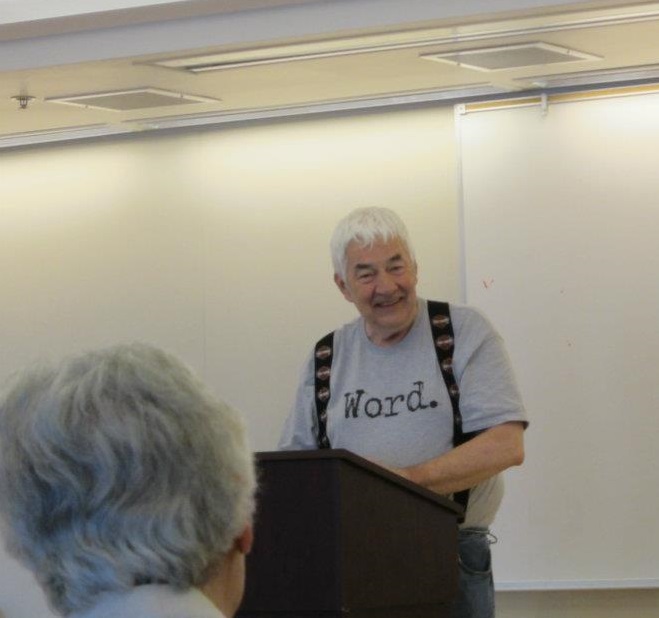
What is that legacy? What message in particular does Wyatt’s poetry, and his life, have for us? To me, it is inspiring that he carried on with his writing, attending readings, and giving support for poetry for as long as his body and mind held out.
Beyond the amusement of words, maybe what poets like Wyatt tell us is that, although there is vulnerability and the oppressive regressions of age, there is a resilience in people, especially in poets, that defies age and goes on, no matter what. Although Wyatt had infirmities of his own and struggled to break through the barriers that the disease of age had imposed on Linda, he nevertheless sought to still have a relationship with her. Sometimes, as he would report on Facebook, it was only a faint sign of recognition in her face, or her ability to say a few words. Then he would go back to writing and comment on the absurdity of war, the injustice of racism, or the disorganization of his personal effects. Social media became his lifeline to the people he had been hobnobbing with at readings for years before, but even on social media, he tried to keep up the good energy.
You may not be physically here now, Wyatt, but as long as we continue to gather, continue to read, write, and publish poetry here in Southern California, your work and your love for life and for others, will be part of the life of this place.

 Los Angeles Literature