
On July 7, local poet Pastiche Queen posted a scathing complaint about their experience working with local publisher, The Los Angeles Press, on Instagram.
The non-binary latindigenous poet and performer said, “I am warning every other author in Los [Á]ngeles: BEWARE @thelosangelespress and @lindaravenswood.” They also said, “…after asking to recoup the costs due to no follow through on any contracts whatsoever, I was sent this as the first piece of correspondence I’ve had with my publisher since MAY.”
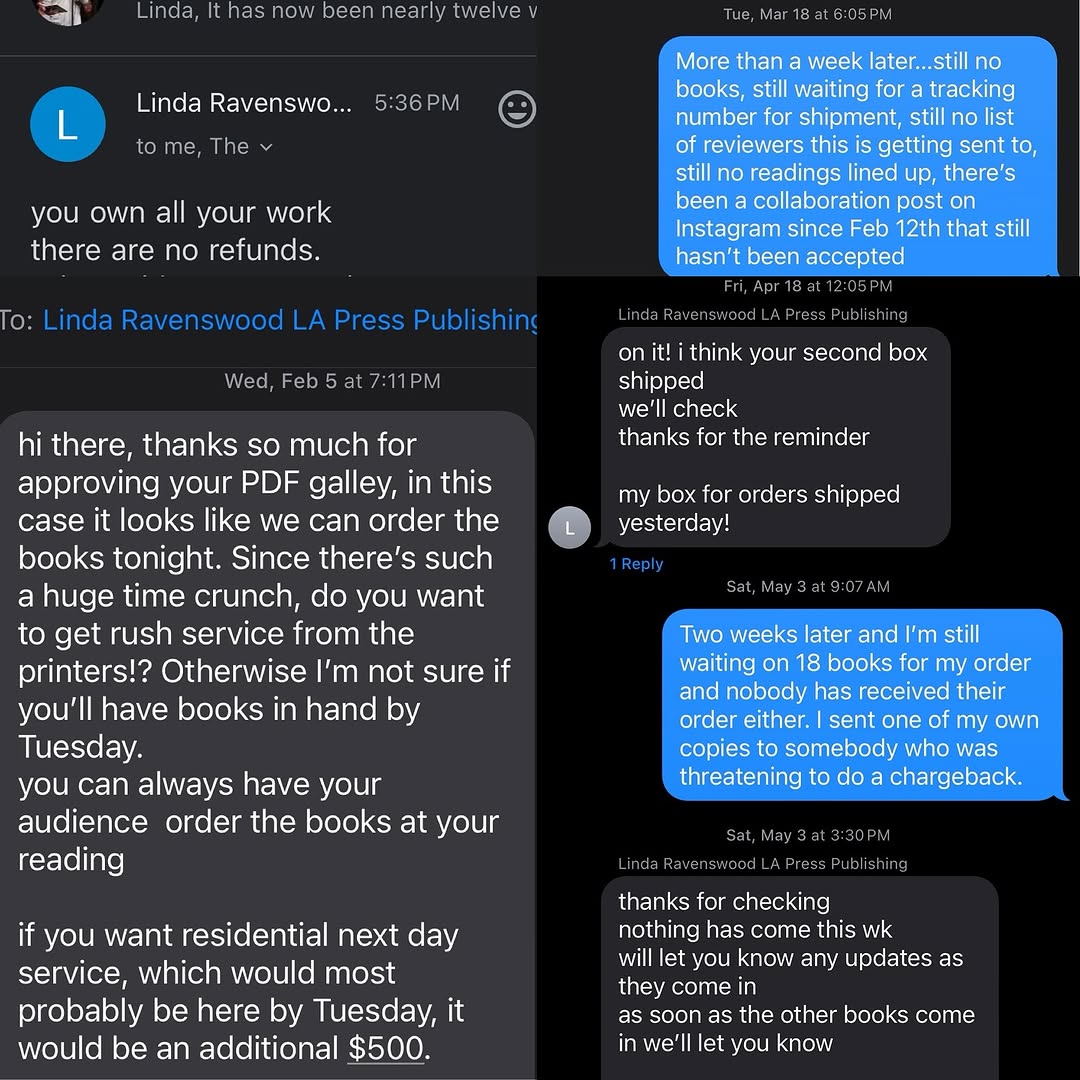
The accompanying picture was a collage of that conversation, with Queen expressing frustration to Linda Ravenswood, the press’s founder, “More than a month later…still no books, still waiting for a tracking number for the shipment, still no readings lined up…” Ravenswood responded by saying “[O]n it! [I] think your second box shipped. [W]e’ll check. [T]hanks for the reminder. My box for orders shipped yesterday.”
Pre-orders for Queen’s book Trans Velociraptors went live on January 16, according to the date of The Los Angeles Press’s Instagram announcement.
Included in Queen’s post are messages from Ravenswood saying, “[T]here are no refunds,” for the money spent to print the book and “[T]hanks so much for approving your PDF galley,” but to get rush service from the printer to get the book into the hands of customers who pre-ordered, “[I]t would be an additional $500.”
Typically, when an author works with an independent press like The Los Angeles Press, customers receive their pre-orders in anywhere from three to six months, depending on the press’ size, their resources, press marketing and release schedule and the printer’s workload, among other factors. And The Los Angeles Press, being such a small press, with Ravenswood and local poet Chelsea Rector being the only employees listed on its website, faces the issues any small independent press faces: limited availability and limited resources.
Ravenswood, thus, has to wear multiple hats: editor-in-chief, acquisitions editor, production manager, and customer service, leaving communication less frequent and limited only to significant developments.
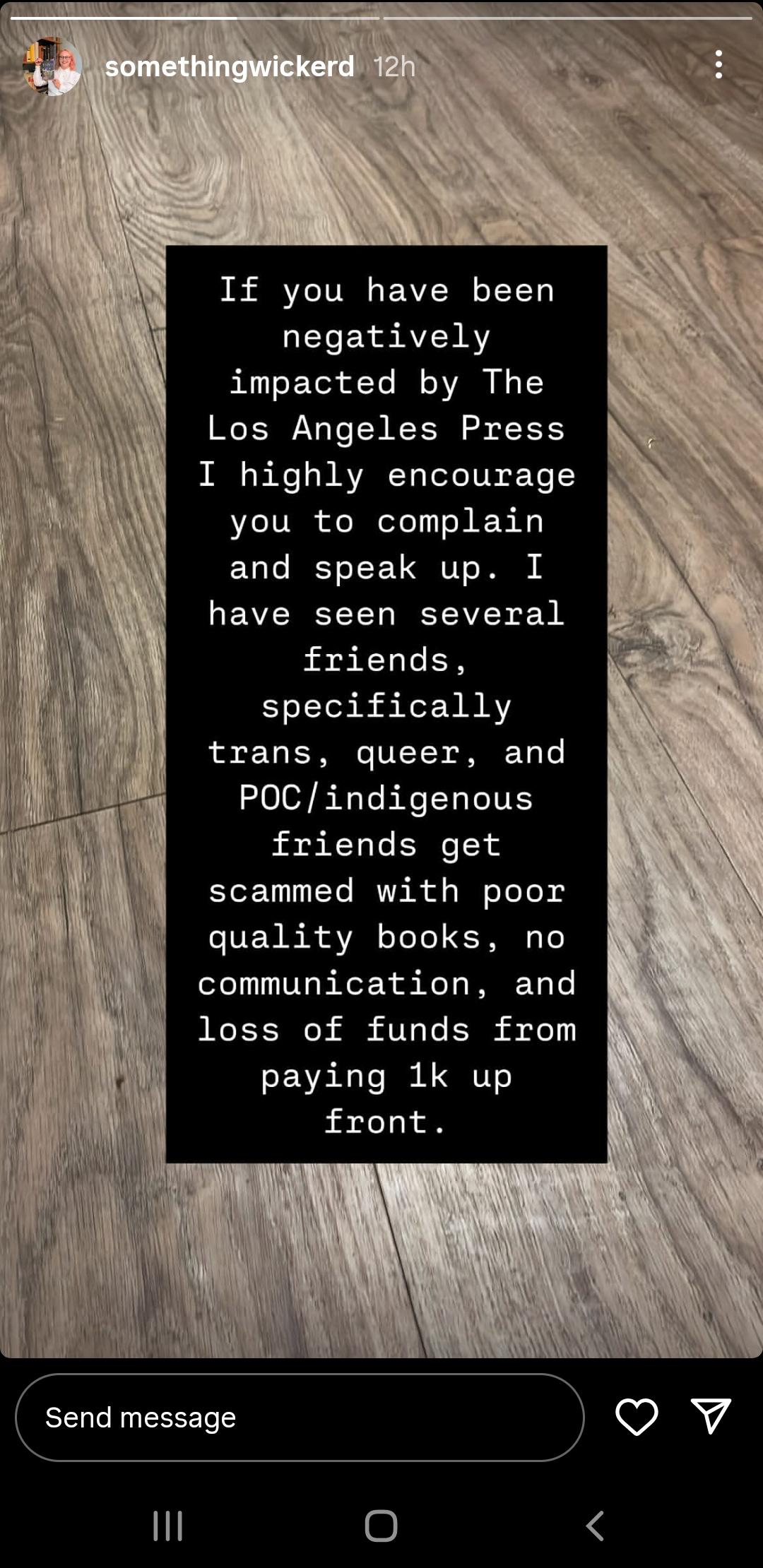
It was not until two days after Queen’s Instagram post, on July 9, that I caught wind of the situation from an Instagram story posted by fellow local LGBTQIA poet and self-proclaimed San Fernando Valley rat, Bryn Wickered. They said, “If you have been negatively impacted by The Los Angeles Press[,] I highly encourage you to complain and speak up. I have seen several friends, specifically trans, queer, and POC/indigenous friends[,] get scammed with poor quality books, no communication, and loss of funds paying 1k up front.”
Queen told me in an on-the-record phone interview that they were charged $1,100 up front to cover the production costs of Trans Velociraptors. But working with traditional publishers, which The Los Angeles Press is one of, Rick Lauber, author of two guidebooks for caregivers, said in a 2021 Writers Digest article that, “traditional publishers asking authors for up front payments are not legitimate.” Such publishers will recoup the cost through sales of the book, because they, especially indie presses, are first and foremost passionate about publishing the book in the first place, as the book relates to the press’s core beliefs they were founded on.
On The Los Angeles Press’s website, it lists their core beliefs, some of which are that “Publishing is a form of social justice. Publishing writers who have never been published or who have been underrepresented in publishing changes the world and shifts power from traditionally held regimes…Publishing is a direct retaliation against erasure.”
However, another local author, The Los Angeles Press, published—Queen provided me with screen shots of their correspondence dated April 18—but wishes to remain anonymous for fear that public disclosure could jeopardize their professional standing, spoke in part to this same issue of being scammed. The author mentioned they “had to buy [an ISBN number] and have everything reprinted” because their “second print had a ton of typos.” They went on to say, “[T]hat’s when I saw typos we had already edited out.”
Pastiche Queen and Linda Ravenswood met while working at the Poetry Brothel, “an immersive, literary cabaret that fuses poetry, vaudeville, activism, burlesque, live music, visual art, magic, mysticism, and private, one-on-one poetry experiences.” It’s “Inspired by turn-of-the-century brothels in New Orleans and Paris…many of which functioned as permissive spaces where marginalized, fringe, and avant-garde artists could experiment and perform their work alongside sex workers or while also performing sex work.”
The Poetry Brothel today “strives to promote empowered sexuality practices,” offering a space where a poet and performer like Queen can safely express the fluidity of their identity.
About a year into their working relationship, Ravenswood, impressed with Queen’s poetry, asked if The Los Angeles Press could publish a book of theirs. Queen was initially surprised to be approached by a publisher interested in their work, but they agreed, feeling it was an opportunity they needed to accept. At the time, they had not heard of any negative experiences related to working with Ravenswood and The Los Angeles Press.
In the same phone interview, I asked Queen whether there had been any red flags with Ravenswood they missed or brushed aside before they agreed to let her publish Trans Velociraptors. Anything that might suggest a preexisting pattern of inappropriate behavior in how she interacted with them or anyone else.
Queen recalled that Ravenswood would often speak to them in a sexualizing way, misused their pronouns even after repeated corrections, and insisted on calling them by their dead name, despite numerous requests to use their chosen name, Pastiche Queen.

During Poetry Brothel practices, Ravenswood would comment on how good Queen’s ass looked, for example. These allegations are corroborated by screenshots Queen sent me of their inbox, showing their conversations with Ravenswood that say, “Hi dear face and bun of amazing…” and “Misgendered!!?!!!! [D]ang it!! Lol!!”
These comments and misgendering came from a woman who’s been involved in the Poetry Brothel for years as the Mistress of Ceremonies.
The only public comments The Los Angeles Press and Linda Ravenswood made were an Instagram post to The Los Angeles Press’s page, dated July 9. The post speaks to Queen’s claim of delayed orders. They have been “delayed due to printer issues, design team updates, and changes in leadership.
“The [LA] [P]ress works with union, USA based manufacturing folk[,] and there have been significant issues this spring and summer.
“Remember, if you cannot wait for your book to be shipped, we work with PayPal[,] and you can always get an immediate refund.
“If you are able to wait for your shipment, books are forthcoming.
“Questions — thelosangelespress@gmail.com.”
There is even one comment and response that accompany the post. An @_donna.tella_ questions The Los Angeles Press’s responsibility to communicate with writers, asking,”[I]s it not your responsibility to communicate about these delays with at least the author, if not the customers?”
The Los Angeles Press responded by stating, “[T]hanks for your message. [Y]ou’re right. [T]he team has been updating authors about these delays since they occurred. [A]ppreciate your patience!”
Still, the post addresses only part of the broader situation Queen described to me in our phone conversation, leaving out several details that contributed to Queen’s claim that the entire process of getting their book Trans Velociraptors out into the world was a “publishing nightmare.” Additionally, Queen provided me with a screenshot from a conversation they had with a frequent collaborator with Ravenswood, who is a local author, who wishes to remain anonymous. In their April 19 correspondence, the author made a statement that retroactively contradicts The Press’s July 9 post. They said, “…another author came to me basically saying [L]inda disappeared[,] what do [I] do[?]”
Linda Ravenswood was contacted for this story but did not provide any on-the-record comments.

However, during our phone interview, Queen discussed the promises made by The Los Angeles Press in the contract they drafted and Queen signed. Queen on July 17, sent me a PDF copy of the deal memo as proof that the promises they spoke of—the press working “to secure excellent venues, collaborations, press events, and performance opportunities for the author—” were made, that they claimed in the interview, weren’t kept. The deal memo goes on to say, “Publication date forTrans Velociraptors is slated for spring 2025, with readings after February 2025….Publisher will send copies to reviewers, radio stations, online channels, and other outlets for PR and promotion as available.”
Though the phrase “as available” is used in contracts and deal memos to limit a drafter’s legal liability, by making the promises conditional, those promises or “services” were one of the selling points for Queen in choosing The Los Angeles Press. That’s because the vast majority of indie presses don’t have the resources to heavily market their books due to limited budgets, smaller staffs, distribution challenges and competition from larger publishers. Nevertheless, the deal memo fails to specify how the press will respond to any delays in publishing the book, if any, in the Spring of 2025, and how they will pursue any press for it, in response to any possible delays. Yet, the full contract was not provided to me.
For full disclosure, at the bottom of the email correspondence Queen sent me between Linda Ravenswood and themselves, there’s a confidentiality notice that reads in part, “This email and its contents are confidential and intended solely for the use of the individual or entity it address.”
However, it is not common practice for publishers to use such statements or agreements. According to EveryNDA, “one professional publisher says that confidentiality agreements just aren’t part of the traditional publishing culture.” And writers getting published for the first time often have little to no knowledge of the business side of writing—what’s expected in a reputable book contract, let alone how to understand legalese.
This gap exists because most writers are uncomfortable talking about the business side of writing, including their own personal experiences. Part of this discomfort stems from long-standing cultural norms in the literary world that treats discussions about money and contracts as taboo.
The romanticized idea of the “pure” artist, broader societal taboos around discussing money, and the fact that many writing programs focus almost exclusively on craft rather than commerce all contribute to this lack of knowledge. Additionally, a lack of transparency around advances and contracts reinforces this unspoken rule, making it harder for new writers to learn about the business. As a result, classes about the business of writing are exceedingly hard to find.
In Queen’s situation, they didn’t learn what these red flags were until they were in the thick of publishing Trans Velociraptors. That’s when they asked other writers about their experience publishing with The Los Angeles Press and heard about the similar issues they encountered.

Pastiche Queen’s was able to get out of their contract with The Los Angeles Press, but not before some copies of their book were produced. They can now publish a second edition with another publisher or publish it independently. They also asked for a full refund of all payments made to The Los Angeles Press, which Ravenswood denied. Plus, they told me in the same phone interview that Linda Ravenswood is taking a sabbatical from The Los Angeles Press, the press she founded.
And in their July 7 Instagram post sharing their experience with The Los Angeles Press, Queen stated, “I’m not about to let this happen to someone else.”

 Los Angeles Literature