
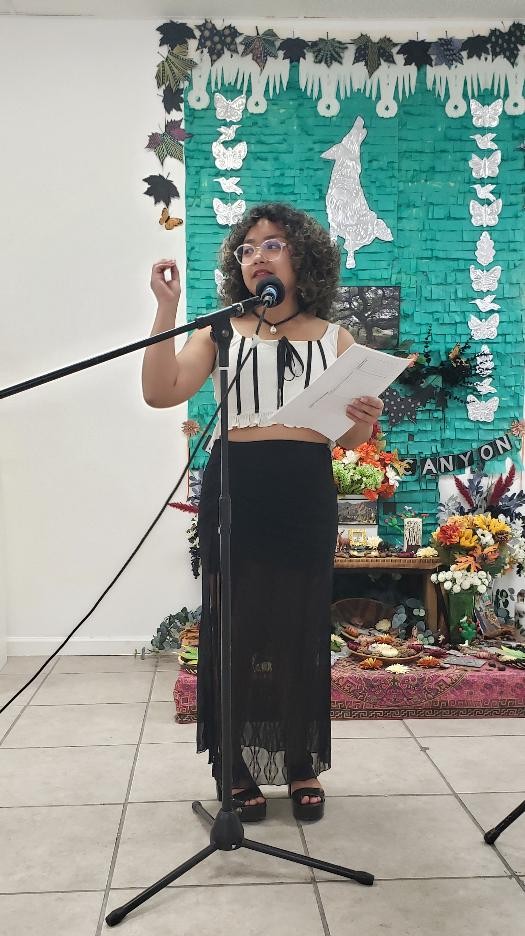
On Saturday, May 3rd, Avenue 50 Studio in Highland Park was packed. Spoken word, self-published and academic poets intermingled amongst the gallery show “Urban Wild: Images from the Heart,” a show that “pays tribute to the wild, urban enclaves of Northeast Los [Á]ngeles, the West San Gabriel foothills and their artist communities,” according to its website. Shortly after 2pm, new host Pam Concepcion stood in front of the mike to relaunch La Palabra. An open mic Avenue 50’s hosted for 25 years.
The features were Ashton Cynthia Clarke and Laura Sermeño, two local writers who were affected by January’s devastating Eaton Fire. The home Clarke lived in for the past 25 years had burned down and the elementary school, Aveson Charter, that Sermeño’s son attended was turned to ash.
La Palabra was relaunched at Avenue 50’s new location at 3714 N. Figueroa after the gallery moved there in January due to gentrification. The gallery’s landlord wanted to develop their location on Avenue 50, alongside the A Line, into a more profitable venture even though they had been a community art staple there and in Highland Park, since Kathy Gallegos opened its doors in 2000.
La Palabra’s new host, Pam Concepcion, immigrated from the Philippines to Los Ángeles in 2023 to be with family already living in the US. Initially, as she settled in—searching for a job, without a car and yet to make any friends—she found herself seeking creative circles to connect with. She was always out at art events in Metro Manila and wanted a version of that in America.
Concepcion, now living in Greater Los Ángeles—a region known both as a creative haven and home to the largest Filipino population in the country—didn’t intend to get involved in the literary community. Her intention was to pursue screenwriting and film and TV production. However, right when she arrived the writer’s strike happened, so she switched up and went back to her writing roots of poetry.
Concepcion looked up local open mics on the internet, found the Beatnik Café on Sunset in Echo Park and attended her first open mic that May.
Like so many writers of color in the Greater Los Ángeles literary community who had immigrated to the United States from elsewhere—or whose parents had made the perilous journey themselves—Concepcion found her tribe among its diverse poets and nurturing spaces, where she could share her truth through organizations and open mics like the Community Literature Initiative (CLI) and the Filipinx-focused Sunday Jump. This included Avenue 50 Studio, whose Latina/o perspective it places on the arts, “provides a place where the life and artistic interests of an underserved community can be made visible.”

Concepcion decided to tie the open mic to the gallery show, to spotlight the stories of who and what these Northeast Los Ángeles communities are, and the struggles and resilience they’ve shown in light of the Eaton Fire. Communities who, “[t]hroughout the twentieth century…attracted artists who were inspired by the wild, yet urban beauty of these areas.” This was why she featured two writers who lived in and around the nearby historic Black Altadena community affected by January’s fires. Not only that, but she asked the open mic readers to write an ekphrastic poem about one of the pieces in the gallery show to read at the mic.
When Clarke read, she made sure to highlight and thank me for publishing her essay “A Writer’s Life in Altadena: In the Line of Arts and the Eaton Fire,” about her time living in Altadena and how she was affected by the Eaton Fire, in Los Ángeles Literature. She read the opening to her essay which captured a portion of the community’s unique location. “All I experienced then was the chill of the 1,900-foot elevation, our quiet, contented breathing and the broad street which sloped downhill in front of us, opening up to myriad urban lights below.”
Laura Sermeño is from El Monte, a Latinx-majority suburb of Los Ángeles with a complex and racist history. During the depression, the area experienced social and labor conflict that resulted in the El Monte Berry Strike of 1933, which exposed the institutional racism experienced by both the area’s Japanese tenant farmers and Latino farm laborers.
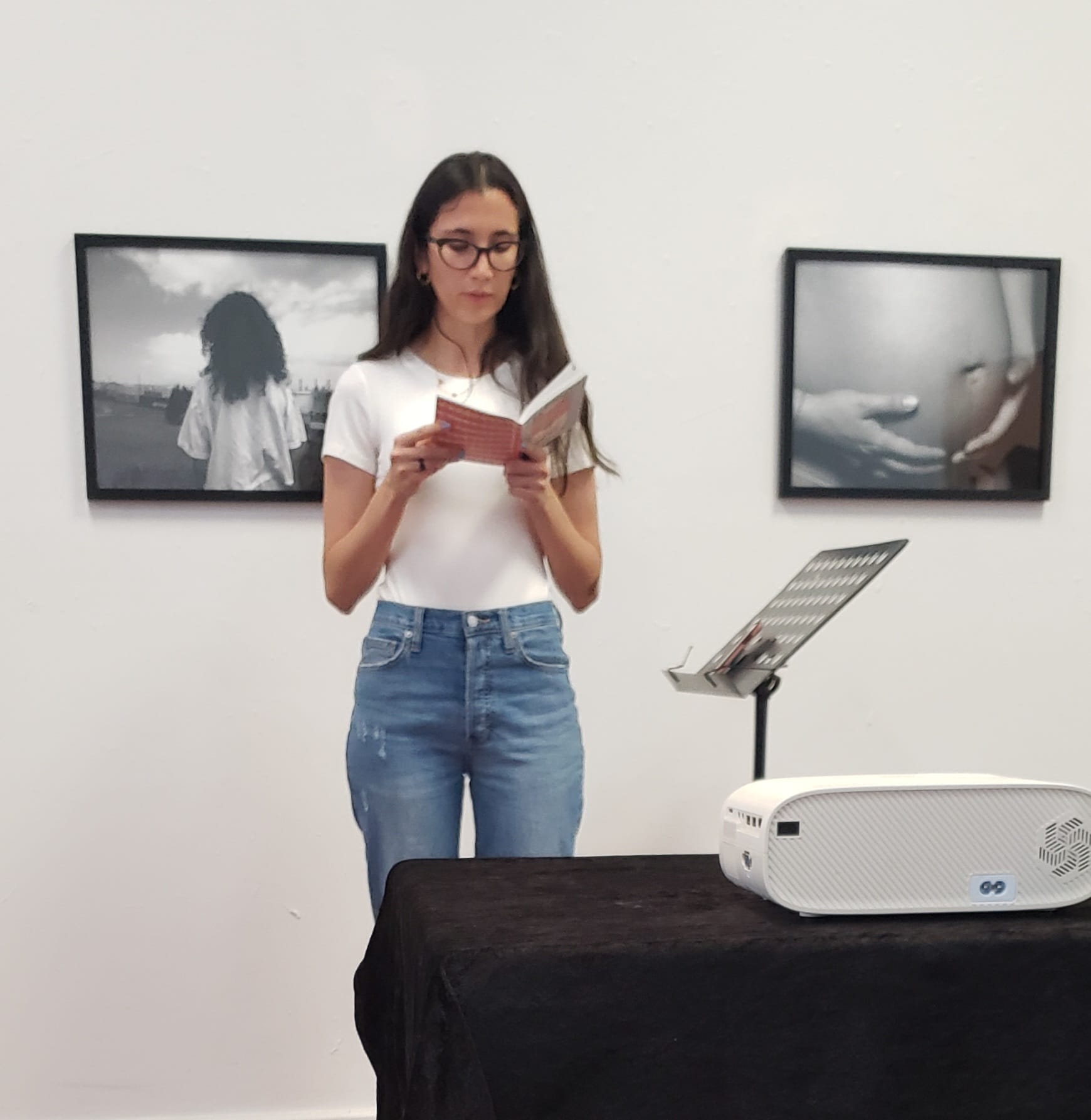
When Sermeño read, she read a poem from her self-published debut born to cry, about the El Monte she grew up in, still infected by institutional racism. In her words before and after the poem and in the poem itself, she didn’t mince her anger at how much she hated growing up in El Monte among gangs, violence, drugs and drug dealing that constantly threatened to suck her in. She knew she had to get out.
Yet, Sermeño also noted how she experienced the Eaton Fire from her apartment that straddled the border of Altadena and Pasadena.
Once the features finished, Pam Concepcion again encouraged the open mic readers to write an ekphrastic poem inspired by one piece of art in Avenue 50’s current show, during the 10-15 minute break that followed.
Several poets who attended and read during the open mic were friends Concepcion met as part of her season 11 cohort in CLI’s poetry and publishing class. Others were known poets in the community, such as spoken word poet Christian Perfas “Soul Stuf” and Barbados native Lynda V. E. Crawford. Spoken word poet Kuahmel, a graduate of CLI’s first season, let the other poets enjoy the stage.
It was the rebirth of an open mic that had been a community staple for so many, especially female and LGBTQIA poets of color, to safely share their truth and gain confidence in their voice, as a femme of color-centered open mic. In its two and a half decades, La Palabra has been hosted by poets such as Puerto Rican American, teacher and Beyond Baroque board President Luivette Resto; Arminian American and founder of the former womyn-identified poetry collective Las Luna Locas, Karineh Mahdessian; and Echo Park native and former elementary school teacher, Angelina Sanez.
But in the last two years before Avenue 50 studio moved to its new location, La Palabra had struggled to find a new consistent host and active member in the literary community. They went through two hosts—one who clashed with Gallegos’ expectations for the role, and another who found the position overwhelming due to her history with mental health—before settling on actor and poet Chole Diaz, an artist more in tune with Hollywood than the local literary scene.
During much of this time, Gallegos was focused on the most serious gentrification threat Avenue 50 had ever faced, as their landlord had previously remained largely silent and absent while gentrification had spread rapidly throughout Highland Park. It kept her busy, working with the community to create a contingency plan for whenever their landlord made their economic eviction official.
Now that Gallegos had settled into the gallery’s new location, she was able to restart La Palabra, stating in an April 20th Avenue 50 Instagram post advertising the special relaunch edition that, “[d]espite the tough changes Avenue 50 Studio has faced in leaving its original home, we will continue the legacy of La Palabra [in] its 25th year. No amount of gentrification can stop the power of poetry.”
Two weeks later, poets such as South Central native Juan Amador, emerging poet Duncan Cuervo and myself joined in celebrating this special relaunch.
When the 10-15 minute break ended, it was the community’s turn to “[pay] tribute to the wild, urban enclaves of Northeast Los [Á]ngeles, the West San Gabriel foothills and their artist communities.”

 Los Angeles Literature
I was so honored to be a featured reader at the renewal of La Palabra at Avenue 50 Studio. Thank you so much, Brian, for this very thoughtful article!
LikeLike