

Poets’ words echoed in the Central Library’s Rotunda making it difficult to understand their language. A big, muted projector screen stood next to the podium livestreaming the poets reading from Paris. A crowd of poets sat and stood around the periphery, listening.
In the Mark Taper Auditorium, the livestream was broadcast across its big screen above its stage, appearing at first glance, dubbed in French, but subtitled in English. Viewers were virtually nonexistent.
September 7th. This was the finale of the Cultural Olympiad, passing it from Paris to Los Ángeles. Concluding with a poetry performance.
The Cultural Olympiad “is a multidisciplinary artistic and cultural program” its website states, that runs during the Olympic and Paralympic Games. It’s the games “opening their doors wide to culture and artists.”
The finale was the culmination of the partnership between the City of Los Angeles Department of Cultural Affairs, Beyond Baroque Literary Arts Center, the City of Paris and the Paris University Club. They developed a pilot project based on the theme of the Paris 2024 Cultural Olympiad: “Art + Sport.” Selected poets read original poems that tied athletics in some way, to their themes and ideas.
“In honor of the L.Á. 2028 Olympics,” a Beyond Baroque Instagram post says, “eight L.[Á]. poets selected as Paris Olympiad Poets [traveled] to Paris to perform in the finale of the Poetic Games.” These poets included former West Hollywood Poet Laureate Steven Reigns and former Los Ángeles Poet Laureate Lynne Thompson.
Their portion of the program, called Marathon Poétique, included 23 French poets, performers and musicians such as Anouk Schavelzon, Eesah Yasuke and Lisette Lombè. The stage where they read was a boxing ring.
However, the Los Ángeles portion of the finale, livestreamed and dubbed “Catch the Mic: Paris to L.Á.,” featured 28 L.Á. poets who performed in the Mark Taper Auditorium. Poets such as Bridgette Bianca, Sean Hill, Matthew Cuban Hernandez, Christian Perfas, Linda Ravenswood, Mimi Tempestt, Jimmy Vega, Brian Sonia-Wallace and Pam Ward. Plus, the M.C. and Beyond Baroque board president, Shonda Buchanan.
Shortly after 2:30pm, the reading began with a land acknowledgment, noting everyone in attendance was on traditionally unseeded Tongva lands, followed by an interpretive performance performed by Tongva artists Tochtii Orozco and Isaac Ybarra with Nikki Ochoa and Mas Guerrero. The performance touched on the colonialism their people experienced upon the arrival of the White man and their continued perseverance through the destruction of their people, culture and society.
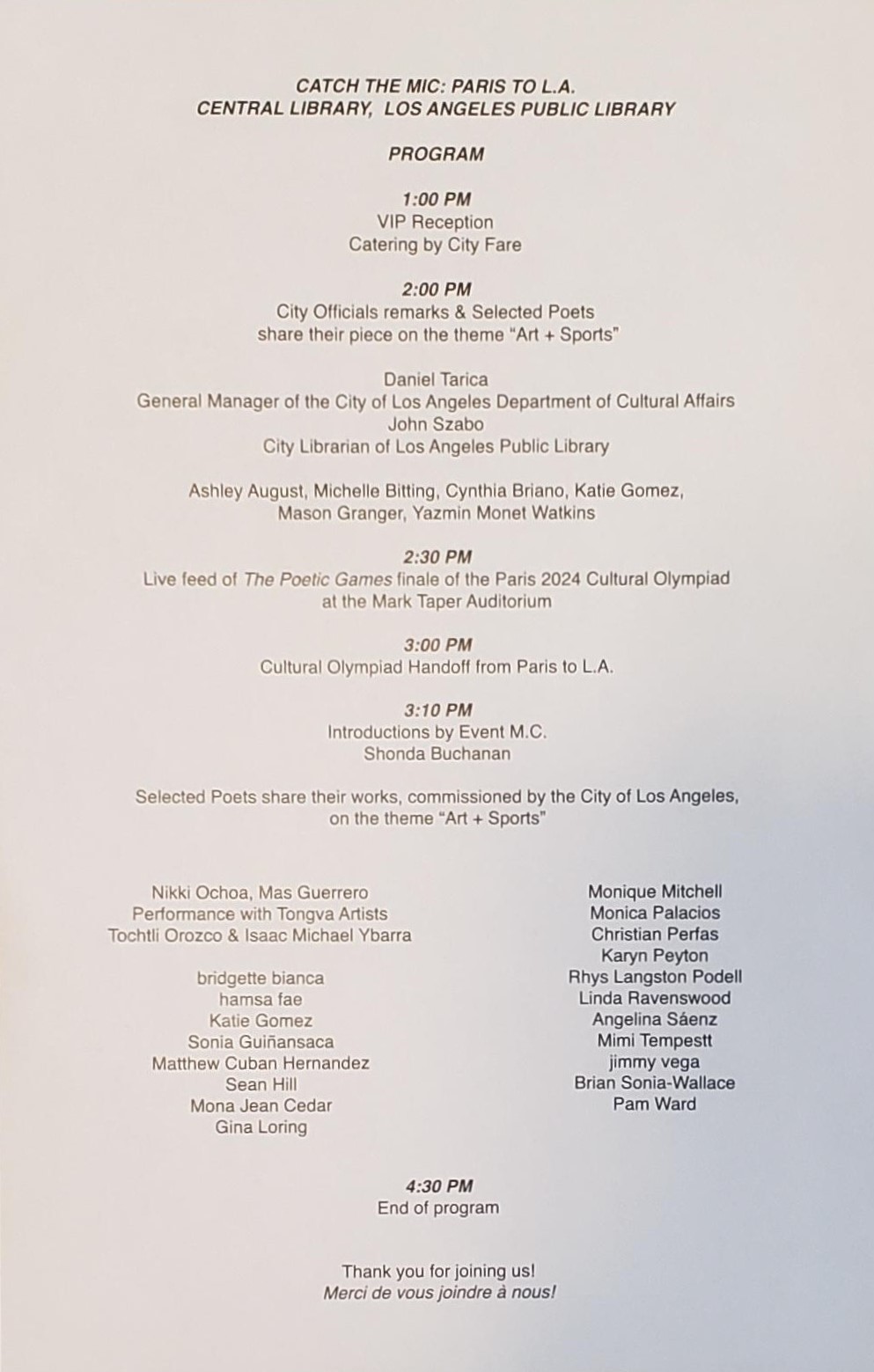
The day’s festivities began before I arrived. The reading in the Rotunda was a special reception for the Cultural Olympiad, for the featured poets, that was catered by City Fire. Yazmin Monet Watkins was one poet who emotionally performed, moving her right arm to emphasize her words, as if she was preaching. She stood behind the podium emblazoned with an oversized Los Angeles Library card.
As Watkins said on Instagram about the poem she performed, “I wrote ‘Heavenly Stands’ thinking about all the people cheering us on from the other side. All of us here sprinting, jumping, tumbling, hurdling through grief. Transmuting pain into gold and emerging victorious on the other end.”
Part of Watkins’s poem reads:
          We speak to the rafters
          soaring to new heights they
          prepared us for.

          We roar their names in
          victory at the finish line.
          Hug air knowing they hug
          ancestors cheering.
In Paris as part of the Paris 2024 Cultural Olympiad’s Poetic Games, four L.Á. poets had their “Art + Sport” poems broadcast from trees in Paris parks to engage the public in the convergence of art and athletics. These “Speaking Tree Poets”—Jax Neal, Sarah Maclay, Terry Wolverton and Tommy Bui—engaged in an aspect of the Olympic Games that debuted in Stockholm in 1912, literature.
According to Nick Ripatrazone’s Lit Hub article, the union between art and sport is ancient and this ancient union “appealed to Baron Pierre de Coubertin, the creator of the modern Olympics.” Although he was not an athlete, he “was drawn to exemplary performance during antiquity and believed in the union of the ‘spirit’ and the ‘flesh.’” De Coubertin even “created a monthly journal, La Revue Athlétique, ‘hoping to raise interest in mainly sports in France.’”
Basketball, for example, has been called poetry in motion, as many who love the game use it to exemplify the beauty they see on the court, as the similarities between the two enterprises form a complementary relationship. Poet Robert Frost wrote about his love of baseball claiming “Poets are like pitchers. Both have their moments. The intervals are the tough things.”
Back in the Mark Taper Auditorium, several poets spoke about place—Los Ángeles, Compton, Watts, and Chavez Ravine—in terms of athletic prowess, determination and perseverance. They related it to athletic feats that occurred in those communities or that people from there accomplished who looked like them (Black and brown).
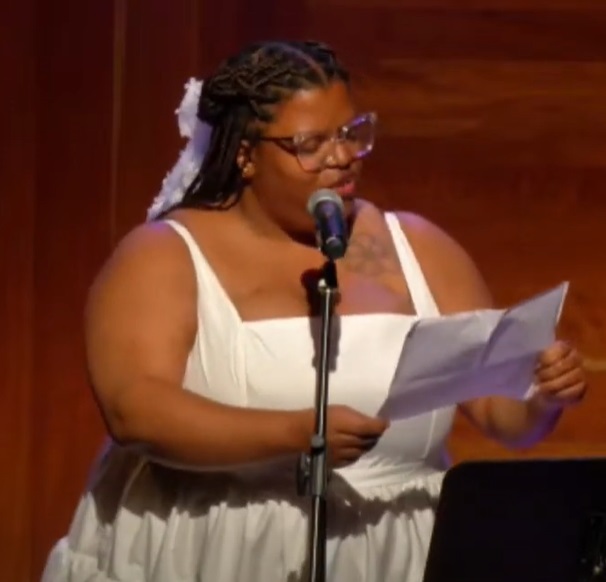
One such poet was Santa Monica professor Bridgette Bianca, whose poem “My Pops Was a Track Star,” is set in South Central, where she was born and raised and still lives. It’s about the life lessons her father taught her that he learned from running track as a youth, even though she’s not an athlete.
          he warned me that the path ahead of me
          was full of hurdles
          but my jumps would be clean
          i just had to count my steps in-between
These poets who spoke about athletics through place were able to explore and push back against race and racism as Bianca does. In her poem’s final stanza, in the context of Los Ángeles, she says:
          we triple threat
          we triple jump
          we triple axel spin
          every narrative
September 7th was a cultural sendoff between two world cities coming together through poetry and athletics: Paris, the City of Light, and Los Ángeles, the Entertainment Capital of the World.
Before the L.Á. poets took to the Mark Taper Stage and after the interpretive performance, one final Paris poet took to the ring. Once, while in L.Á., Alain Mabanckou discovered his passion for basketball when he witnessed the Lakers play at Staples Center, now Crypto.com Arena.
In much of the second half of the poem, Mabanckou relates the strategy and gameplay of basketball to the process of being a writer. And compares a writer’s work ethic to that of Kobe’s. He’s uniting “spirit” and the “flesh.” The intellectual and the physical.
          Basketball has taught me to take timeouts
          to drop my notebook, eat some fruit
          and answer my email.

          When I get back to work
          My biggest mistakes become obvious…

          Smile at my sports-coach wiles in my text
Upon completion of the poem, he told Shonda Buchanan, via the livestream, “I look forward to seeing you in Los Ángeles” at a “Lakers game.”
And with that, Paris handed the poetic reigns to Los Ángeles.

 Los Angeles Literature