
Author’s Note: My story was inspired by the following theme, however in my case, it was a children’s librarian who touched my life. Libraries as Houses for Books: How have books and stories in a library touched your life or imagination?
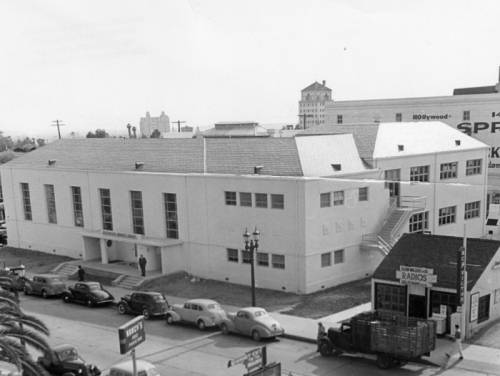
Oasis. Spiritual sanctuary. Refuge. Retreat. As the child of two working parents, the library was a second home to me. Doing homework, reading, observing the comings and goings of a colorful crew of characters in an ever-changing cohort. Each holding forth at their own table displaying their varied quirks and eccentricities. I wasn’t aware that libraries were considered to be a safe place for so many; especially the displaced and the disenfranchised, which in recent years has increased to much larger proportions. For me, under the watchful eye of Miss Wooten, the children’s librarian, it was a sacred sanctum where I could spend time after school until my mother or father would come to pick me up. Being surrounded by what seemed like an infinity of books was nirvana.
My local branch was under the shadow of the famed Hollywood sign, on Ivar Avenue, between the more louche environs of Sunset and Hollywood boulevards. Housed in a free-standing two story building with a tiled fountain at the entry and a short flight of stairs, each visit to this unique edifice felt like a special event. I would learn in later years, the historical structure (originally funded by the legendary Andrew Carnegie) had been featured in the Humphrey Bogart classic, The Big Sleep, and included the archives of D.W. Griffith and Charlie Chaplin, which would be destroyed in a disastrous arson fire in 1982.
My mother, a glamour photographer at the time, was an avid reader, a habit she did not share with my father, a physical therapist, who preferred listening to sports events on the radio. It was the early 1950s and we had still not acquired a television. Ignorance was bliss. I kept myself occupied “reading” stacks of Life magazine in my mother’s studio, intrigued by the lines of symbols I discovered under the iconic photographs. The precocious four-year-old would learn that those symbols were the alphabet and would eventually be reading the photo captions and headlines.
One day I accompanied my mother on her next visit to the library to get my own stack of reading material: picture books by Leo Lionni, Dr. Seuss, Ludwig Bemelmans’ Madeleine series, Kay Thompson’s Eloise and more. When we got to the checkout counter, the librarian informed my mother that children had to use their own library card. My mother said that I didn’t have one and when she asked for a form to fill out, the librarian replied that five was the minimum age to receive a card. My mother said that I was actively reading and the librarian sheepishly added: “Unless she can print her own name.” To which my mother responded, “Give her a pen.” We walked home triumphantly carrying our books, which were secured by large rubber bands.
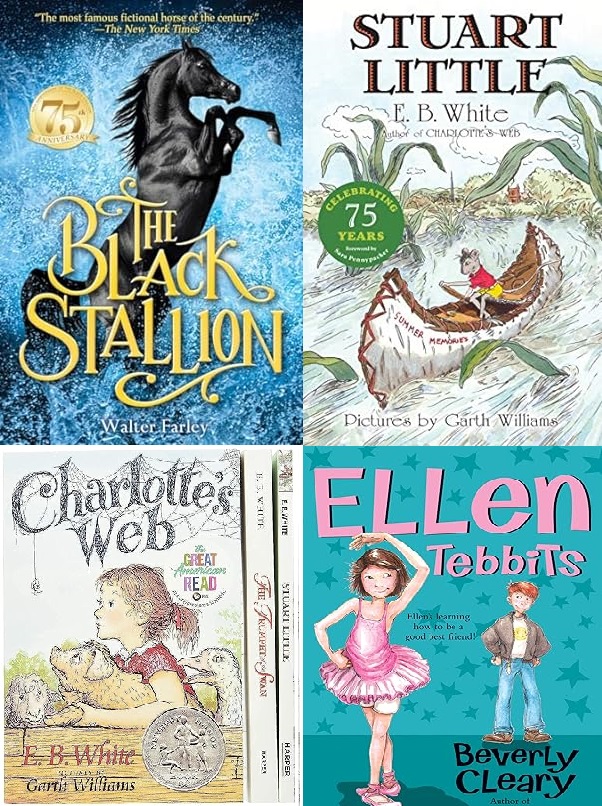
That day turned out to be auspicious. Twenty years later my own daughter would get her library card just before her fifth birthday, and at 12, would be winner of the summer reading contest, having read more than 50 books, under the guidance of her own children’s librarian, Mrs. Forrester. Several decades later, my granddaughter would join the next generation of avid readers. A pastime we still share today. When you spend so many hours in the Children’s section, you develop a rapport with your librarian. With her enthusiasm and engagement, Miss Wooten took me (and so many other children) to the next level of reading, and my tastes evolved from fairy tales and The Black Stallion series to memorable storytellers like E.B. White (Charlotte’s Web and Stuart Little) and Beverly Cleary (Ellen Tebbets series), among so many others. I wondered what it would be like to someday get my own name on a book as its author.
My love of reading provided me with a love of writing. When I was six, my father gave me a second-hand Smith-Corona typewriter, which would keep me occupied for hours. I created my own neighborhood newspaper when I was eight, with a circulation of ten copies, which I made using carbon paper (there were no copy machines!), and sold for 5 cents each to neighbors and family friends. I kept a diary and I wrote little poems and stories, but it wasn’t until middle school that I joined the newspaper staff as a writer, which I would also pursue through high school and college. I wanted to be a critic and have my opinion count. To inform and inspire, to provoke. I wanted to write, but I also needed to be read. As a fledgling journalist I climbed the career ladder just out of college, “graduating” from the school paper to an underground journal, freelancing for the San Diego Union-Tribune and the Los Angeles Times, then moving on to national magazines, from Cosmopolitan to Penthouse, TV Guide and more.
As much as I enjoyed meeting the demands of each new assignment and seeing my byline as the cherry on the tart, I still aspired to be a storyteller. I was just not sure in which genre. I’d started running as a form of fitness and preferred quick spurts of speed as opposed to the more grueling commitment of a half-marathon or more. I recognized that similar feeling with writing, in that I preferred focusing on poems and short stories rather than investing the time and energy in a novel. After publishing three poetry chapbooks, my aspiration was still to write children’s books. Everyone said how difficult it was to break in, but after my first grandchild was born, I decided to take on that challenge.
Through a remarkable chain of circumstances, good timing, and a couple of unusual story plots, combined with a top illustrator, I made my debut as a children’s book author in 2007. Elusive Moose and Hidden Hippo received accolades, were published in several languages, and available in libraries across the United States, as well as in Finland, Canada and South Korea. At a reading at a library in Belmont, Massachusetts, I was introduced to a children’s librarian who looked strangely familiar. After reminiscing a bit, I realized that it was Mrs. Forrester, the children’s librarian who was once based at the library in San Diego which our family had frequented.

Librarians are more than people sitting behind a desk. They choose their vocation because they have an affinity for books as well as an enthusiasm to share that predilection with others. In the hallowed environs of a book-filled library where silence is encouraged, their voices remain heard. And continue to resonate for so many of us.
I dedicated my two children’s books to my daughter, son and my grandchildren. In retrospect, maybe I should have included a tribute to Miss Wooten. I’ll save that for the next one. Three’s the charm.

 Los Angeles Literature