

Back in October 2023, Los Angeles Literature asked me to write an article, but I’d been so swamped it wasn’t even possible until late April 2024 to begin composing anything because I’ve been playing the long game. Parenting, teaching, freelancing, taking field trips with my students, reading books whenever I can slow down and even coaching soccer last Fall. My 10-year-old son plays AYSO and for the second year in a row, I was an assistant coach. Needless to say, it’s been busy.
Sometime in September 2023 in the middle of soccer and the fall semester, I stumbled on Christine Sinclair’s memoir, Playing the Long Game. For those that don’t know, the Canadian soccer star Sinclair is the all time record holder for women and men in international goals scored with 190 goals in 331 games over 24 years. She is an Olympic gold medalist, two time bronze medalist and World Cup Champion with the Canadian team in 2020. She has more records and accolades than I can list but her memoir is inspirational because she outlines how she accomplished it all.
Sinclair was never the flashiest player, but she stayed consistent for two plus decades. Henry Aaron, the former all time homerun leader, was similar. There may have been individual players who had bigger seasons statistically like Roger Maris or Mickey Mantle, but to put up those types of numbers season after season for two decades, that’s how you become Sinclair or Aaron. Game after game, goal after goal, she never stopped scoring, even at 40. There’ve been other great women and men soccer stars, but she stands alone with what she’s accomplished.
Staying Consistent
You might be asking, what does a Canadian woman soccer player have to do with Los Ángeles literature? This is a valid question, but the short answer is that her excellence is an inspiration to us all because she shows what happens when you stay consistent and keep showing up. Before saying more about Sinclair, I want to shout out Los Ángeles poets like traci kato-kiriyama from the Tuesday Night Cafe, Cory Cofer aka Besskepp from A Mic & Dim Lights, Shihan, Poetri and Gimel from Da Poetry Lounge, Rick Lupert from Coffee Cartel and Cobalt Poets and Don Campbell from Saturday Afternoon Poetry. Each of these poets have hosted the same venue consecutively for upwards of 20 plus years. They have persevered.
These poets and Christine Sinclair show that greatness is achieved through consistent presence, perseverance and staying focused. There are several writers in the L.Á. literary community that remind me of Sinclair in their own way which I will get to in a moment.
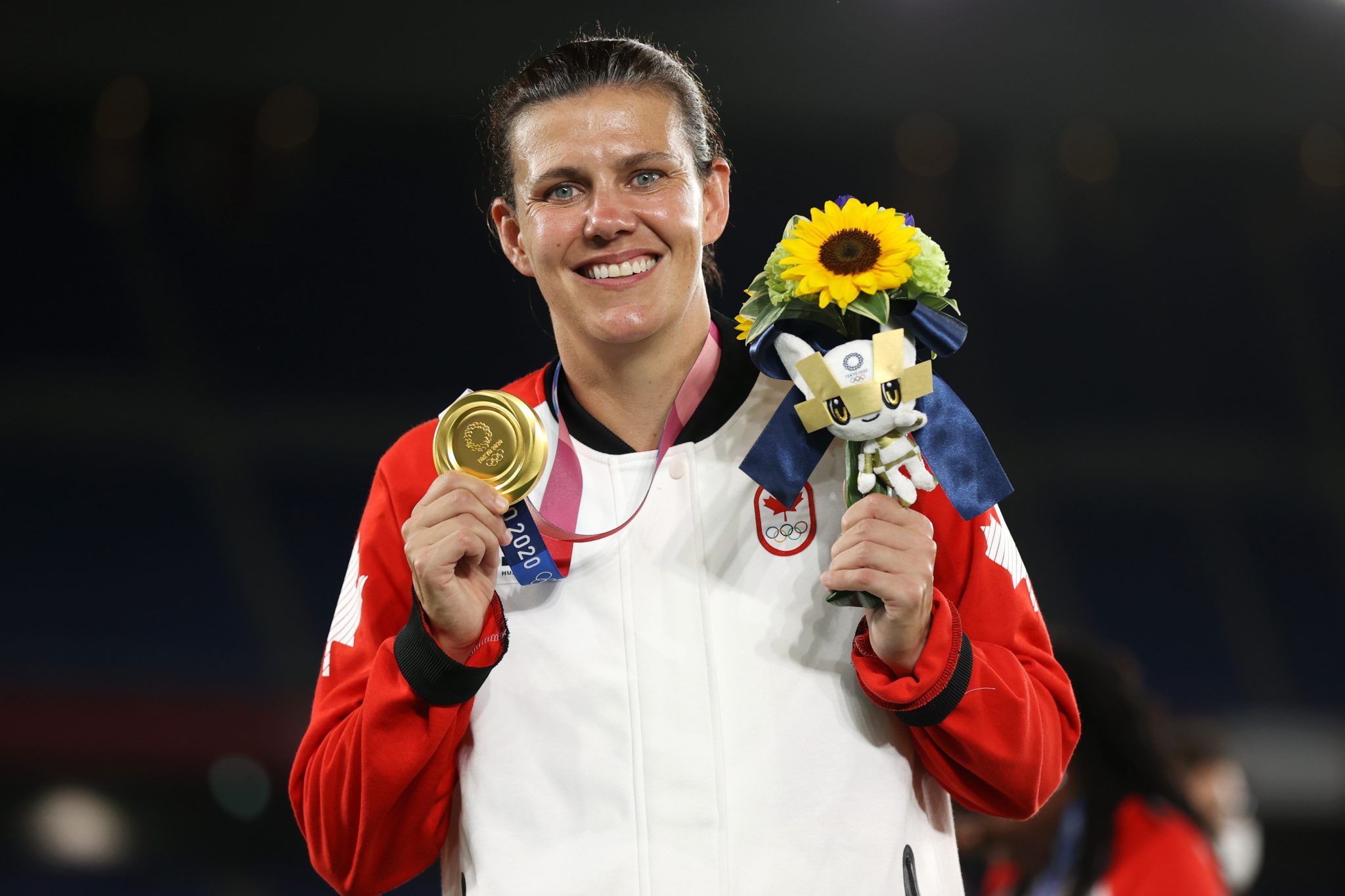
First though, it’s not an exaggeration to call Sinclair the Tom Brady of women’s soccer. She is 57 goals ahead of her closest counterpart. To put it into further perspective, Lionel Messi, the Argentine World Cup champion only has 106 international goals, 84 less than Sinclair. Not even earlier Brazilian soccer legends like Pele or Ronaldo have anywhere near as many goals in international competitions as Sinclair. “Soccer was just something I loved,” she writes. “It was my freedom. No stress. Just playing a game. I never imagined it could be my life.”
Sinclair’s book is affirming because it reminds us to stay in the zone, focus on what we want to accomplish and not get distracted by setbacks, frustrations or what others are doing. She just showed up everyday for 24 years. Moreover, the Canadian team was consistently second, third or fourth before they finally won the Olympic gold medal and eventually the World Cup when she was in her mid 30s. She recounts story after story from her childhood beginnings to the various tournaments and international competitions.
With all the recent attention to Women’s Basketball and stars like Angel Reese and Caitlin Clark, I know many readers will be equally inspired by Sinclair’s life-story and the episodes her memoir describes. And though Sinclair retired from competitive soccer shortly after the book was published in 2023, her thrilling stories about her soccer journey offer hope on page after page after page. While I was reading it, I was overwhelmed with family, work and unexpected trials but Sinclair reminded me to hold steady and keep playing the long game.
One Book, One Campus
In the midst of soccer season I taught four classes at Woodbury University, running the school’s first year experience program and the One Book, One Campus campaign simultaneously. The One Book program is a national campaign that different schools, libraries and cities do to get people in a community sharing a common read. It’s a great way to get folks talking about books and addressing literature as a way to build social cohesion. Our book last fall was bell hooks’ award winning, All About Love, published in 2000.
In All About Love, hooks examines the question: what is love? Combining her own life experiences with decades of research, she synthesizes dozens of threads to propose an ethic of love that is sacred, redemptive and uplifting while still being unflinchingly honest. Our students loved it because it unpacks “love” revealing the deeper complex implications of “love” beyond the obvious tropes of romantic love we see in film and television.
In the book’s “Introduction: Grace: Touched By Love” on pages XV to XVII, hooks talks about a piece of graffiti art that lifted her spirit during a period of intense grief. It was a statement she would see everyday walking to her job teaching at Yale University. The message emblazoned on construction walls declared: “The search for love continues even in the face of great odds.”
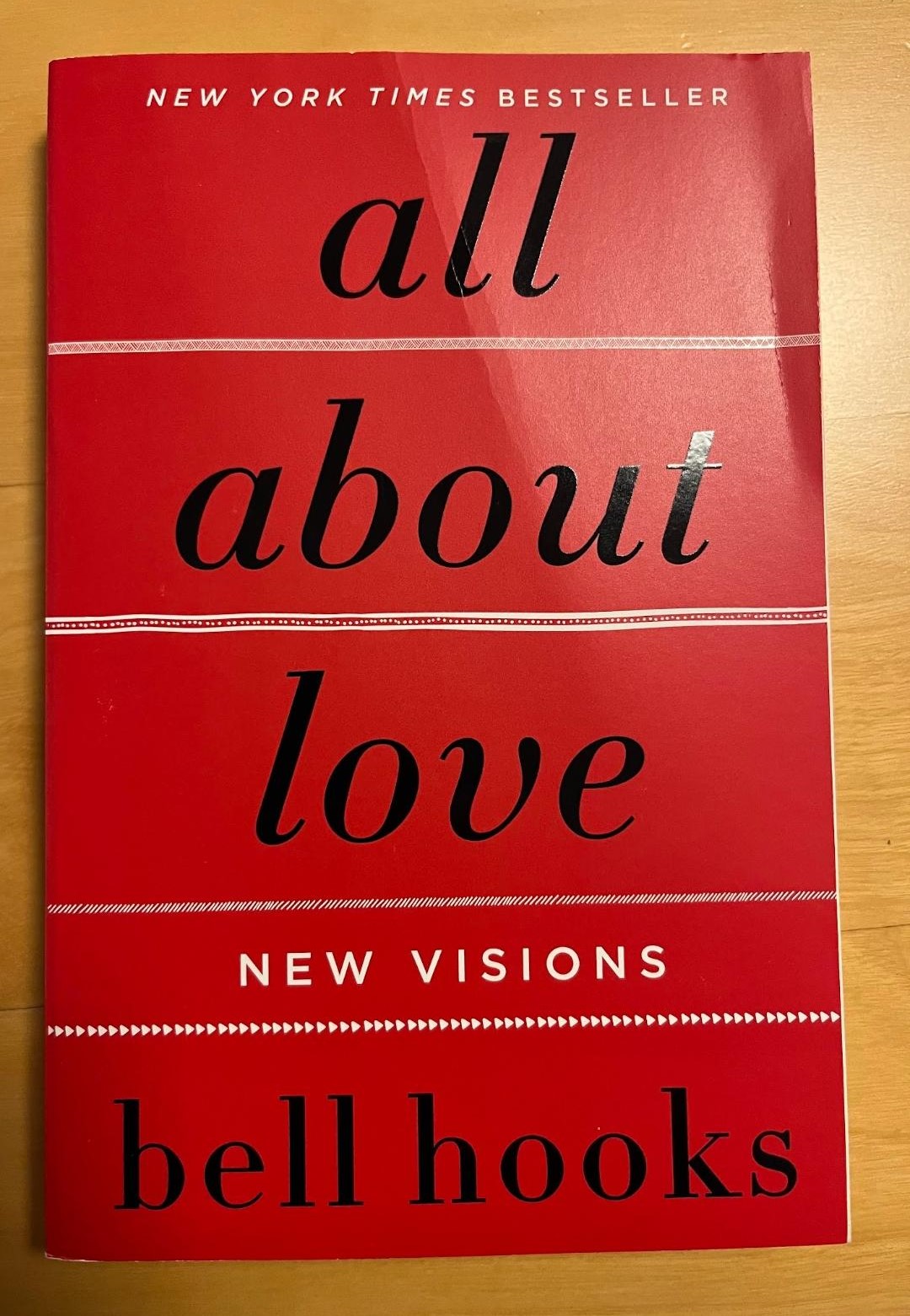
At the time she read these words, hooks was recently separated from her partner of almost 15 years, so seeing these words everyday kept her going. “Whenever I passed this site,” she writes, “the affirmation of love’s possibility sprawling across the block gave me hope.”
Though the piece was eventually painted over, hooks managed to find the artist and had a face-to-face conversation with them about the meaning of love and how “public art can be a vehicle for life-affirming thoughts.” This idea of public art being a vehicle for affirming life was a thread I wanted to explore, so we took several classes to Judith Baca’s Great Wall of Los Angeles in the Valley Village district, just 15 minutes west of Woodbury’s campus in Burbank.
The Great Wall of Los Angeles Love
Baca’s Great Wall is a 2,800-foot-long mural that delivers a 10,000-year People’s History of Los Ángeles. Spotlighting a history of social and political struggles from the perspective of women and people of color, it is monumental. Countless Angeleños who grew up near the Wall or have spent significant time there have expressed how the wall empowered them, educated them and gave them affirmation in a similar way to how bell hooks received the graffiti statement about love.
We had many lively discussions about hooks’s expansive definition of love after visiting Baca’s Great Wall. We discussed public art as a vehicle for affirming life. The Great Wall is a perfect vehicle for this conversation because it shows many different communities that came together socially, politically and spiritually and these images on the wall pair well with hooks different threads on love throughout the book.
Moreover, in our quest to understand these different dimensions of love and hooks’ respective treatises, we created our own “Great Wall of Love,” mural on the Woodbury campus. A few hundred students and a few faculty and staff members helped paint a wall that was 60 feet long and 5 feet tall. We had Bea Ruilli, Baca’s longtime co-conspirator, visit our campus as the student’s began painting. Ruilli was Baca’s Assistant Director when the Great Wall was originally painted from 1976 to 1983.
In addition to painting a Woodbury Wall of Love, we did a poetry reading at the Burbank library with student poems that were inspired by All About Love, Baca’s Wall and our Woodbury Wall of Love. This was experiential learning at its best and reminded me that reading, field trips, public art and project based learning creates civic engagement on so many interconnected levels. One of the most active students was Noah Munoz. He told me: “If there’s anything I’ve noticed from being at Woodbury, it’s that true connection on campus comes through the form of creativity. The mural on campus, like the art wall in Woodys, felt like it brought together all corners of the campus and strengthened the community of Woodbury University.”
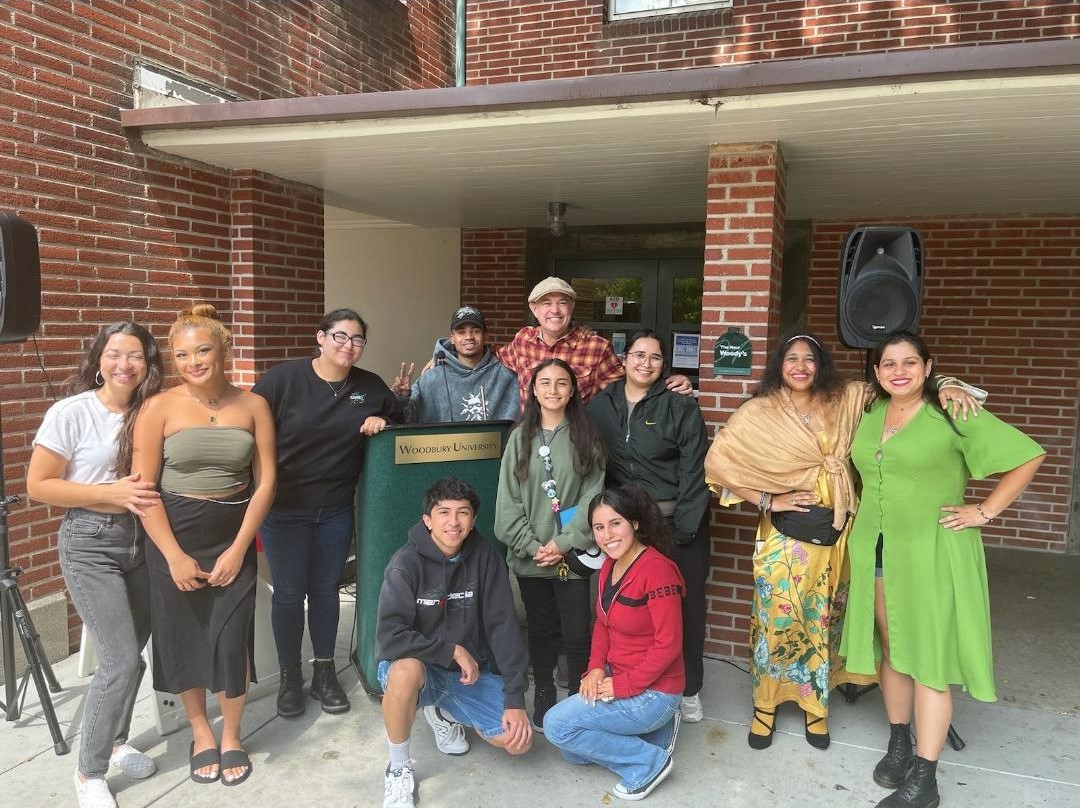
In the midst of painting the wall we held our twice a month open mic at Woodbury, Verse Come, Verse Serve. We started the series in January of 2019 holding it every two weeks, usually on Tuesdays in the school’s outdoor patio. In the fall of 2023 though we held it in the center of the quad next to the Woodbury Wall of Love under a massive jacaranda tree.
It proved to be an electrifying few weeks of painting and poetry. I have hosted open mics for two decades and at every school I have taught at and I have witnessed time and time again how students reading their writing aloud leads to civic engagement, whether it be students beginning to volunteer in their neighborhoods, hosting their own poetry events and in some cases I have even had former students that become architects and urban planners after they had begun studying and writing about the city. We also had staff members reading their writing alongside students. The focus was always collaboration and connection on campus.
Our first hosts for Verse Come, Verse were Aspen Leavitt and Laila Cooke-Campbell through the Spring of 2019. In the Fall of 2020, Aspen Leavitt was joined by Joshua Jones as the co-host before he graduated in Spring 2021. Aspen Leavitt remained the host all the way to their graduation in the Spring of 2022. Sarena Vazquez was the host for 2022-2023 and in 2023-24 our host was Jaclyn Navar. I have also worked closely on the series with Professor Linda Dove.
Co-hosting poetry events with Linda Dove has been one of the highlights of my teaching career. Linda is encouraging and generous to students and offers them a great example of how writing is a way of life that also teaches emotional intelligence and communication skills. She’s been a big part of Verse Come, Verse Serve.
The Birth of a Poet
We’d often invite guests from around the Los Ángeles poetry community to share their work with the students. One guest I invited last year was Daniel Yaryan, the founder of the Sparring with Beatnik Ghosts Poetry series. Yaryan was impressed with my students’ poetry. I told him that there are few things in this world that I love more than seeing the birth of a poet. As a result he said he had the perfect book for me by Willam Everson (1912-1994) with that exact name, Birth of a Poet.
When I read the book, I understood why Yaryan gave it to me. Everson was an influential California poet associated with both the San Francisco Renaissance and the Beats. He was also Yaryan’s mentor in the early 90s before he passed. The book mixed aphorisms with practical advice on how to become a poet and teach poetry. Among the pages and pages of Everson’s wise words, one of the most poignant passages was about holding sacred space.
Everson emphasized that writers and teachers need to create a sacred space to write and also share their work. He meditated on the idea and how this leads writers to finding their purpose. The following two Everson sentences express it succinctly: “In the recognition of a sacred space you are founding your world, endowing existence with significance. And in your recognition of vocation you are finding your purpose in life.”
Everson’s concept of sacred space is exactly why I always go out of my way to create sacred space in my classes, at open mics I host and even with a project like the Woodbury Wall of Love. When we create these spaces, we give people room to become bigger and better versions of themselves. We are giving them permission to express themselves and explore their voices and creativity in a world that does not always offer room for self expression.
Reading Everson in the thick of the hectic fall semester was just as inspirational as Christine Sinclair’s memoir. And Everson himself played the long game as a poet and professor, living to be 81 years old, publishing almost 30 books and teaching at UC Santa Cruz for decades. Everson and Sinclair are powerful examples for what happens when you persevere.
To me, this reinforced the importance of creating sacred space with events like Verse Come, Verse Serve. The series became especially relevant during Covid. We did it online and for that year and a half we were home, it was a refuge for student poets and faculty to hear each other and exchange energy.
Noah Munoz was one of the students that both painted the mural with us and read his poetry. ”Having participated in these events,” Munoz reflects, “helped me feel more connected with my school community and peers through the power and importance of creativity.”
While we were rocking our poems and painting the Woodbury Wall of Love I discovered in my independent research that the late great African-American Los Ángeles muralist Elliot Pinkney (1934-2019) graduated from Woodbury over 60 plus years ago. Pinkney had worked with Judy Baca on mural projects and he is known for large vibrant murals at Metro Stations, several local schools and all over Watts, Compton and Long Beach. His mural for the Mafundi Institute in Watts on 103rd Street is legendary.
As Jenise Miller wrote in 2020 for PBS So Cal, Pinkney also played a major role in the 1970s at the Compton Communicative Arts Academy. Reflecting on his legacy, I decided that we should paint a mural of Pinkney at Woodbury, especially because he passed away in 2019.
Woodbury is very much an art school with an award winning Animation Department as well as Game Art, Architecture, Game Design and Film. It occurred to me that to have a mural of a great muralist, let alone a Woodbury alumni like Pinkney on the Woodbury campus could be very inspirational to students. I got excited about the possibility of a mural honoring him. One of Pinkney’s most famous murals, located on 52nd street is titled, “Beacon of Hope.” Ultimately this is what murals and poetry provide, hope and considering the times we are currently in, we need more hope now more than ever.
Pinkney, like Sinclair and Everson, played the long game and when he passed away he had painted over 80 murals across Southern California. I really wanted to honor his legacy. The head of Woodbury’s art gallery Patrick Nickell agreed with me. Nickell’s ran Woodbury’s Nan Rae Gallery for several years and we have collaborated in the past on student art shows. He and I envisioned a mural of Pinkney on the north wall next to the gallery. We also discussed the idea of having a show of Pinkey’s prints in the gallery in 2025.
Words Matter
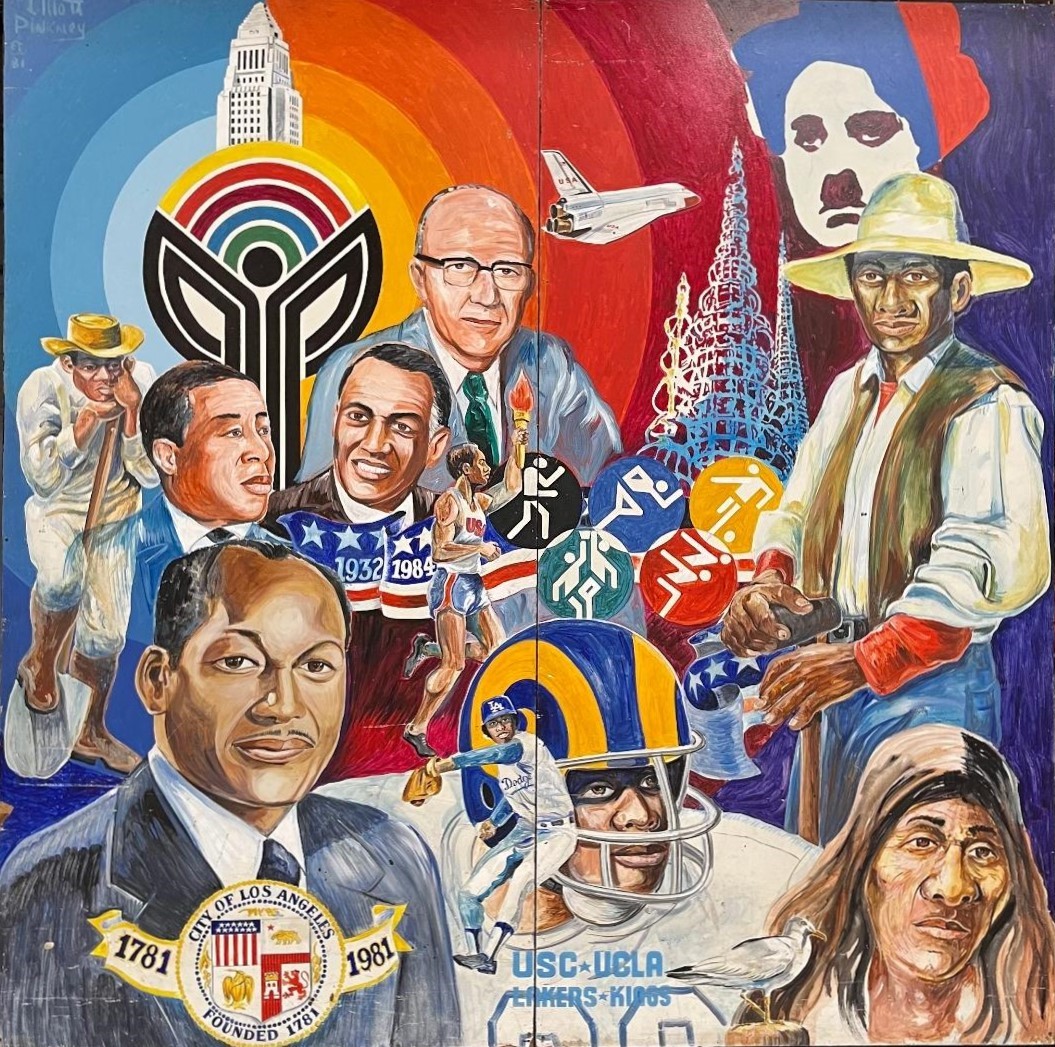
In a moment of further synchronicity, I was invited to a community center and gallery in Watts for an event in mid November called “Words Matter.” Held at the Watts Labor Community Action Committee (WLCAC) on Central Avenue there was a poetry workshop bringing together students from four high schools: Verbum Dei, Loyola High, Bishop Amat & St. Mary’s. I was invited by the poet and teacher F. Douglas Brown. Brown organized the event and also let me know that six large Elliot Pinkney paintings were on display at the WLCAC.
Before the reading and workshop we toured the WLCAC’s massive gallery and sure enough there were incredible Pinkney pieces as well as dozens of other paintings and sculptures by other artists, including one by Noni Olabisi. I took photos of Pinkney’s work reveling in the moment. It was a cycle of six interrelated paintings from 1981 that shined a light on Black Los Ángeles featuring individuals like Mayor Tom Bradley, Jackie Robinson, Kareem Abdul-Jabbar, Charles Mingus, Wilt Chamberlain, Elgin Baylor, Sportscaster Jim Hill, Sammy Davis Jr., and many others along with iconic Los Ángeles imagery like the Watts Towers, City Hall, the city seal and institutions like the Rams, Dodgers, Lakers, USC and UCLA. One of the works commemorated the 200th anniversary of Los Ángeles’s founding inscribed with 1781-1981.
To see Pinkney’s work that day was incredible synchronicity because his art had been on my mind all autumn while I was in the midst of trying to convince folks at Woodbury to let us paint a mural on campus honoring his legacy.
The poetry reading and writing workshop at WLCAC featured traci kato-kiriyama and Barbara Fant. These two stalwart poets kept over 50 students enthralled in a circle listening to their poetry before they led the group with some writing prompts. Barbara and traci spoke about their own long careers as poets and educators. Traci is the founder of the esteemed Tuesday Night Cafe Poetry series in Little Tokyo and an award-winning poet, playwright, actor, activist and audio book narrator. Her most recent book Navigating With(out) Instruments is from Writ Large Projects. Barbara is equally accomplished as a poet, activist and educator. Currently working for the Homeboy Art Academy she’s won poetry slams all over America and inspired thousands of students with her captivating poems.
Between listening to traci and Barbara and seeing the Pinkney paintings, I was deeply inspired. I was ready to go back to Woodbury University the next day to further explain why we needed to honor Elliot Pinkney in a mural on our Burbank campus.
Unfortunately, the school administration said there were too many other activities happening for them to hear my proposition or even understand why it mattered. A few months later I was still trying to convince admin to sponsor a mural of Pinkney when I got the news that the University of Redlands was acquiring Woodbury. Due to budget issues, I was also informed that gallery director Patrick Nickell, Linda Dove and I were not going to have our contracts renewed.
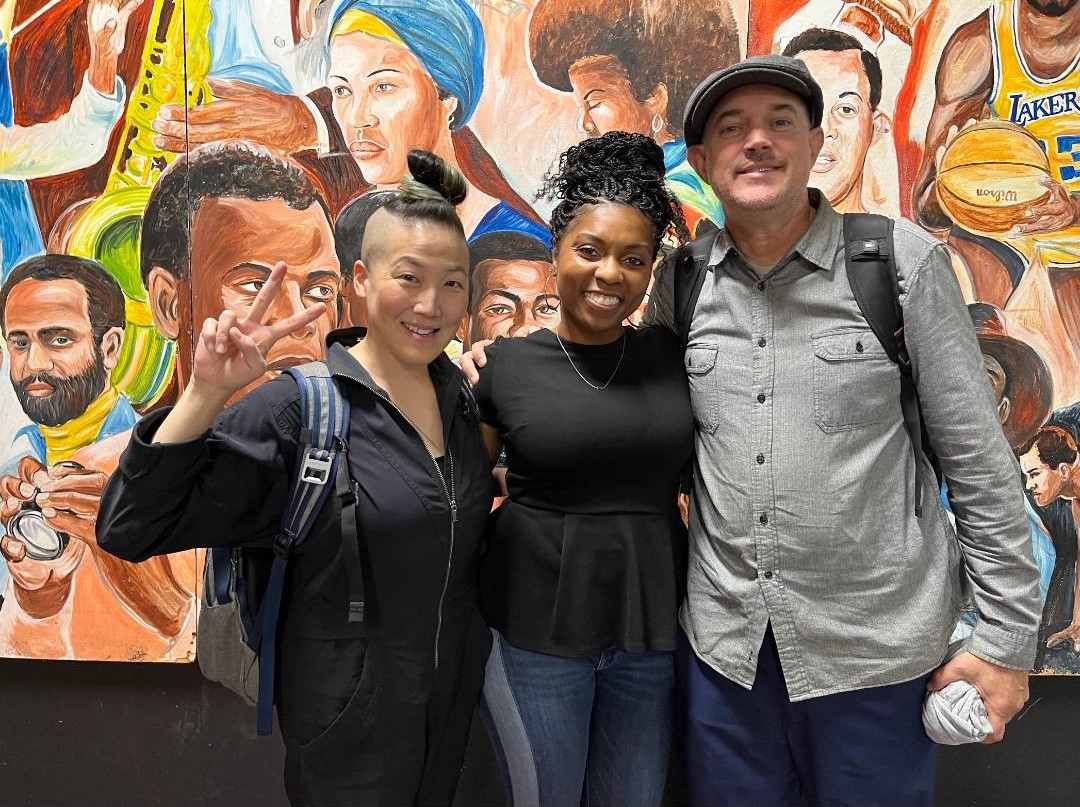
Linda and I have done dozens of events together over the last 7 years. I could not have asked for a better professor to collaborate with. Linda is a gem. And Patrick Nickell is equally magnanimous. Plus he’s the only person I have ever personally known that was awarded a Guggenheim. We had a blast co-producing student art shows together over the last few years. I’m going to miss our collaborations, but I am thankful that Patrick, Linda and I were able to do so much together.
Sometimes it happens like this. Rather than being too sad about being laid off or the era ending, I am just thankful we got to do everything we did. The school year ended in early May and on April 23rd, we had our final Verse Come, Verse Serve. We did not get to paint the Pinkney mural on campus either. Nonetheless, I am not discouraged. I am going to start another open mic series at the next school I teach at and I still hope to instigate an Elliot Pinkney mural somewhere as well. To bring it back to Christine Sinclair’s memoir, I’m playing the long game. We are not done.

 Los Angeles Literature