

Lisbeth Coiman is a Venezuelan American poet and writer whose called Southern California home for close to a decade. Having arrived in L.Á. after living in Oklahoma, a place she never wants to return to—“Oklahoma sits a bit too conservative”—she’s finally able to call SoCal home.
She built this home from scratch. Through her lifelong love of language and literature, which she studied in college in Venezuela, it was a social linguistics class she took, reading the likes of “June Jordan and Sonia Sanchez, Nikki Giovanni, and Gwendolyn Brooks,” that brought her to life. It was the first time Coiman could connect to the literature she read. “‘This is real; these are people like me,’” she said in a Coachella Review interview.
That’s why, in part, she sought out SoCal’s local literary community. The love of language was still there. Plus, with the region’s vast ethnic diversity, Coiman was able to carve out a little bit of home by finding the salsa dance community. According to the Wikipedia entry on salsa dancing, there is even a Los Ángeles style that Coiman calls “flamboyant.”
“Everywhere I turn in Los Angeles,” Coiman said in the a Shoutout LA interview from 2022, “poets and writers have helped me and opened opportunities to me that I could only dream of 20 years ago when I first arrived in the USA.”
This community Coiman has built formed slowly, as the isolation of Southern California’s vast geographic landscape, and the isolation of being stuck at home, alone, during the COVID-19 lockdown, caused the connection to community to feel tenuous. That she was not a part of the landscape. Still, “I am most proud of the way I have built a community from scratch.”
One way she’s done this was by partnering with prominent local poet and American Book Award winner Peter J. Harris, whom Coiman had bonded with as he coach her through the process of writing and assembling her debut poetry collection Uprising/Alzamiento (Finishing Line Press, 2021). The collection draws attention to the Venezuelan humanitarian crisis, by asking some heavy questions human’s often shy away from: How do we respond to human suffering? How are we complicit in allowing it to occur?
Recently, I asked Lisbeth Coiman about the influences on her writing, local and otherwise and how they’ve shaped her work.
The interview has been slightly edited for accuracy.
Brian Dunlap: Who were the original influences on your writing? Poets, writers, maybe even musicians? Teachers? Why and how have they influenced your writing?
Lisbeth Coimen: In the beginning, I was a reader.

As a child and early teen, I read Spanish classics both in fiction and poetry. In my first years in college, I delved into Latin American literature: Garcia Marquez, Juan Rulfo, Quiroga, Vargas Llosa, Cortazar, Carlos Fuentes, Octavio Paz, Mario Benedetti, Cesar Vallejo and Roberto Juarroz. Towards the end of my 15 years of effort to graduate from college, I was reading mostly in English. Then, I took a class called “Language & Society,” which was an exercise in sociolinguistics. In that class, we analyzed how language is still used to perpetuate post-colonialist oppression and how writers use language as resistance. I read Chinua Achebe and Njabulo Ndebele. For the first time I read African American writers which were up to that point excluded from all the literature classes I had taken. I was reading the poets who were invited to the World Stage as readers, thousands of miles away in Caracas. Isn’t it fantastic how we are so connected?
I fell in love with June Jordan, Le Roy, Nikki Giovanni, James Baldwin, Langston Hughes, Lucille Clifton, Gwendolyn Brooks, Phillis Wheatly, and so many others, both in fiction and poetry, but mostly women poets. Eventually, I chose to write my undergraduate thesis on the poetry of Sonia Sanchez because I identified with her anger. She was perhaps the angriest of the civil rights poets. And I was an angry woman in the early 90s. I dived deep into African American culture to analyze her conversational style, spoken word poetry, the elements of call and response in her work and its political message.
By far, Sonia Sanchez has the greatest influence in my vertical poetry. From her, I learned that even a love poem can make a political statement. Under Sanchez’ influence, my work becomes a call for action, not a dead document on a page waiting to reveal its meaning to elitist readers. In my poetry collection, Uprising/Alzamiento her touch is present in poems like “De Mujer a Mujer” a spoken word piece encouraging my people to revolt against the Venezuelan regime. The entire collection is my platform to create awareness about the humanitarian crisis in my homeland. Some of my most meditative work is strongly influenced by Roberto Juarroz.
Dunlap: Dunlap: What local writers, past or present, have been influential to your writing and/or you’ve fallen in love with? In what ways have they been influential to your writing and/or in what ways have you fallen in love with their work?
Coiman: I learn from Peter J. Harris and S. Pearl Sharp the most. They are the two poets I look up to when I doubt my craft and even my involvement in the community. From Peter I have learned to strive for excellence in my work, to reject the comfort of mediocrity. A year ago, I pulled out of a contract because I wasn’t satisfied with my work. From Pearl I have learned the economy of our literary work, to refuse trading our art for a stroke of the ego. Art is the result of hard work and as such must be paid because, in her own words, “poets pay rent too.” Pearl’s leadership commands authority. She is an innovative, multi-faceted artist, always leading the way in the different realms where poetry takes the center stage, whether in her written work, her performances, or her films. I admire her and wish I could attend all her events and read all her work.

I have an eclectic taste in reading. I read anything, from the YA cozy sleuth by Jennifer Chow to horror fiction by Kate Maruyama, historical fiction by David Rocklin, from noir poetry by Suzanne Lummis to spoken word poetry by Sean Hill, to memoir by Cassandra Lane, to journalistic research by Melissa Chadburn, to romance by Aurora Rose Reynolds, to philosophy—I am interested in Stoicism. There was a time when I couldn’t wait for Margaret Atwood’s next book or any other ultra-famous writer.
Dunlap: What writers do you read today, whether poets, essayists, novelists or others? What draws you to their work?
Coiman: Today I read mostly my peers, or writers I look up to as role models. I buy the books and place them in a pile on my coffee table without any order. I read the good, the bad, and the ugly, always hungry to learn something new, how different writers and genres use language to do different things. Today I might finish a book of poetry and then grab a novel. To give you an idea, I have read all of Peter J. Harris’ poetry collections and all of Jennifer Chow’s cozy mysteries, two worlds apart. This year, I am interested in Ada Limon, Lynne Thompson, S. Pearl Sharp, Louise Glück, Javier Zamora, Suzanne Finnamore, Myriam Gurba, and Rosebud Ben-Oni. I miss reading in Spanish, though. I am making a commitment with myself for 2025 to read only in Spanish.
Dunlap: From your engagement in the local literary community, what are your honest thoughts and opinions about this community, good, bad or otherwise? It’s issues. It’s positives and anything else?
Coimen: I am lucky to have come to L.Á. at this stage of my life, free of personal entanglements. I am at liberty to enjoy what our literary community has to offer. At the beginning, I felt like a kid in a candy store, with so many options available. It was difficult to decide what to do. I learned early on to move around the different geographies to hear the diversity of voices around town. I have gone to the Valley and to San Pedro, to Malibu and to Highland Park, to Leimert Park, to Little Tokyo, to Venice. And wherever I go to an open mic, or a feature, or a book release, there is always the opportunity to hear something captivating, engaging, transforming. I love to bathe in the luxury of our diversity.
I think poets and writers must move around the city to allow themselves to be influenced by the richness of our diversity. If you only relate to a specific group, or style, there comes a point when you are repeating yourself, doing the same thing over and over. It’s ok to have a niche, do one thing so good that you become an authority in that thing. It is probably the equivalent of specialties in medicine or engineering. If you are a metal engineer, you don’t know about bioengineering. Or like many primary care physicians, which I have learned the hard way, who don’t deal with mental health issues. Instead, I love wandering around, experimenting with styles, techniques, letting myself be influenced, or trying something completely new. Maybe because I came here so recently, I must try everything before it’s too late.
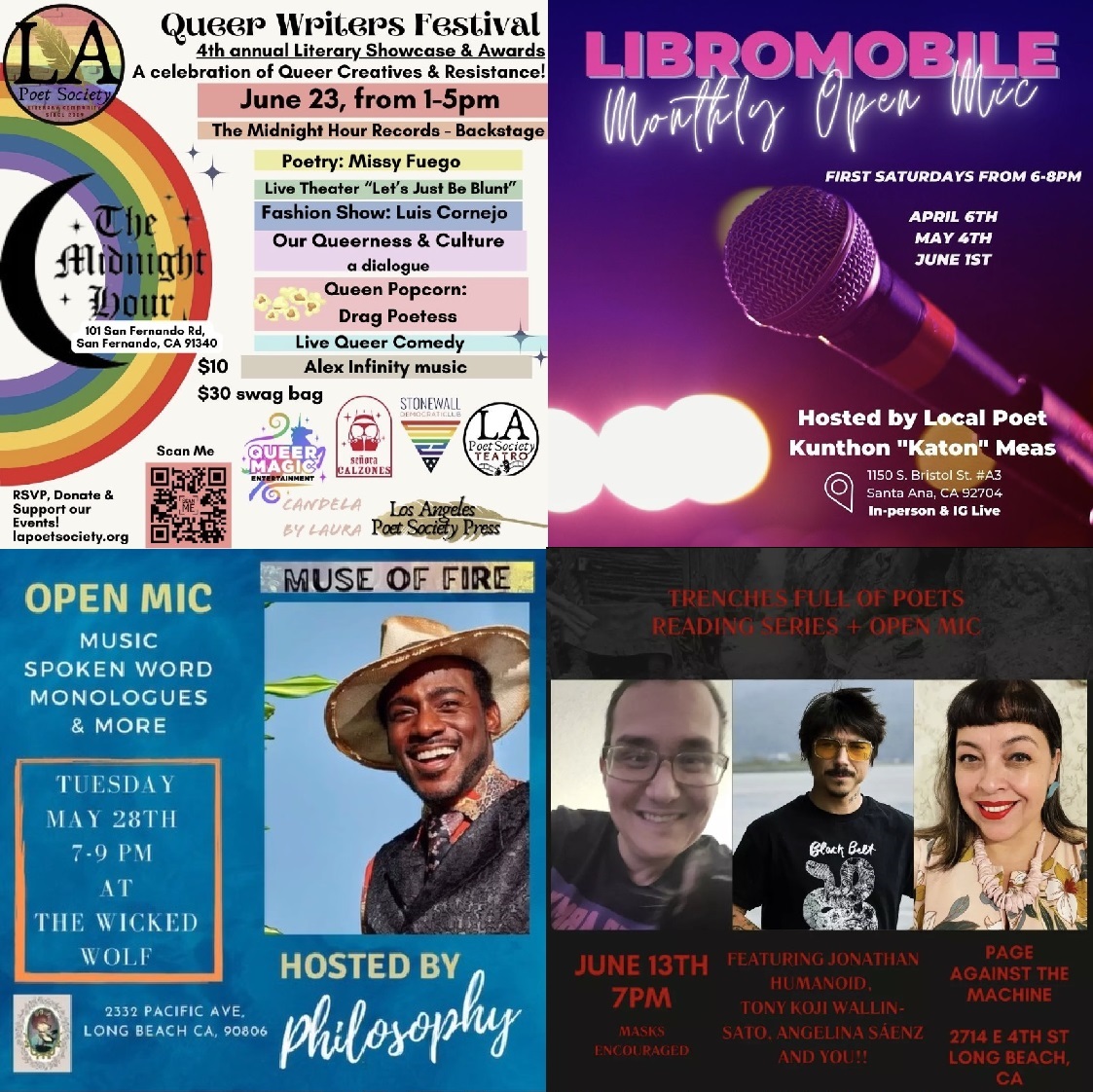
However, there are so many opportunities to participate that the novice may soon forget that to read one poem in front of a mic, one must first spend hours writing. There was a time, especially during the pandemic, that I needed to be hyper-involved to survive the isolation of 2020 and 2021. I participated in every zoom event. And I was also promoting a book, so I went at it with hunger. I am grateful for every opportunity I’ve had then to reach a wider audience.
Most of the poets I’ve come to admire have been in the scene for over 30 years. They had a lifetime to build this community. To try to emulate that in my short experience in Los Ángeles is impractical and unrealistic. I don’t have that many hours in a day anymore. After all, I am a working woman, on my own. I am committed to my art, but also determined to retire with dignity, not destitute. I don’t share the romantic notion of a starving artist. I must first and foremost take care of my basic needs for housing, nutrition, and health, before I decide to spend any time involved in my community.
I am glad I am not afraid to disengage to look for other experiences or simply take care of myself. It will take another 30 years to build my own community. I don’t know if I had so many years in me, but I am going to try one poem at a time.

 Los Angeles Literature