

I arrived in Long Beach at the 3rd Annaual Festival of AAPI Books on a gloomy May Saturday. The first panel in the Community Room, at the Michelle Obama Library, featuring Pete Hsu, Rooja Mohassessy and Shadab Zeest Hashmi was nearly over. There was also children’s writers reading in the library’s Tween Space featuring Rachell Abalos and Our Nipa Hut.
The festival took place on the first weekend in May, the same weekend as four other local book festivals in Southern California: LitFest in the Dena, Heavy Manners Literary Fair, week one of the 3rd Pomona Valley Book Fest at the L.Á. County Fair and the Viet Book Fest in Santa Ana.
The small book fair in front of the library’s main entrance featured Long Beach’s Bel Canto Books, owned by Filipina Jhoanna Belfer, selling books by the featured authors. The festival was the brainchild of Belfer and her friend Cathy De Leon, Library Director of the Long Beach Public Library. They wanted to showcase and promote Asian American, Native Hawaiian and Pacific Islander stories, histories and contributions in the literary field, through the local AAPI literary community and out into the nation’s AAPI literary community as a whole. It’s part of the never ending effort for communities of color to showcase their non-stereotyped and diverse stories and voices that continue to be marginalized, ignored and misrepresented across the United States.
However, I was invited to the festival by Alixen Pham, poet and volunteer Adult Author Coordinator for the festival in charge of curating local and national AAPI adult authors. This year’s festival featured Pulitzer Prize winner Viet Thanh Nguyen, California Poet Laureate Lee Herrick, host of LibroMobile’s open mic Kunthon Meas and Gina Apostol.
Also apart of the bookfair was Gloo Books, “an independent publishing company,” founded by Karen Chan, “that creates beautiful, high quality children’s books for a more inclusive, just and compassionate future,” its website says and Bitty Bao Books, a line of Chinese bilingual board books for children founded by former LAUSD elementary school teachers Lacey Benard and Lulu Cheng.
More could have been done with the book fair to highlight SoCal’s AAPI portion of the local literary community. There were a few other venders in the small walkway that sold plants, treats and other merchandise that had nothing to do with literature, but were local businesses, such as KUBO, a Filipinx-led collaborative collective workspace. They were invited because Bel Canto has 400 Square Feet of retail space inside the collective. However, not nearly enough of the public knows about the local AAPI literary community, and such a festival focused on highlighting their literature is an excellent opportunity to engage and inform the wider community. Inviting local community organizations, open mics and independent presses such as Sunday Jump, Tuesday Night Project and Kaya Press for example, would engage the wider community in the vibrancy of AAPI literature in a region with such a prominent AAPI population.

When I arrived, there was a decent sized crowd. While I browsed the Bel Canto table as I waited for the second adult panel to start at 12:30pm, young Asian women perused the table, picking up a book or two to flip through before Belfer’s husband engaged them in conversation about the bookstore and the festival. Connecting with the community.
I wanted to attend the second panel because Lee Herrick was one of the three featured writers, along with Carolyn Huynh who grew up in Orange County’s Little Saigon community, and Kunthon Meas. Before they engaged in a conversation about identity, community, history and family and Herrick discussed his identity as a Korean adoptee, they each read from their work. Instead of Meas sharing poems, he read an essay he’d published, about how critical thinking has lost its edge, hurting our ability to engage in and understand what it means to be human. He tied the discussion to his family and his Asian identity as a first generation Cambodian American and to what society is currently going through, such as the prevalence of misinformation and the ills of technology such as AI.
During the discussion Huynh said she creates her Vietnamese female characters around the women she grew up with—her mother, aunties, their friends. It helps her to create distinct characters, to show the diversity of who they are. The ones she didn’t see portrayed in the media, to move away from the few archetypal portrayals that continue to be recycled.
The panel was about half full and afterward, the crowd at the bookfair had thinned out. I didn’t care to see the next panel, but I stayed, waiting for the keynote speakers, Viet Thanh Nguyen and Gina Apostol, to close out the festival.
The Festival of AAPI Books was small despite the Michelle Obama Neighborhood Library’s large size. The library was renamed the Michelle Obama Neighborhood Library when it moved to its current location on Atlantic, in North Long Beach, to a 24,655-square-foot state-of-the-art building, on September 10, 2016.
Only 18 authors were featured. But in an email response to several questions I asked, Pham said, “I envision the festival growing in size and reach with opportunities for more AAPI authors to participate; for businesses to support the AAPI communities through sponsorships so we can pay organizing expenses, including paying authors market rate honorariums; [and] for small AAPI organizations to participate and promote their various works for the AAPI communities.”
It was the intimate size of this year’s festival that fostered a laid-back, approachable vibe that made it easy to interact with the authors, who were eager to chat with attendees. That was until a crowd started to form near the community room for the keynote talk. The community was coming out to hear a Pulitzer winner in conversation, a big name author that hinted at where organizers wanted the festival to go.

As Pham told me, “I would love for [Festival of AAPI Books] to be as well-known and popular as [the] L.A. Times Festival of Books with the financial backings necessary to invite and host world-renowned AAPI authors as well as local writers and poets.” For the festival’s biggest name, the community room was ninety-percent full. The conversation kicked off with a clip from the newly released HBO show “The Sympathizer,” based on Nguyen’s novel of the same name.
As a political novel centering on the Vietnam War from the perspective of the communist North Vietnamese, the talk began politically and remained that way throughout. Nguyen touched on the artistic choices he made in the book and those the show’s creator, Park Chan-wook, made in the show. An artistic choice in the show was to mirror and comment on the classic racist trope that all people of color of a certain race or ethnicity look alike, so Chan-wook flipped the script and had a white actor, in this case Robert Downey Jr., play all the white roles.
Later, as they touched on how to write realistic characters, Apostol explained that to her, understanding others, especially people she vehemently disagrees with, is not being empathetic or showing them empathy, it’s to understand that’s how the world has shaped them, that their circumstances reflect back on the state of the world. Having been born and raised in the Philippines, she used the example of Imelda Marcos, wife of former Dictator Ferdinand Marcos, who used her position as first lady and governor of Metro Manilla to plunder government coffers to obtain personal wealth during a time of crushing poverty in the Philippines.
Nguyen also spoke about the recent controversy surrounding how USC, where he is a Professor of English, American Studies and Ethnicity, and Comparative Literature, handled the peaceful pro-Palestinian student protest on campus. He punctuated the protest’s peaceful nature by retelling how he wandered around the encampment noticing students engaged in teach-ins, studying for their upcoming finals and stayeing motivated to continue their fight in support of the Palestinian people, to stop the genocide and for the university to divest its endowment from companies that support Israel and weapons manufacturers.
The conversation’s atmosphere was one of need, for the audience to have public figures speak so honestly and directly about these current events and writing politically—speaking out—that somehow all tied together organically by the end.
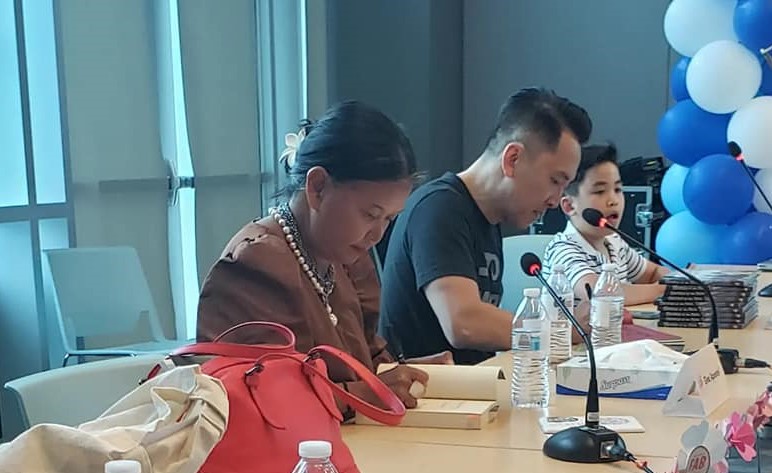
At conversation’s end, Nguyen introduced his young son Ellison, announcing that his son would be signing copies of the children’s book Chicken of the Sea, that they wrote together. He sat beside his dad with pen in hand ready to sign the book about a band of chicken pirates. With the conversation over, a long line formed down the center of the community room, pointed towards where the two authors conversed, fans eager to interact with and grab Nguyen and Apostol autographs.

 Los Angeles Literature