

Three months into 2024 and the literary community has been busy creating and fostering relationships. Hosting events to build solidarity. To build solidarity as best as one can in a community that stretches far and wide, from L.Á. and Orange Counties, to the Inland Empire in the East.
This vastness at times, coupled with our famous congested freeways, too often confines us to our neighborhoods. Keeps our travel close to home. That, along with the lingering effects of redlining, our work and families, can cause Southern California to feel lonely, for us to feel alone. Isolated from community just outside our windows.
Yet, as poet and co-host of Trenches Full of Poets, Mauricio Moreno, tells his audience each month at Page Against the Machine in Long Beach, his favorite part of the night is after the open mic is over, when everyone is able to converse, to connect with each other, the night creating and fostering relationships. When we feel less alone.
One of the first big literary parties of the year took place at the World Stage in Leimert Park on January 17. It was Poets of the World Stage Press Wednesday at the Anasi Writers Workshop where, every third Wednesday of the month, the press takes over the open mic for the release of their newest publication. In the cultural heart of Black L.Á. From a press dedicated to the creation and proliferation of African American Literature, especially the Black voices from the local community.
Ebony Morgan was celebrating the release of her debut collection of poetry Flat Soda for Roses. On stage, behind the microphone, was a wall of pink flowers with an arch. In front of the arch is where the night’s readers read. Lit up in the middle of the bank of pink were the glowing pink cursive words Flat Soda for Roses. The collection “invites the reader on a poetic journey of transformation, resilience, and self-discovery,” it says on the release party’s Humanitix event listing. “This debut collection of poetry is a testament to the power of finding strength within oneself, even in the face of adversity.”
Before and after the book release, to the left of the stage, a DJ spun records.
When the readers took the stage—open mic readers, the readers Morgan invited such as Carlos Ornelas and Morgan herself—the lights were dimmed like in a romantic restaurant. The title of her book glowed seductively from the stage.

At one point during the reading, Morgan explained the meaning behind the book’s title. “Like a withering flower, we may at times find ourselves buried in the soil of life’s challenges,” it also explains on the Humanitix event listing. “Yet, within that darkness, lies the potential for rebirth. Just as flat soda can revive a wilting flower, we too can find the remedy to breathe new life into our own existence.”
When the night ended and the DJ returned to spinning records, many in the packed crowd made space among the rows of chairs to turn the World Stage into club and took to the dance floor.
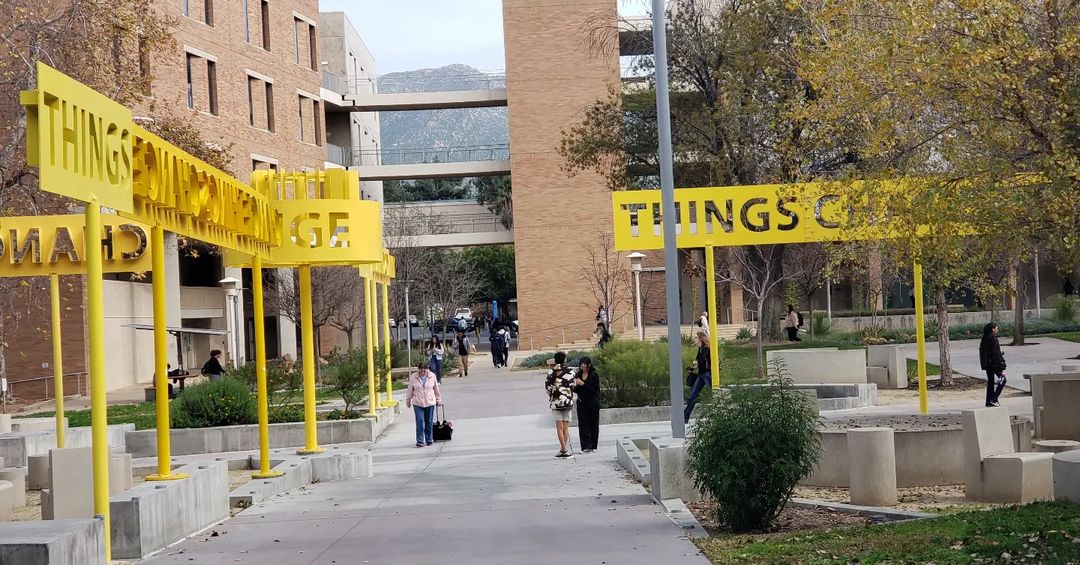
On February 10-16, the 47th Annual Writers Week took place at UC Riverside. It featured authors both famous and not, ones who are prolific and ones who had recently published their debut books. Free and open to the public, Writers Week is hosted by the university’s Creative Writing Department to provide students the opportunity to meet and connect with published authors, who will hopefully one day, become their colleagues. As in years past, events ranged from readings, to conversations, panels, and social activities, all focused on the widely varied and exciting work of the featured authors, some from among the university’s Creative Writing Department.
This year, as in years past, Writers Week featured local writers such as poet, professor and Bell Garden’s native, Vickie Vértiz; poet, Santa Ana College professor and Corona native Donato Martinez; poet and Executive Director of the Inlandia Institute, Cati Porter, poet and Southern California native Jose Hernandez Diaz; and fiction writer and Los Angeles Review of Books Editor Lisa Teasley, among others.
Each conversation, panel, and reading took place in Interdisciplinary South room 1128, a regular size lecture hall, next to the Athletics and Dance building which houses Johnson Family Practice Center. Each event I attended was hosted by a different graduate student, who, after each author read an excerpt from their work, asked 1-3 questions, then opened up the conversation to the audience. There was enough time between events for attendees to chat with the authors and buy their books.
The events this year didn’t have titles, but the two I attended took place on Friday from 11am – 12:30pm, featuring Kate Bolton Bonnici, Donato Martinez, Cati Parter and San Diego Poet Laureate Jason Magabo Perez and from 1pm – 2:30pm, featuring Reza Aslan, Minda Honey, Vickie Vértiz and Issam Zineh. Hearing Issam Zineh, a Palestinian American poet and scientist read, to hear his perspective and his voice, was especially powerful, considering the genocide currently being perpetrated against his people in Gaza.
The one major downside of Writers Week is that it occurs during the day on weekdays when students have class and the public is at work, making it challenging for people to attend. Otherwise, the festival is low-key (one event at a time), making it easy to meet and converse with the authors who are more than happy to meet the audience.
On February 28, The Book Rack, a beloved used-bookstore in Arcadia, “tucked between a hot pot restaurant and a chiropractor’s office” according to the Los Angeles Times, closed after 40 years.
Karen Kropp, the store’s owner for the last 20 years, saw sales slowdown when consumers shifted to online shopping and saw them dwindle even further during the pandemic. When the world reopened, she was only able to hold on by the skin of her teeth by cashing out her life insurance policy. Now, nearly 79, she realized it was time to retire.
“‘I put everything I had into this place,” Kropp told the Times. “Everything.’”
In its early years, The Book Rack was often busy and according to The Times, “[t]hey often did more than $10,000 in sales per month.” This enabled Kropp to hire “local high school students to help run the shop,” though “she manned it alone most of the time, working 10-hour shifts.”
At the end, Kropp realized her work started to feel like a job and she had left no time for herself.
As Karen Kropp could no longer afford to keep the store open and could no longer afford to live in California, she closed The Book Rack, only memories able to sustain it anymore.
On March 22, Re/arte, the bookstore and cultural center located in Boyle Heights, announced on social media its new chapter “as a joint venture of three independent book publishers—El Martillo Press, Libro Abierto Press, both LA-based publishers and Black Freighter Press, San Francisco-based publisher!” For nearly three years Re/arte has served the Boyle Heights and Los Ángeles literary communities, providing space where readers, published authors, writers and poets “from different regions including LA, SF, and México…bring timely discussions on political thought, contemporary art, and literature with a focus on Chicana/o/x, Mexican, Latin American, and Black imagination.”
According to Re/arte, these publishers “are…independent, not backed by institutions or the Big 5.”
El Martillo, founded by Southern California natives and poets Matt Sedillo and David Romero, published its first books last year, focusing on voices from California and the borderlands. Their authors include Pomona Poet Laureate Ceaser Avelar and Palomar College Professor Sonia Gutierrez.
San Francisco based Black Freighter Press, co-founded by Tongo Eisen-Martin, San Francisco’s Eighth Poet Laureate and Alie Jones, a self-care advocate, writer and Creole mermaid, according to its website, “publishes revolutionary books. [They] are committed to the exploration of liberation, using art to transform consciousness. A platform for Black and Brown writers to honor ancestry and propel radical imagination.”
Libro Abierto Press, Re/arte’s publishing arm, founded in 2023, is “dedicated to advocating and showcasing Chicanx (including Mexican, Central American & Latin American) literary arts.” They publish sin cesar literary magazine, founded by Viva Padilla, founder of Re/arte.
According to Re/arte’s Instagram, “Together, the publishers seek to work together to bring about a liberated imaginative space free from the tethers of institutions.”
West Hollywood Poet Laureate Jen Cheng is a person that builds bridges. As a queer Asian American woman, she’s passionate about creating spaces where all feel safe and respected, where everyone can be themselves and share who they are. In the literary community, that manifests in the bi-monthly literary series Palabras Literary Salon, at Latinx with Plants in Boyle Heights.
Palabras’ mission is to create intergenerational and intercultural community building, inspired by the consciousness raising of the civil rights elders and Maya Angelou’s salons. Attendees sit in a non-heirarchical circle, without a stage, as the curated guest reader list representing the sprawling diversity of the literary community, reads on that session’s theme. The guest readers’ are broken up by a featured reader.
In a region (Greater Los Ángeles) that’s 71.9% people of color and is famous for its LBGTQIA haven of West Hollywood, the feeling still persists that there are not enough of these welcoming intercultural community literary events that aren’t LGBTQIA and race and ethnicity focused. That are specifically for building holistic solidarity.
The March 17th edition of Palabras continued Cheng’s efforts of intergenerational and intercultural community building through literature. Several poets I know—Lisbeth Coiman, an older Venezuelan immigrant; Arthur Kayzakian, Arminian; Angela Peñaredondo, LGBTQIA Filipino and Cynthia Alessandra Briano, Chicana—along with Black and native LGBTQIA writers, were some of the diverse voices who read under the open air canopy on Latinx with Plants’ patio as part of the curated list of guest readers. They made it known how important this event and events like it are to them. To be heard. To be seen. To be respected.
The feature, Rooja Mohassessy, an Iranian born poet, read from her debut collection When Your Sky Runs Into Mine (Feb 2023). She also brought the Genocide in Gaza into the patio, so as not to forget the destruction, the violence, that is destroying Palestinian lives, especially to the women and children and to remind us all to continue to speak out and advocate for peace. Mohassessy went on to read poems about her parents, her family, her Iranian history, memories, focused on the women.

Once the reading was over, Cheng encouraged everyone in attendance to introduce ourselves to someone we had yet to meet. to foster and create new relationships, to continue to build solidarity.
In March, Get Lit—Words Ignite, was awarded $1 million from MacKenzie Scott’s Yield Giving as one of their Yield Giving Open Call awardees. Awardees are community-led organizations that work with people and in places experiencing the greatest need in the United States.
Get Lit is a Los Angeles-based education nonprofit founded in 2006 by author and educator Diane Luby Lane, that uses spoken word poetry to increase teen literacy and student engagement while providing valuable career training in the arts. Through in-and after-school programs centered on classic and contemporary poetry and multi-media expression, Get Lit advances education, promotes literacy, and offers opportunities for young people to create community and raise up their authentic voices. Their programs include free poetry, performance, music, filmmaking and screenwriting workshops for under resourced Southern California youth ages 12-19.
Yield Giving launched its Open Call last year and from a pool of over 6,000 applicants awarded $1 million each to 361 community-led non-profits whose explicit purpose is to work to advance the voices and opportunities of individuals and families of meager or modest means, and groups who have faced discrimination and other systemic obstacles.
“This money will allow us to deepen our work and expand our reach” to “close the literacy gap while improving youth mental health,” said Founder and CEO, Diane Luby Lane in Get Lit’s press release. They will be able to provide “more arts in education to students throughout Los Angeles County and beyond.”

 Los Angeles Literature