
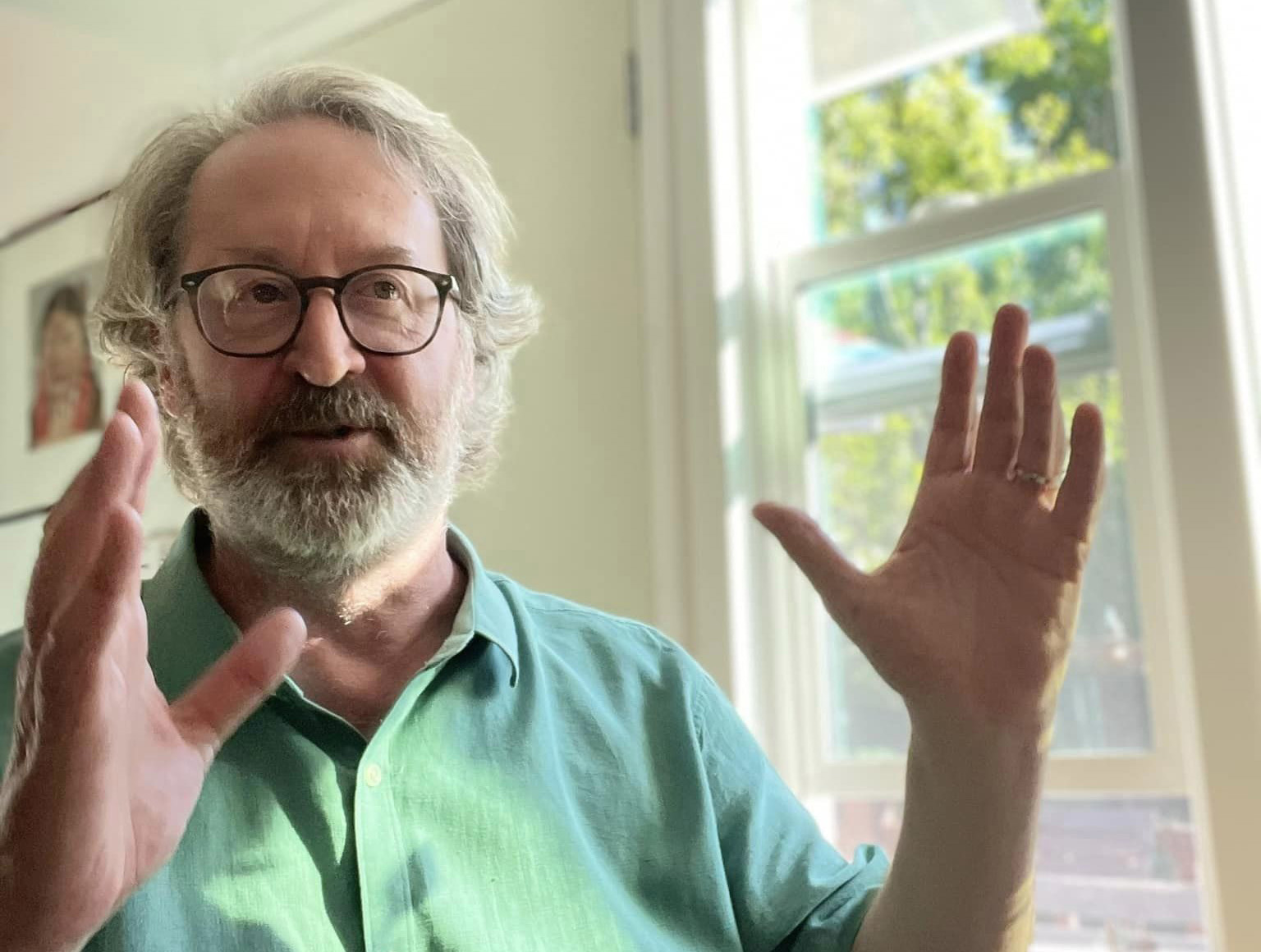
In 1983, Jeff Rogers arrived in Los Ángeles with his friend and writing partner John Matson, after basically loading everything that mattered to them—crates of records, boxes of books, their typewriters, etc.—into Rogers hand-me-down, rust-fringed, white Chevy Malibu. The reason: to become rich and famous screenwriter poets. As they both loved movies and poetry, their plan was to make a living writing scripts, so they could write poetry for the love of art.
But, before leaving Michigan, Rogers had dropped out of college because he had this romantic notion, as he said in an Poetry.LA interview “that one couldn’t learn to be a writer in school.” He was “kind of a believer in…the Jack London school,” where one had to go on adventures, work lots of strange jobs and meet lots of interesting people to have enough material to write about.
After arriving in L.Á., as with the best laid plans, Rogers and Matson ended up dividing the labor, and Rogers just kept writing poetry. The Hollywood dream of fame and success never materialized.
In the intervening 40 years, Rogers has found Los Ángeles to be “an incredibly rich place” that he’s always loved, leading him to write a lot of poetry about the city. But it took him nearly 40 years before he published his debut collection Right Wrong Night Song (2022) from World Stage Press, about the freeways and neighborhoods of Los Angeles, the BLM protests of 2020, nature’s terrible beauty, and wordless internal landscapes, to capture telling moments of human behavior in all our messy glory.
Recently, I asked Jeff Rogers about the influences on his writing, local and otherwise and how they’ve shaped his poetry.
The interview has been slightly edited for accuracy.
Brian Dunlap: Who were the original influences on your writing? Poets, writers, maybe even musicians? Teachers? Why and how have they influenced your writing?
Jeff Rogers: How young was I when mom began reading to me every night before bedtime? The magic and music in the stories and her voice as I sank into the couch with nighttime coming down through the picture window cast a spell over me from which I’ve yet to awaken. Most delicious: the stories with poetry and magic. Poems, spells, and incantations are kissing cousins. Winnie-the-Pooh, Dr. Seuss, The Wizard of Oz, A Child’s Garden of Verses by Robert Louis Stevenson; a collection of world fairy tales called East of the Sun and West of the Moon. And supremely: The Hobbit and The Lord of the Rings, where the poetry brought dimension and texture to Middle Earth: the drinking songs, adventure ballads, road ditties, and elvish spells—the oral history and everyday news of a living world.
Every tale must have a teller and somewhere early on I began to catch glimmers of these wizard weavers of words and nurse the desire to learn their lore and practice their ancient arts.
Once you become attuned to poetry you find it everywhere. In my late 60s/early 70s childhood I heard it in the music: “Puff the Magic Dragon,” Dylan, Simon & Garfunkel, Beatles. With my parents active in the civil rights movement and daily injections of the Vietnam War and Watergate coming into our living room, songs like “Blowin’ in the Wind,” “Revolution,” and “Ohio” sang to me that the stuff of politics is the stuff of our lives, in no way separate from art and poetry—which are big as the world and can hold everything in it.
So, when I got fired up by Ferlinghetti’s Coney Island of the Mind to start writing poetry seriously myself at about 20, politically engaged poetry seemed natural to me. Other key influences in my early poet years: Lewis Carroll, Richard Brautigan, Bukowski, and Gary Snyder. In about 2014 after Trayvon Martin and Michael Brown, I became acutely aware that in fact my real world concerns around racial justice were missing in action from my work and that’s when I set myself the task to write poetry that investigates race and whiteness without writing bullshit—and struggled toward some of the poems and the essay-afterward you can find online and in my book Right Wrong Night Song, published in late 2022 (World Stage Press).
Dunlap: What local writers, past or present, have been influential to your writing and/or you’ve fallen in love with? In what ways have they been influential to your writing and/or in what ways have you fallen in love with their work?
Rogers: I’ve been writing in L.Á. scene since 1983—forty years of loves and influences—some directly on my writing by teaching or inspiration; some by showing me the arts as building blocks for community.
In 1986, Mira-Lani Perlman (later Oglesby) looked over a chaotic story draft of mine and said all that matters are voice and structure. She was a genius of both, so I listened. Essential L.Á. poet and teacher Laurel Ann Bogen in her Sunday morning workshop would often scan a poet’s first draft, point partway down the page and say, “The poem starts here,” knowing that our first lines are often how we find our way in. During a Drunken Masters New Work Series event, Rocio Carlos once said there’s a gap of mystery between a poem and the reader, and another gap of mystery between a poem and its title. Gaps of mystery—I love that. Sara Borjas on another Drunken Masters night said when revising a poem she asks three questions: Is it honest? Is it specific? And when can silence do as much as speech? Words to shape words by.
L.Á. can be a tough place when you first arrive from somewhere else. I’d been here three years when Mira-Lani became my entry point into the literary scene. A charismatic collector of people, she gave me my first reading in spring of 1986 at a long-gone café near USC called the Cloisters, then deployed me in a series of crazy-brilliant performance projects. At last L.Á. felt like home.
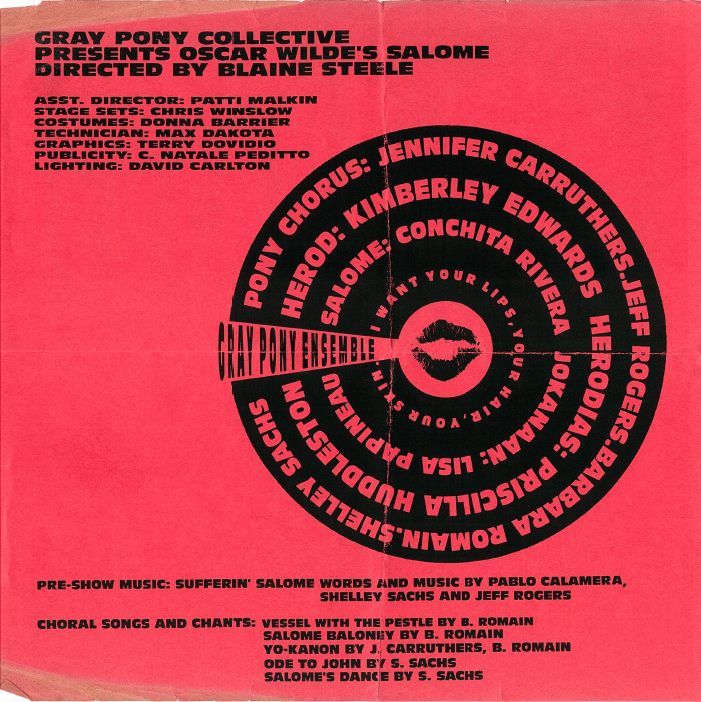
Through Lani I met artist Barbara Romain—who sadly died in early January, 2024—and her husband, Christopher Natale Peditto. Chris was a New Jersey-born poet who came up in the Philadelphia scene. In L.Á. he founded the performance troupe Gray Pony for The Poet Alive—San Francisco street jazz poet Bob Kaufman’s work scored for multiple voices. I loved it so much I pushed for more and from 1988 to 1992 we mounted small shows in historic coffee houses like Highland Grounds and The Onyx Sequel, then graduated to full-scale theater pieces like our surprise-hit run of Oscar Wilde’s Salome. Chris invested his inheritance to found Heat Press Editions, a small press that published Eric Priestley’s abracadabra, among others. Chris died in 2014. Eric died in 2022.
Continuing into this century I’ve found new friends and kindreds souls in a series of subscenes of the vast and vital greater L.Á. scene. In 2006 when I was grieving my mom’s death, my wife Elise engineered a secret parking lot transaction with Marilyn Friedman to buy me a birthday gift certificate for classes at The Writing Pad. Through the Pad I met Ernessa T. Carter, who became a novelist and built the early blog site Fierce and Nerdy, for which she invited me to write the weekly “blogumn” Hippie Squared. Later I kept a daily diary there, in three line poems posted each day at noon called Three Line Lunch.
After a few reclusive years I began performing again In 2014. I soon met Linda Kaye, another charismatic poet who gathers people, and became one of her regulars. I also made the rounds of poetry shows with open mics, where I reconnected with older poets I’d known on the scene in the eighties and nineties and bonded with a newer set of younger poets, growing my community in all directions as I went.
Lee Boek of Public Works Improvisational Theatre, who I first met in the labor movement, began to feature me in his Storyphile variety shows, packed with poets, storytellers, and musicians. Through Lee I met Anna Broome who followed Boek’s lead with her Broome Room series, an Arts District staple at Artshare LA.
Somewhere in there I met Peter Woods, Chiwan Choi, and Judeth Oden Choi, the visionaries behind Writ Large Projects, and in 2017 I jumped at the chance to get involved in their second round of 90×90—ninety arts events in ninety days. I partnered with writers Janine Lim and later Brian Lin to help produce Drunken Masters, an irreverent but surprisingly nurturing event series where newer writers receive drunken feedback from masters in their genre before a live audience in a bar. We kept DM going for a couple years until we slammed into that global pandemic.
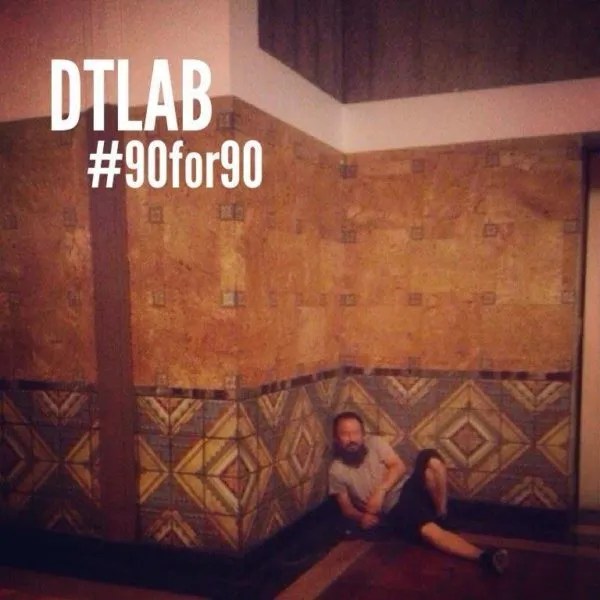
I met so many writers and poets through 90×90 who’ve become lasting friends and influences—including Hiram Sims, founder of Community Literature Initiative (CLI) and the Sims Library of Poetry, and co-publisher with Conney Williams of World Stage Press. I put together my book manuscript through CLI’s poetry publication class, fall 2020 through spring 2021. For nine months my classmates and I wrote together, gave tender, focused feedback, and helped each other through bouts of COVID and family deaths, all from our separate little Zoom boxes—before we finally met in person among hugs and tears.
Dunlap: What writers do you read today, whether poets, essayists, novelists or others? What draws you to their work?
Rogers: My reading moves back and forth through time and across forms and genres. Call me biased but I think many of our best writers and particularly poets are based in L.Á. Being a good L.Á. literary citizen means reading a lot of my L.Á. friends’ work—and forever having a towering stack of more to read. I wish I could list them all.
[Two] L.Á. poets [and a Fresno poet when she lived in L.Á.] whose work I’ve returned to often for inspiration and to figure out how they do it—are bridgette bianca (be/trouble), Sara Borjas (Heart Like a Window, Mouth Like a Cliff) and Rocio Carlos (the other house and Attendance). Recently, I’ve loved Luivette Resto’s Islands Not Found on Maps and Jeremy Ra’s Another Way of Loving Death; Ron Dowell’s Watts Uprise and Benin Lemus’s Dreaming in Mourning.
Kate Maruyama’s Family Solstice helped me survive my second bout of COVID in late 2020 and served as an example of how to interrogate whiteness while telling a damn good story. Toni Ann Johnson’s Light Skin Gone to Waste is a book of connected stories that tell one tale of such emotional power with not a word wasted. Myriam Gurba’s Mean and Creep knocked me on my ass—compulsively readable, tough and funny truth-telling.
I love so many kinds of writing, but I seek honesty, humor, insight, stuff that grapples with humans in all our glorious fucked-up complexity. I like lyrical writing and plain writing that packs a punch. I like writing that makes me understand myself and other people and reminds me we’re all the same in the most essential ways. Writing that makes me want to go back out there and wade into the thick of things, that inspires me to listen deeper and find better ways to say my own piece.
Dunlap: From your engagement in the local literary community, what are your honest thoughts and opinions about this community, good, bad or otherwise? It’s issues. It’s positives and anything else?
The delightful L.Á. dilemma on any given day or night is not: Are there any readings? It’s, which reading do I attend? Because there are so many happening at once.
I’ve found the L.Á. scene to be welcoming and nurturing. I find poets and writers here generally support and appreciate each other, across scenes, neighborhoods, ages, and every other illusory division. I’ve heard from folks who’ve lived in NYC or other big cities and also L.Á. that our scene is uniquely supportive. That’s been my overall experience and it makes me feel good.
I do feel entitled as a white poet to note that while the L.Á. area is about 25 – 30% white, I still see a surprising number of all-white or mostly-white literary events. I invite folks producing them to ask honest questions about who they include and why. It can be easy to default to old friends or folks we feel we can relate to. But every inclusion is also an exclusion and an active choice made that shows who we are and what we believe about our community. By sheer demographics, not to mention talent and accomplishment, most of our best poets and writers are BIPOC—many among the best in the world.

 Los Angeles Literature