
I was visiting the Billie Jean King Main Library one day in late 2019 when one of the librarians told me that Long Beach was about to host a Youth Poet Laureate program! This is exciting for many reasons: Long Beach has a thriving and eclectic literary scene; I know that as a teenager, I would have been ecstatic to know about something like that; and, as a poet, of course I was delighted to hear about more poetry programming.
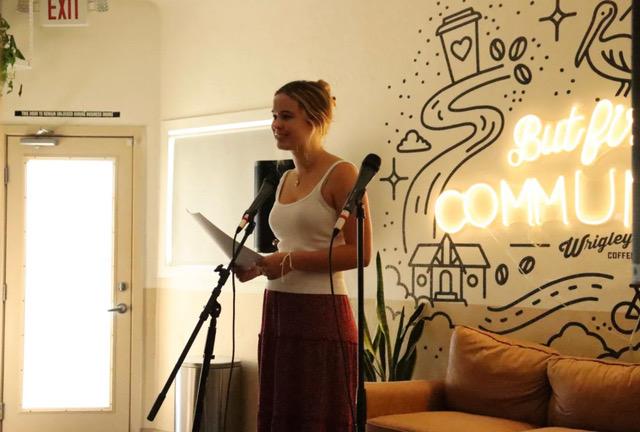
As fortune would have it, the Youth Poet Laureate program had to be put on hold due to the COVID-19 pandemic. But on June 1, 2023, Claire Beeli was named the city’s first youth poet laureate! Four poet ambassadors were also officially announced. When I heard Claire read at the ceremony, I was instantly taken in by the power and detail of her words. I had a chance to catch up with her via email and she graciously allowed me to interview her here!
Nancy Woo: Hi Claire, thanks for agreeing to let me interview you! And thanks for reading some poems at my book launch for I’d Rather Be Lightning in August. I really enjoyed your poems about Long Beach. How does living in this city inspire you as a writer?
Claire Beeli: I know every writer says this, but Long Beach really is unique. From my understanding, it’s one of the most diverse cities in California, and the strength of its community is incredible to witness. The concept of community in general is a significant inspiration for my work, so I’m grateful to live somewhere that has such a tight-knit one. Everything about the diverse Long Beach community, from its varied food culture to its ethnic diversity and lively activist sector, inspires me to write and work to better my city.
Woo: Congratulations on being the first Long Beach Youth Poet Laureate! What has been your favorite part of being Youth Poet Laureate so far?
Beeli: So far, it’s how involved I get to be in the Long Beach literary community. The opportunity to work with young writers and encourage their voices as other poets and writers have encouraged me is priceless. Knowing the power of literature means I know how uniquely impactful every voice can be, so the opportunity to help even just one Long Beach youth express themself is an honor.
Woo: Can you share with us a little bit about your journey? How did you end up as Youth Poet Laureate?
Beeli: A family friend knew about how much I love to write and recommended that I apply. Honestly, I was pretty hesitant, but I submitted an application online at her insistence, which included a portfolio of poems and a resumé. From there, I was accepted as one of ten finalists, all of whom would perform a reading in front of a panel of local poet judges. Based on my performance, portfolio, and community involvement, I was selected as the Poet Laureate, and four Poet Ambassadors were selected to work with me.
Woo: In addition to writing poetry, you also write fiction and creative non-fiction. When did you know you were a writer?
Beeli: I don’t remember realizing that I love to write. I’ve always been good at writing academically, probably because of how much I read as a child, and I’ve always felt so free in the practice. The first piece of creative work I can remember writing was a play in the fourth grade (a Shakespearean drama titled Rainbows Versus Unicorns) but I first felt like a writer during COVID-19. I had so much time that I started writing for hours every day, slowly making my way from rambling journal entries to short stories and poetry. I started taking classes and workshops, and by the time I started reading craft books, I was a goner. I think I’ve always known that I’m a writer, but that I only recently realized I could actually be one, if that makes sense—that it was as simple as putting pen to paper, over and over, until something I liked emerged.
Woo: Can you say a little bit about what your writing process is like?
Beeli: Most of my writing comes from my journal. I’ll write down ideas, images, first drafts, and sometimes second drafts on physical paper, then transfer those into a word processor for further revision. I’m inspired by everything, from my favorite philosophy podcast to inside jokes with my friends. I like to think of my writing as a distillation process for the sensory and emotional madness that is the world around me; a way to purify the chaos into beautiful, meaning-rich bites. (Or at least, that’s the goal, anyway.)
Woo: Who are some of your favorite poets?
Beeli: Right now, my favorite poet is Joanna Klink. I’m reading her book Raptus on the recommendation of Matthew Kelsey, a poet and instructor at the Kenyon Young Writers’ Workshop (whose work, by the way, is also outstanding), and it’s exactly the kind of poetry I dream of being able to write. I’ve also been into Anne Carson and Richard Siken lately, as well as Mary Oliver, but my tastes are always shifting.

Woo: How do you know when a poem or a piece of writing is finished?
Beeli: I’m the worst person to ask this question. In my opinion, a piece of writing is never finished, even after publication. You can find me with a pen before almost every reading I perform at, still crossing out and adding words to pieces I’ve gone over dozens of times. If I ever am privileged enough to publish a book, I might not be able to resist re-publishing new, freshly-edited editions every year.
Woo: You are really well-published for your age! Submitting to literary journals comes with the understanding that sometimes a publication will choose not to accept a piece. How do you handle rejection?
Beeli: Most of the time, well, though sometimes not. I’ve developed a sound system for submissions: I archive the email and pretend it never happened if it’s a rejection, and I celebrate if it’s an acceptance. Sometimes, a rejection will hurt if I wrote a piece specifically for a submission call or if it’s from a magazine I’ve been reading for a while, but I’ve gotten better at dealing with it over time. I’ve started trying to think of rejections as practice for college admissions, or just real life. It hasn’t always made the rejections sting less, but it’s made me more appreciative of the process.
Woo: Do you plan to pursue creative writing as a career, or do you know what your plans might be for after high school?
Beeli: I’m definitely hoping to study creative writing in college. I’ve loved every second of learning about the craft and history of writing, and I would love to continue to do so in a university setting among like-minded peers. After that, who knows—the ability to write full-time would be a dream, but I know it’s a rare one to see realized. Wherever I end up, I know I’ll still be a writer, whether I’m scribbling in my notebook during corporate lunch breaks or a staff writer at The New Yorker. The craft will always be a part of my life.
Woo: In addition to writing, what other hobbies or academic pursuits do you enjoy?
Beeli: Lately, I’ve been fascinated with linguistics (especially after reading some of Elif Batuman’s incredible work, as well as R.F. Kuang’s Babel). Emily Wilson’s translations of the Odyssey and Iliad were also revolutionary; their incorporation of a female perspective reshaped how I see classics and the art of translation. I’m fascinated by the living, breathing nature of language, and how its tiniest shifts can signify the deepest values of a historical group. My AP Seminar project last year examined how translations of the Bible have enabled colonial efforts, and my AP Research project is on differences in perceived text formality with more Latinate versus Germanic etymology. I’d love to study linguistics and translation in college.

Woo: How are you received by your peers as a poet? What do you think poetry means to your generation?
Beeli: The kids aren’t nearly as bad as most people seem to think. When poetry comes up, most of the people my age I’ve spoken to are interested, or at least receptive to the subject. Among the peers I meet in the literary and art communities, it’s a joy to connect with others and bond over our love of the creative practice. I might be wrong, but I feel like I can sense a Gen Z poetry renaissance on the horizon—social media poetry-that-sometimes-doesn’t-quite-feel-like-poetry could be the start. Lots of my friends find real joy in engaging with art, film, and literature in a genuine, appreciative way, and I know that so many of my peers could love poetry the way I do if they gave it a chance.
Woo: Thanks so much for taking the time to let me interview you! One last question: What do you think poetry can achieve in the world.
Beeli: To me, loneliness is one of the biggest problems the world is facing right now, and poetry is a potent antidote. Its ability to tap into emotions and experiences that so many people share, or at least the core essence of them, is unique and invaluable—plus, that ability can make people feel less alone. I know I’ve felt poetry unlock feelings and dreams I never knew I had, or that I felt alone in. At times when I’ve felt like no one could possibly understand what I’m feeling, my favorite poets have surprised me. I’m hoping that poetry can bring the same feeling of recognition and solidarity to the rest of the world, too.
 Los Angeles Literature