
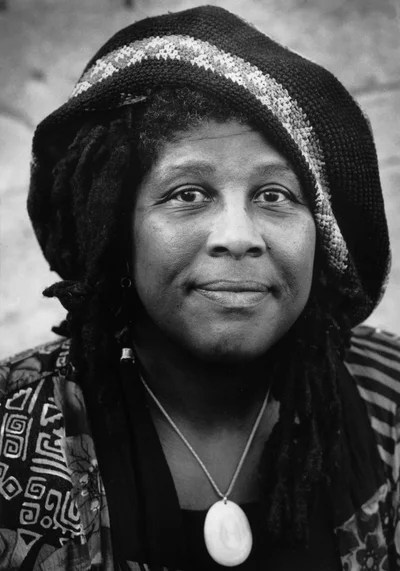
I never got to see Wanda Coleman read. I got into poetry around the time she died in 2013. But hearing her voice in the few YouTube videos I found grabbed me and never, never let go. It’s the inflection of her voice, filled with attitude and I found that in the recording of her poem “Wanda, Why Aren’t You Dead?”
There is irony and frustration in her voice, the poem underlined by racism as Coleman relays what people want her to be in the form of questions.
	wanda why are you so angry…
	wanda what is it like being black
	i hear you don't like black men
	tell me you're ac/dc. tell me you're a nympho. tell me you're into chains
It’s Coleman’s ability to command an audience and explore her life in America with unapologetic honesty through the context of her outcast status as a Black woman, her time as a single mother, being poor living in Los Ángeles, being from my hometown—that drew me to her angry prescient personally political poems.
During her life, Wanda Coleman was known as L.Á.’s unofficial Poet Laureate, the position only officially established a year before her death. On the strength of her poetry and performances, she helped get L.Á. recognized for its homegrown literary community as she stayed involved locally by teaching workshops at venues like Beyond Baroque, mentoring young local poets like Pam Ward and Sesshu Foster, while reading at different venues throughout the city.
Yet, growing up in Watts in the 1950’s, Coleman used literature as a refuge from the torture others brought upon her due to her looks, “her dark skin and ‘unconkable kinky hair,’” The Los Angeles Times said. She could best express herself, what she experienced, through poetry.
On the night of November 19th, that’s what I heard playing through the speakers as I stepped into Beyond Baroque’s theatre, a recording of Coleman’s distinct voice reciting her poetry; the vynal album Twin Sisters produced with Exene Cervenka, the singer of punk rock band X.
The air was electric and the seats began to fill, even the extra rows of folding chairs. The audience spilled into the bookstore. It was a night to honor the naming of the performance space, The Wanda Coleman Theatre. Day one of the 2023 Southern California Poetry Festival. It kicked of with a bit of the community’s history.
The poets Pam Ward, Sesshu Foster, Luis J. Rodríguez and Laurel Ann Bogen each told their personal memories of Coleman and recited a favorite poem or two of hers. Bogen, a fixture at Beyond Baroque for decades and a mentor to many young poets through the workshops and classes she’s taught at places like the UCLA Extension Writers’ Program, opened by saying “as they say, I had a misspent youth’ and the poem—“The Lady in the Red Veiled Hat—” that Coleman had written about and for her, that she read, reflects that.
	follow her. late one evening, along
	avenues and boulevards as she cruises
	for the indefinable/as she prowls the dingy digs and viperous
	venues seeking the elusive moment when the words
	ignite the heart.

Yet, when writer and graphic designer, Pam Ward, stood at the podium in front of the red curtains, she opened in her boisterous griot’s voice, underlined with smooth confidence.
“I wouldn’t even be here if it wasn’t for Wanda Coleman. I was working at a place called the Women’s Building downtown and they used to do art shows and poetry readings…and…I was there on a little job [in] graphics and then all of a sudden I hear these two voices—it was mostly white women, a few Latinos—and I hear these voices come in the room and they’re talking shit man and I’m like—laughing and loud and boisterous–and I was like ‘who are they?’ and they introduced themselves. They were Michelle Clinton and Wanda Coleman and I was like ‘where are you guys from?’ And they’re like ‘oh, we’re from Watts,’ and I said ‘well, my momma’s from Watts,’ and actually my grandfather’s from Watts and my grandfather’s…brother played with Nat King Cole as his bassist and…one thing I remembered and think is apropos for Wanda is, you know, she was a person from the streets but she honored and made the streets beautiful and Nat King Cole people used to ask him where did you learn to play and he would always say SWU, and that was Sidewalk University and I feel I’m from Sidewalk University and Wanda was from Sidewalk University and I just feel that that’s in the house tonight.”
L.Á. history was naturally rolling off Ward’s tongue and my ears were glued to her words, fully inhabiting the night’s historic embrace of a key part of the city’s literary history.
To illustrate Coleman’s continued influence, the main event featured poets and educators Mimi Tempestt and Terrance Hayes.
Tempestt is currently finishing her PhD in Literature with a concentration in Creative/Critical Writing at UC Santa Cruz, her dissertation diving deep into the life and work of Wanda Coleman. As a Black LGBTQIA poet born and raised in Los Ángeles, she became a punk rock kid, attending the city’s legendary backyard shows, staying out late into the night.
“I too was a junkie like Luis at some point in my life and I escaped to the Bay because I was going to get my shit together and fuck Los Ángeles…right?
I ended up at Mills College and my mentor was Trong Tran…I walked into Trong’s class and I had a shaved head…I’ve always been a beautiful woman, but you know sometimes I don’t want people to see, you know, all, all of this. So I had a shaved head and a punk t-shirt, a choker chain and I walked in this class with an attitude and he goes ‘you remind me of my old friend.’ I was like ‘ok, whatever. Who’s your friend?’ He goes ‘my friend Wanda…’
I wanted to do a presentation in his class on either Harriette Mullen or Sesshu Foster and he was so adamant about making me read…The World Falls Away. He was like ‘no, you don’t have a choice. You’re going to read this. You’re going to present on this.’ So, I presented on…that work…and I was like ‘ok cool…I still like Sesshu.’

So, I went to have dinner at his house and he’s telling this story about how Wanda was at his house…with his students a few years prior…from when she passed and as he’s getting to like the puncher, he’s telling a story about…something not so nice that she said about June Jordan—I won’t say what she said—but as he’s getting to the hook of the story…the lights in his entire house just flashed so that’s when I started paying attention, say what, and my homegirl Toya, she goes ‘Wanda…you hear us talking about you. We sorry girl. We’re sorry. We’re not going to play with your ass no more.’ But ever since that moment I was like whoa this is weird and…it took me on a five-year spiral and a discovery of Wanda Coleman and ever since then I realized that I was supposed to be there in that moment with Trong and the lights and…she became my obsession. So, I’ve been obsessed with Wanda for the past five years.”
These were all stories about Coleman’s impact. And about how Coleman’s influence continues today. Not only from Tempestt’s story but from Hayes, who said he teaches Coleman’s American Sonnets, assigns his students to write their sonnets after hers, which is why he collected 35 of them in Coleman’s selected poems he edited: Wicked Enchantment.
Beyond Baroque’s Executive Director, Quentin Ring reminded everyone in attendance that “through almost the…entirety of Beyond Baroque’s existence, [Wanda Coleman] was a fixture in our workshops…and very much a fixture here in this theatre.”
To the left of the theatre’s entrance hangs the brown framed plaque that reads in big block letters, “The Wanda Coleman Theatre.” Clear for everyone to see.

 Los Angeles Literature