
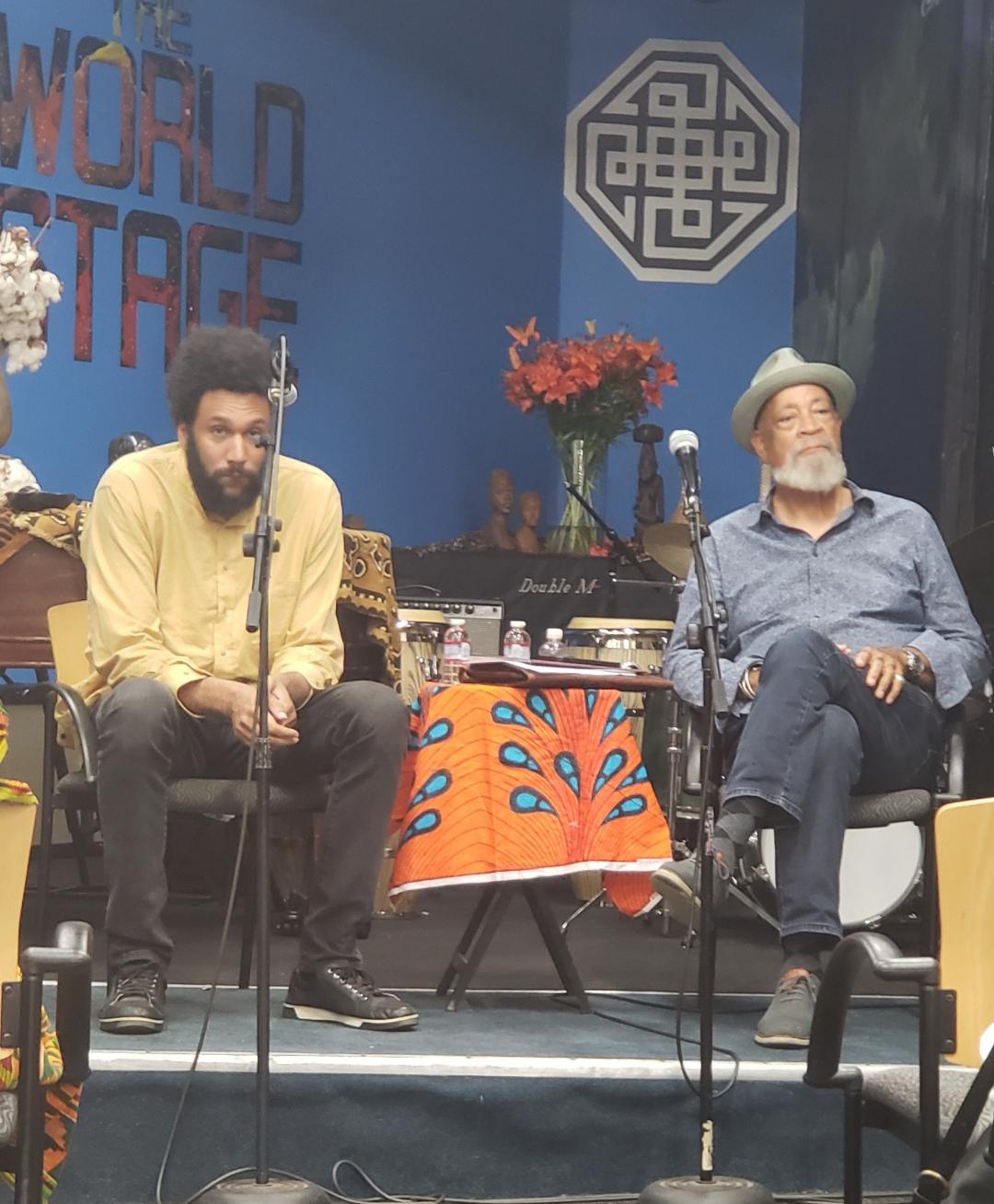
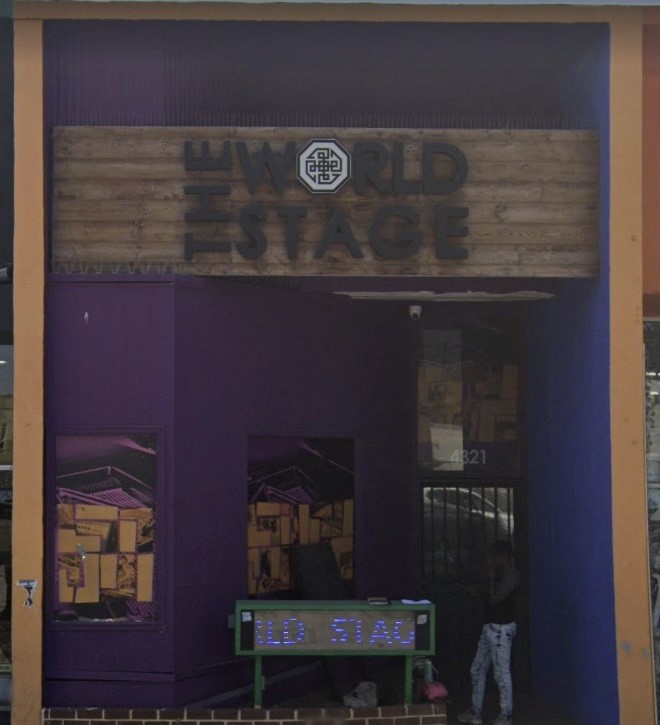
Wednesday, August 9, 2023. The World Stage in Leimert Park. The Anansi Writers Workshop had been taken over for the second week of Black August, “an annual commemoration and prison-based holiday to remember Black political prisoners, Black freedom struggles in the United States and beyond, and to highlight Black resistance against racial, colonial and imperialist oppression.” Poet Benin Lemus hosted the abbreviated workshop and the main event “A Literary Mixtape” was hosted by poet and musician Nailah Porter.
“A Literary Mixtape” featured a conversation with and performance by poet, L.Á. native and co-founder of the World Stage Kamau Daáood and the Eight Poet Laureate of San Francisco, Tongo Eisen-Martin.
Both poets write deeply rich and layered poetry that speaks to the Black experience in similar, but different ways. Daáood directly speaks as the traditional griot, telling his people’s stories through Jazz-inflicted wordplay and rhythm. His messages are both gritty and life-affirming at the same time. For example in “Liberator of the Spirit:”
	raging rainbows
	coming out the lips of a horn
	golden tongue on fire
	inspire us higher
	ears lick the air
	sensitive radars
	searching the airways for truth
	eyes peering into life seeking justice
	hands able and ready
	to serve a righteous cause
The grittiness enhanced by Daáood’s deep, gravely voice. Eisen-Martin on the other hand has said his poetry and himself are “an absolute product of every nook and cranny of San Francisco.” The city of his birth. His poems are direct about America’s imperial, racial, social and societal violence which is obvious for what it is, but has been gaslit and has to be talked about for what it is and its impacts on individual lives. In his poem “A Good Earth,” he says:
	I’ve really done it, Lord. Explored the mumbles of my mind.
	Explored what’s naturally there. And I found no brainwashing. I
	found Africa, Lord
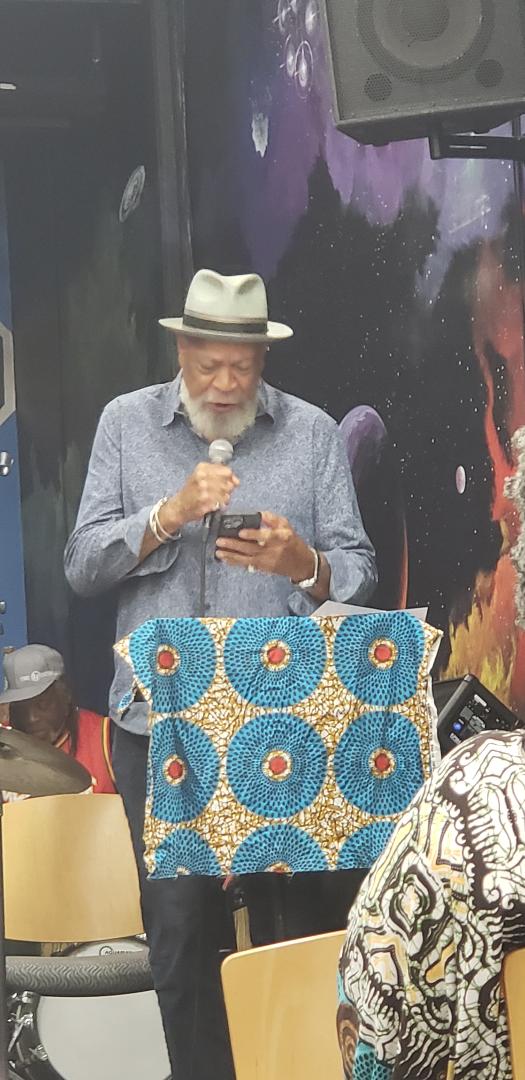
Daáood’s presence brought a historical weight to the evening. A history that stretches back in the literary community to the late 1960s and the famous Watts Writers Workshop and his activism in the city’s Civil Rights battles.
The Watts Writers Workshop was created in September 1965 by screenwriter Bud Schulberg in the wake of the Watts Rebellion a month earlier. As Schulberg later said, “In a small way, I wanted to help…the only thing I knew was writing, so I decided to start a writers’ workshop.” Daáood was the youngest member—18—when he joined in 1968. That was two years after the workshop was the subject of the hour-long NBC documentary, The Angry Voices of Watts that drew media attention to the workshop, making it famous.
And come together they did. The audience wanted to hear and learn from and feel and be motivated by these poets’ powerful words. During their talk Daáood praised Eisen-Martin, not only for his poetry, but his grassroots activism. For taking up the fight against the country’s structural racism from his generation. As Eisen-Martin said in a KQED article, participating in grassroots activism is actually part of his creative process. In the article he said, “By the time you pick up the pen, it’s sort of too late. So much of craft begins with the life you live before you pick up the pen.”
The talk was bookended by the reading, Eisen-Martin pensive, brown furrowed, often looking down, words rolling off his lips, half concentrating on his words and half feeling the weight of his ideas. While Daáood’s deep, gravelly voice seized attention, a fierce, warm punch punctuating the importance of his stories. Outside of Eisen-Martin’s performances, he’s quiet and unassuming, like he’s taking in what is happening and being said all around him before he responds. Or he would be unassuming if it wasn’t for his 6-foot-8-inch frame. But whatever assumptions one might have of this tall Black man, they disappear as soon as he opens his mouth. The same with Daáood, especially when he read, mic gripped in his right hand, about the freedom of his people, in his poem “Griot Notes:”
Freedom in this sound…
We speak of this day as magic
we speak of sky
we speak of asphalt
and the spirit that flies
music of libation
poured over sirene pierced ears
endless breath woven through the tapestry of time
Daáood’s uplifting words paint an average day in a typical city using descriptors like “asphalt” and “sky,” as a type of freedom if looked at as something “magic[al],” that causes a shift in perspective, coming at, experiencing, a negative in life, whether a situation or circumstance, positively, as something that doesn’t hold someone back. His words caused the audience to nod their head, snap their fingers or say “mm-hmm” in agreement, a truth they’ve always known, but needed someone else to say for that truth to truly connect.
However, the night’s funniest moment came when Porter asked Eisen-Martin and Daáood to ask each other a question. They looked at Porter, then each other, at a loss as what to ask. Daáood asked something like “How are you doing?” and Eisen-Martin said, “Good.” A smattering of laughter rose from the audience at how simple the question and answer was, as they had a chance to ask each other something illuminatingly instructive. Then, after an unsure pause, Eisen-Matin effectively asked, “You’ve raised two amazing children. How’d you do that? I’m about to be a father myself.”
The audience immediately stood and swelled in warm, congratulatory applause.
The night ended as literary events always do. The audience hung around, made the rounds saying hi and conversing with the poets they knew, some hoping to speak with the features for a minute or two. But Daáood had already left, a person more an introvert than a socializer. A poet who doesn’t feature too often.
This is the heart of Los Ángeles’ Black artistic community: Leimert Park. Where, on a Wednesday night, its members got to listen to two poets speak and read, who inhabit the concept of community to a T.

 Los Angeles Literature