
Alma Rosa Rivera is a nerd. She wears big oversize glasses that often sit near the end of her nose, deep rich colored lipstick that make her lips stand out and big, often funky earrings. Plus, she’s in love with the words that tell the stories of her and her community’s brownness. “Here’s to being a weird little brown girl and only getting weirder and weirder,” she said in an Instagram post. Rivera is a Chicana after all.
Rivera was born and raised in Santa Clarita in a typical Catholic Chicanx household. But at 20, in 2011, she moved to Koreatown where she grew as an adult, grew into her values and beliefs and into her desire to be a poet. “Poetry was something I sort of fell into,” she said in a Luna Luna journal interview. “I began writing as a form of therapy,” but now “I also use it as a voice to talk about things while people don’t want me to talk about.” Rivera ended up cutting her poetic teeth outside of Koreatown, performing spoken word at La Conxa in Boyle Heights.
Fast forward to 2023 and Rivera is happily married with two kids, living in the Inland Empire city of San Bernardino where she continues to write. Still infuses “the angry brown subcultural kid inside of my heart,” into each poem.
Now, living in a city and region labeled as a cultural desert, but in reality, lacks the creative infrastructure—the opportunities to mentor young artists and writers and the venues where they can present and read their work, etc.—to foster the vibrant cultures that do exist (the IE is majority Latinx), Rivera and her husband have turned an eye to creating fostering the artistic community in San Bernardino from the perspective of their Chicanx community Rivera’s always passionately written about.
After a false start that took up much of last year Rivera and her husband took the lessons learned and opened Barrio Fuerza in June, in Downtown San Bernardino, with a grand opening party that packed the house to see poets Matt Sedillo, Brenda Vaca, Angela Aguirre and the woman of the evening, Alma Rosa Rivera read with San Bernardino’s own MILPA, providing the music.
I emailed Alma Rosa Rivera in June, about last year’s false start. about her and her husband’s goals for Barrio Fuerza and how exactly they plan to support the artists and poets that come through their space. The following is our interview with only minor edits for clarity.
Brian Dunlap: How did the idea to open a literary and arts space originally come about/occur to you and your husband?
Alma Rosa Rivera: The idea of opening a community space together has been in our hearts for as long as we’ve been together—about 7 years. Separately, before we ever met, we were both doing community work. The first time I saw Rich was at the iconic pool and billiards in East Los. He was passing out flyers for the next art show for his magazine, Originals Magazine. We have always been about this life, about organizing community, long before each other. We tried getting a small space in East L.Á. a few years back when we still lived in L.Á. but it seems that that wasn’t our place or time,
Dunlap: You mention you and Rich have always been “about organizing community.” For what reasons are you two about community organizing? What caused you two to get into this work?
Rivera: I think the one thing me and rich have in common is our beliefs around community and culture. We both care about preserving our stories, creating space specifically for Chicanos and BIPOC, and owning our own businesses as brown people. We both had those beliefs separately, before we were together, and so I think that’s the glue of our relationship. Outside of our children we have a deep love for our culture and representing it in a positive light.
We decided to make Richs work space into a partial store for a few reasons but mostly because we are very aware of the lack of Chicano/Indigenous/Latinx spaces out here in I.E. and specifically San Bernardino. We are inspired by our friends and their shops/ community spaces. We are a bit like La Conch and a bit like Espacio 1839 and yet not at all and we are just being Barrio Fuerza. We’re in between being a shop and community space.
Dunlap: You mention that, before you and Rich met, you two were doing community work. What kind of community work were you two doing?
Rivera: Before we met. I was part of a Chicana Feminist Collective called Con Fuerza Collective. We organized women’s circles, discussion circles and cultural events. Rich was organizing Art shows for Originals magazine and working on the last issues of Teen Angels. He then created his current magazine Originals Magazine.
Dunlap: How did this idea of a literary and arts space move from just being an idea you two had, to one you wanted to see and make a reality?

Rivera: Rich has been working freelance for about two years now. He got his initial first space, a few spaces down from where Barrio Fuerza is, as a work space for him. It was never going to be a store or necessarily a community space. It was supposed to be his space for Originals Magazine and to work on his freelance work. When we decided to take the jump for our current space it was sort of aligned for us to take it.
Dunlap: You mention that Rich has his own magazine Originals and that it has something to do with art. Since most people don’t know what Originals is, briefly explain what the magazine is, what it covers and in what way(s) it covers it.
Rivera: Originals Magazine is a magazine that showcases the best of Chicano and lowrider culture. The magazine interviews different artists, musicians, photographers and anyone moving the culture forward.
Dunlap: Why did you and your husband think you two were the right people to spearhead and open such a venue?
Rivera: I think we balance each other out. I’m very social and know a lot of people in the poetry community. I’m good at organizing events and coming up with ideas. Rich is really good at design and the technical side of owning a brand and business. We’re both creatives that are a little different. I’m extremely extroverted and he’s more of an introvert.
Dunlap: After the first space failed, what made you want to try again? How did you have the money to try again?
Rivera: I wouldn’t say the first space was a fail…it was more a misfortune. We had a crooked landlord that never connected the power for us but gladly took our money. We aren’t rich people. Honestly, I think were the poorest family that I know. Hah! We are trying to build something with very little and because of that it’s a slower process but I know we’re special people. I know deep in my heart that we are created to do something bigger than ourselves.
Dunlap: You mention that you know “we’re special people.” In what way(s) do you see Rich and yourself as special people?
Rivera: What some people might not know is that we’ve had a decade of community organizing before opening this space so we have a deep understanding of how to bring people together and creating events and flyers. We have a lot of connections with artists, writers and creatives in both the I.E. and L.A and especially in the Chicano community. We live and breathe this. For us this is our life work and we take it seriously.
Dunlap: Why did you decide and find it necessary to open Barrio Fuerza in San Bernardino?
Rivera: Ever since I moved here, I was shocked that there isn’t one bookstore in this city. There still isn’t. I know we have to work on bringing books into our store and having the open mics monthly is a way to bring poetry to the city meanwhile we can afford to do that. It isn’t a secret that I really hated San Bernardino when I first moved here but overtime, I’ve met some of the most beautiful people I have ever met in my life. The people that come out of this city astound me. The way the community really loves on each other and support each other, is something I admire and honestly feel is different than the L.A scene.
Dunlap: Why do you think now is the right time to open a literary and arts venue?
Rivera: I think it’s in the air over here. Everyone who lives in San Bernardino and is interested in the arts is talking about it. There’re events everywhere; art shows, open mics, community gardens, workshops. The arts are alive in San Bernardino…I feel really proud to sit back and witness that and then to jump in and be a part of it with Barrio Fuerza. That dirt patch with all the trash on it has flowers, who knew! We’re all watching the super bloom of San Bernardino.
Dunlap: What are your goals for Barrio Fuerza? What do you and your husband want to accomplish with this space, apart from it being the headquarters for Originals Magazine? Do you want it to be a safe space for young, emerging, underrepresented local artists to fully express themselves through their poetry and art; as a place where young artists can take classes on how to make a career from their art; as a venue to support local artists of color throughout their careers though various programs or do you have other goals?
Rivera: I know we want this to be a space that is designed with Chicanos, Latinx and indigenous communities in mind. We welcome all walks of life, but I think it’s important to create spaces that are special to our brown experience. I would love this to become the spot for anyone who wants to connect with their culture. I want someone to say they fell in love in this space and maybe they’ll even name their daughter after me!
In all seriousness though, we want the space to be used by community. We hope to open up opportunities for people to throw shows here, have book releases, or a solo show. I know that the right people will come our way over time.
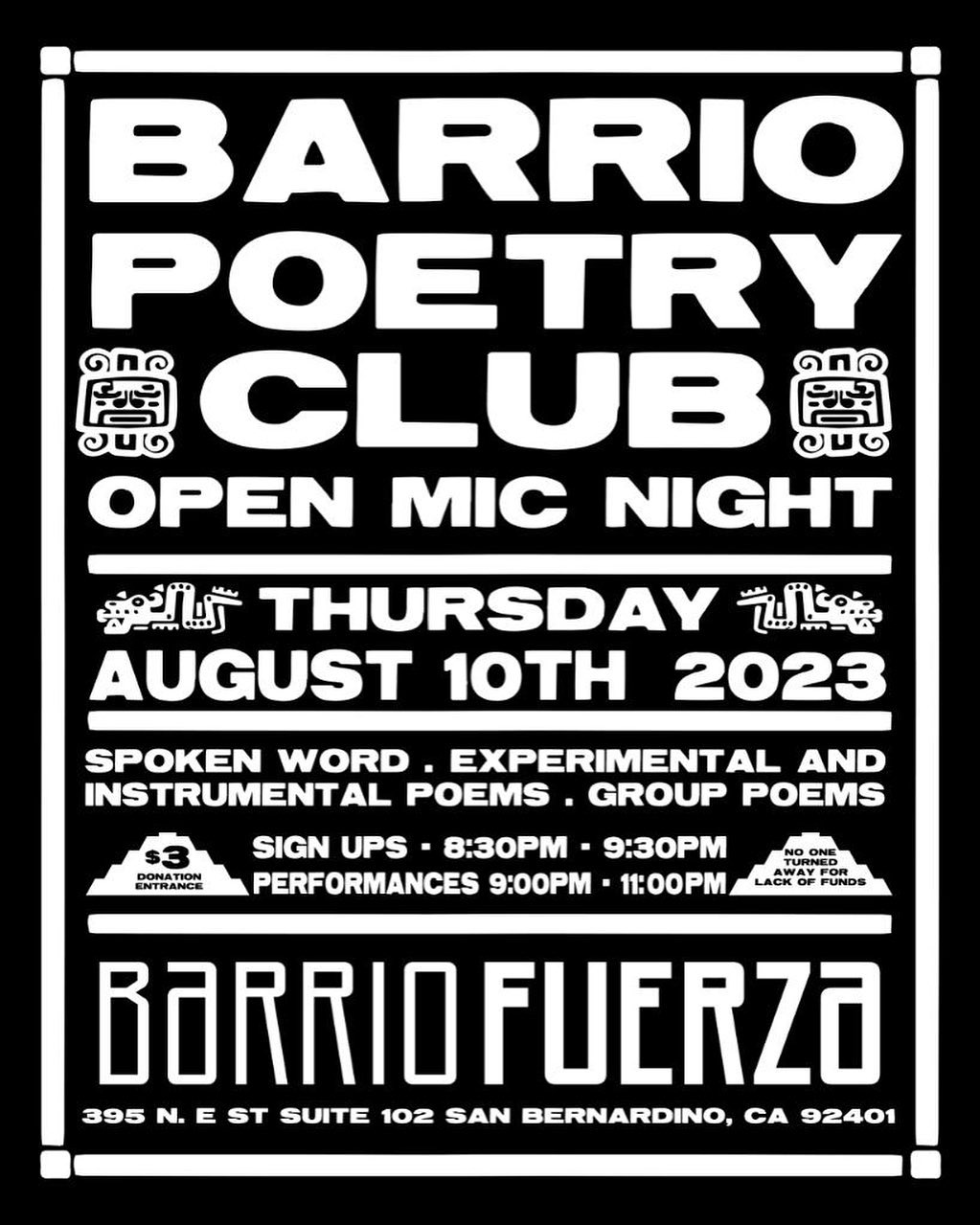
Dunlap: You say in regards to what your goals are for Barrio Fuerza that “we hope to open up opportunities for people to throw shows here, have book releases, or a solo show.” To clarify, do your goals eventually include art and writing workshops and other related classes as well?
Rivera: Yes, I’m hoping to have a day of the week where anyone who is working on a manuscript can come together and write. I’m also hoping to have a workshop series here soon. The front of our space says we are poetry space and that word is very intentional. I want this to be a space where poets gather and poems are created here. Being a poet is a very beautiful gift. It doesn’t make that much money, but it adds so much beauty to one’s spirit. It’s a great honor to be a poet. Revolutionary.
Dunlap: How are you going to fund Barriro Fuerza? With grants, donations, both? In other ways?
Rivera: We hope to build up Barrio Fuerza into a brand that anyone can wear. We want it to be worn in shows like This Foo and see people in community wearing the shirts anywhere from San Diego, Arizona and Japan. We’re mainly relying on community to support us. We plan to apply to grants and I’m planning to finish a book and start doing college readings. I took a zoom class hosted by David Romero about booking colleges and learned so much. I hope he does that class again.
Dunlap: Are the funds going to pay the writers and artists who host events and workshops, etc. and the writers and artists who feature? The employees who work at Barrio Fuerza or on the magazine, if any? Are the funds so you can afford to put on events? How are the funds going to be used?
Rivera: For now, all of the work will be done by us and will be distributed back into the business. It’s going to take a minute to actually make a living off of Barrio Fuerza. We’re aware of that. Right now the bread and butter is Originals Magazine and Rich’s graphic design work. I hope to go full swing into college readings this year to help invest into our business.
Dunlap: Is Barrio Fuerza—your goals for it and how you’ve structured the space—are an extension of the themes and issues that you write about? Of the political portraits of beauty and tragedy that Chicanx face when standing between the fence of many different worlds, of family and love? In what ways?
Rivera: I think my poetry and my community work go hand in hand. There’s a very thin line between the two. I think the common themes between the two are love, culture and community. Community for me is water. The quarantine almost took me out without that connection of others. I’m a poet one hundred percent but the only thing I know I will be till the day I die is a community organizer and member. For me creating spaces and seeing artist and poets come together is like creating the ultimate poem, the ultimate art piece. Something gorgeous that Cheech Marin would want to frame and collect.

 Los Angeles Literature