
Editors Note: The following was originally presented as part of the panel discussion “Younger Political Poets of Southern California” at All Power Books in Los Ángeles on August 6, 2023.
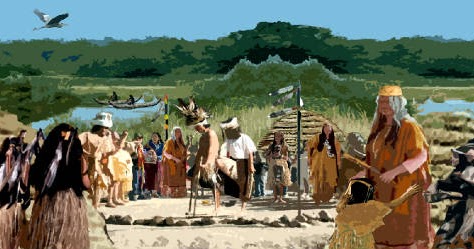
Political storytelling has existed in Southern California since the beginning. The natives, who still live on this land, like the Tongva of the Los Ángeles Basin, told myths, some of which include strife. For example, the Tongva creation story includes Weywoot, the god of the sky, who
developed “into an ambitious and ruthless leader who attempted to conquer others. Weywoot’s followers grew restless with his leadership. They killed Weywoot by grinding a piece of Toshaawt,” a large rock, “and applying the paste to Weywoot’s chest. The people burned his body at Povuu’nga,” where Long Beach State is located today.1
Then, in the early to mid-1880s, poet and writer Helen Hunt Jackson became an advocate for the better treatment of Native Americans by the U.S. government. She first published the nonfiction book Century of Dishonor, chronicling the treatment of the natives by the government from colonial times up to her present, before releasing Ramona, set in Southern California shortly after the Mexican American War and is considered the starting point for Los Angeles literature. Though Ramona tries to be an appeal on behalf of Native American rights, its focus is on the love story between the main characters Ramona, a Scottish-Native American orphan girl and Alessandro Assis, a young Native American sheepherder, set against the romantic portrayal of mission and Mexican era California. To write the novel, Jackson toured Southern California to document the conditions of the natives.2
This mythologizing of Southern California, “the booster spirit” as poet, journalist and educator Mike Sonksen calls it,3 that Ramona engages in, caused writers who knew better, like Cary McWilliams, to push back against these narratives, the Spanish fantasy past, the marvel of the film industry, etc.
McWilliams said himself that it was, “my years at the Times,” that was “a marvelous introduction to 1920s Los Angeles,” and his time as a lawyer “was very much an invitation to the history of the region,”4 that drove him to write beyond the myths and eventually penned his seminal book on the history of Southern California, Southern California Country: An Island on the Land in 1945.

Political storytelling also has deep roots with writers of color and LGBTQIA writers in SoCal. Chester Himes was the first writer of color to famously pen a political novel about race set in Southern California. He depicted the life of Robert “Bob” Jones, a newcomer to Los Ángeles from Ohio, in his novel If He Hollers Let Him Go, published in 1945. The novel “contains many auto-biographical elements”—Robert Jones is “a [B]lack shipyard worker in Los Ángeles during World War II struggling against racism, as well as his own violent reactions to racism.”5 Jones’ experience and reaction to racism in L.Á. mirrors Himes’. Himes said in his autobiography “under the mental corrosion of race prejudice in Los Angeles I became bitter and saturated with hate.”6 This was partly due to Himes’ experience working as a screen writer for Werner Brothers.7
Then 1963 is essentially when LGBTQIA writing in Los Angeles began with John Rechy’s semi-autobiographical novel City of Night. Two sections of the book take place in Los Ángeles and features an unnamed gay Mexican American protagonist, not unlike himself, who hustles in both Perishing Square Downtown and Hollywood. In the novel Rechy includes The Cooper Do-nuts Riot in 1959 when the lesbians, gay men, transgender people, and drag queens who hung out at Cooper Do-nuts and who were frequently harassed by the LAPD fought back after police arrested three people, including Rechy.8
Then in 1965, in the aftermath of the Watts Rebellion, Screenwriter Budd Schulberg started the Watts Writers Workshop in South Central. It was a space for young Black people of the neighborhood to express their feelings and experiences, not only about what happened to their community do to the Rebellion, but to their experiences of growing up and living in these designated Black neighborhoods. Their treatment, or harassment by the LAPD. The writers involved included Quincy Troupe, Johnie Scott, Wanda Coleman, Kamau Daáood and the poetry group Watts Profits. Johnie Scott’s powerful poem “Watts 1966 — Remembering When” encapsulates his anger at “Mighty Whitey,” built from a lifetime of experience with Whitey, when he says:
…on come the all-seeing
Eyes of the television cameras
Controlled by the probing, insensitive
Hand of the detached reporter who
Purports to relate the news to millions

While there, in the eye of madness,
He quakes in his boots and wonders
When his turn to be beaten shall come.
(Left bleeding like a brutalized rag doll
That has outlived its usefulness…
Johnie Scott went on to become a professor of Africana Studies at CSUN for 33 years before he retired in 2017.9
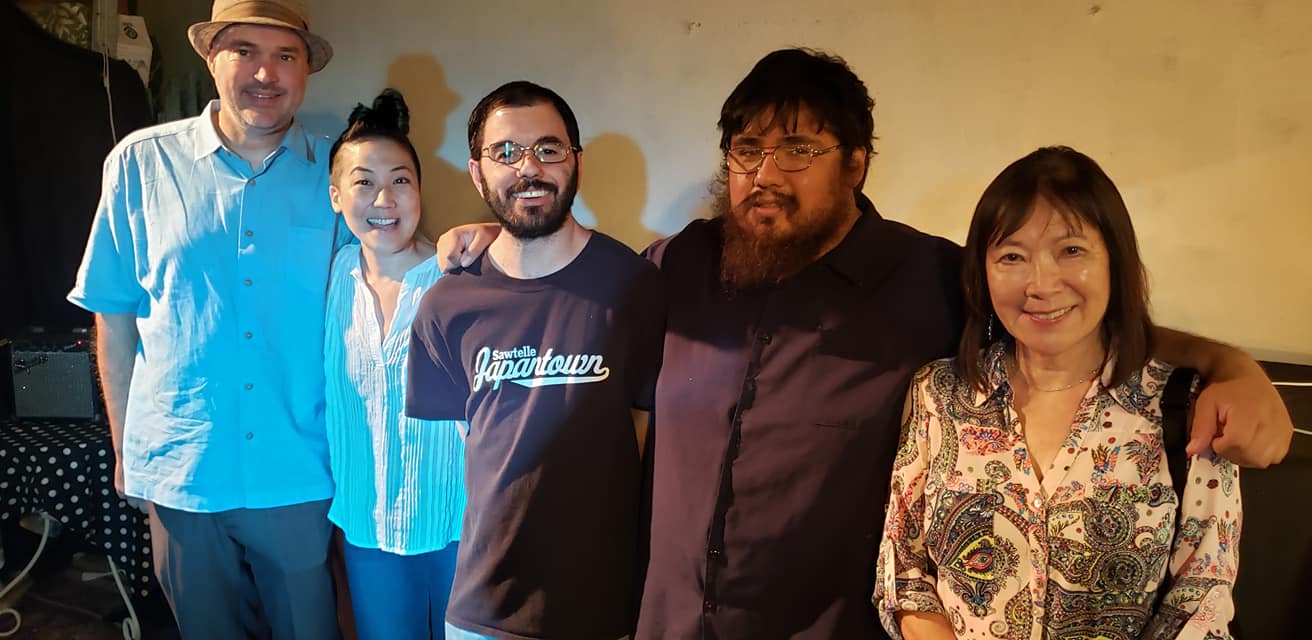
There are so many other important political storytellers of Southern California that make up this long and deep tradition in Los Angeles literature, but I don’t want to go on and on and bore everyone who came here to hear these three powerful political storytellers discuss what they do, what they write about and share with you a few poems. But this doesn’t make them any less important, like Pasadena native Amy Uyematsu, who we lost in June at the age of 75. At UCLA in the late 1960s she became a student activist in the Asian American Movement and active in creating Asian American Studies. She penned the essay “The Emergence of Yellow Power in America” about the insistence of Asian American identity as a direct outgrowth of the Black Power Movement’s consciousnesses-raising theories.10 She then co-edited the widely used anthology, Roots: An Asian American Reader before becoming a LAUSD math teacher for thirty-five years, her last stint teaching at my high school, Venice High, just after I graduated in 2003. Yet, in the early 90s, Uyematsu began publishing poetry, releasing her first book Thirty Miles from J-Town in 1992, which I haven’t read, but in 1998 she published Nights of Fire, Nights of Rain, urgent poems about the issues of day-to-day life in Los Angeles that opens with the poem “This Shame Called Joy” about Latasha Harlins “being shot in the back over a $1.79/carton of orange Juice.”11 She went on to publish four more books of poetry, her last That Blue Trickster Time just last year.
And the final poet I’ll mention here is the forceful Michelle T. Clinton, who grew up in South Central in the second half of the 1950s. She was active in the literary community in the 1980s and early to mid-90s, associated with Beyond Baroque, where she lead a multicultural women’s poetry workshop. As a Black woman Clinton described her work as “an attempt to assimilate the racist & sexist violence in my body.”12 Not only that, but in her seminal collection Good Sense & the Faithless published in 1994, a tough, hard, honest and necessary collection of poetry, her poems also centered on gay and lesbian issues and the particular politics of bisexual identities, seen in some of my favorite poems in the collection: “Politics of the Bisexual Deep Fry” and “We’re All Gringos on this Bus/Ode to the Am. Butch.”
All this is to say, this is the tradition these three writers—Karo Ska, James Coats and Andrés Sanchez—and myself, inhabit. Hopefully this long and deep literary history of political storytellers in Southern California, that I’ve briefly mentioned here, has set the context to help understand our discussion here today, as we discuss the “Younger Political Poets of Southern California” who, these three writers included, write, publish, perform and teach in the community today.
Sources
1. Atkins, Damon B. and Bauer Jr, William J. We Are the Land: A History of Native California. Oakland, California: University of California Press, 2021, 13.
2. “Helen Hunt Jackson.” Wikipedia, July 6, 2023. https://en.wikipedia.org/wiki/Helen_Hunt_Jackson.
3. Sonksen, Mike. “Carey McWilliams, California Prophet.” KCET, February 27, 2015. https://www.kcet.org/history-society/carey-mcwilliams-california-prophet.
4. Sonksen, Mike. “Carey McWilliams, California Prophet.” KCET, February 27, 2015. https://www.kcet.org/history-society/carey-mcwilliams-california-prophet.
5. “Chester Himes.” Wikipedia, April 18, 2023. https://en.wikipedia.org/wiki/Chester_Himes.
6. Himes, Chester B. The Quality of Hurt: The Early Years: The Autobiography of Chester Himes. New York: Paragon House, 1971, 76.
7. Davis, Mike. City of Quartz: Excavating the Future in Los Angeles. London: Verso, 2006.
8. Faderman, Lillian, and Stuart Timmons. Gay L.A.: A History of Sexual Outlaws, Power Politics, and Lipstick Lesbians. Berkeley: University of California Press, 2009.
9. Ball, Morgan. “CSUN Africana Studies Professor Retires after 33 Years on Campus.” CSUN Today, May 9, 2017. https://csunshinetoday.csun.edu/faculty-and-staff-news/csun-africana-studies-professor-retires-after-33-years-on-campus/.
10. Uyematsu, Amy. “The Emergence of Yellow Power in America.” Gidra, October 1969.
11. Uyematsu, Amy. Nights of Fire, Nights of Rain. Brownsville, Or.: Story Line Press, 1998.
12. Clinton, Michelle T. “Michelle T. Clinton.” Salon, October 5, 2000, https://www.salon.com/2000/10/05/clinton_65/.

 Los Angeles Literature