
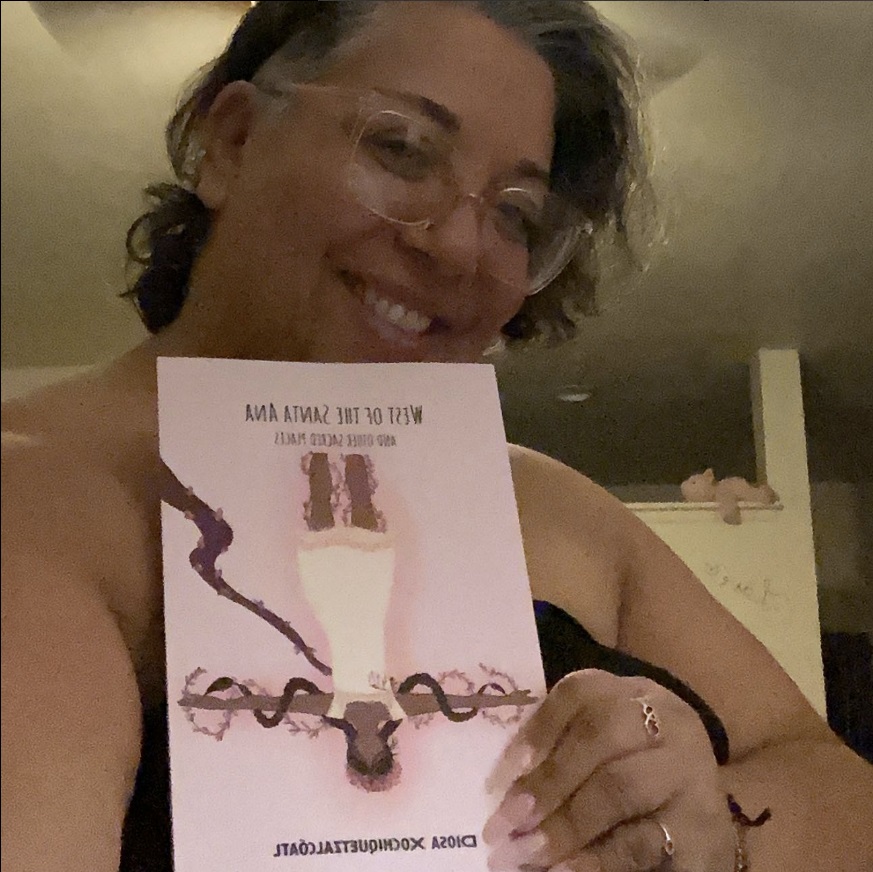
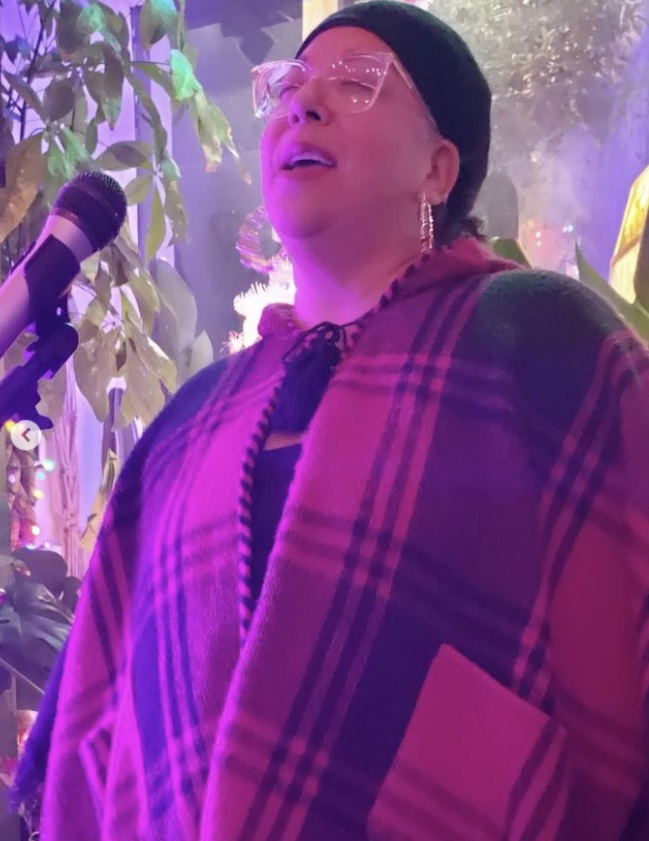
Diosa X is a multilingual, multi-talented poeta with a voice and spirit as rare and dangerous as falling stars. She is also a member of my international women’s poetry network TESORO, a group dedicated to the idea that women’s voices need to be in the wind, and creating /maintaining safe and protected spaces where those voices can flourish. The idea in itself is revolutionary; Diosa’s voice and vision, the way she walks through life and “sings her soul” are a welcome and necessary part of that revolution. So, when she sent out the call for an interview I jumped at the chance. We sat at a Sizzler in San Diego; philosophizing, querying, and laughing our heads off. I can’t get the giggles and guffaws on paper, but the “q” and well-thought out, soulful, heartfelt “a” …we got that covered.
The interview has minor edits for clarity.
Stacy Dyson: So, every time I’ve tried to say your last name, I feel like my head is going to explode. Help me out, here.
Diosa Xochiquetzalcóatl: Diosa Xochiquetzalcóatl DEE-oh-sah SOH-chi-KET-sahl-KOH-aht.
Dyson: Give me some basic 4-1-1.
Xochiquetzalcóatl: I’ve been teaching classes in ESL and Citizenship, for over 20 years. I’m multilingual…English, Spanish, and I dabble in French, Nahuatl, and Tsalagi. I have two books published: A Church of My Own, Hechizera: Sus Sultry Spells, and my third book, West of the Santa Ana And Other Sacred Places, is on the way. I’m a three-time slam champion, have 1 kid, and I’m still waiting for the day I have my pet pig, Charlie, in my hands.
Dyson: What got you started?
Xochiquetzalcóatl: A middle school poetry unit. In 7th grade, we did this major poetry unit where we put a book together…we actually created a manuscript, now that I look back. There were all these European poets…
Dyson: Old Dead White Guys 101…
Xochiquetzalcóatl: Yeah. I said where are all the women, where is the poetry in Spanish? I did write the poems that I had to. I remember writing a poem about hickies…
Dyson: From personal experience or were you just theorizing at that point?
Xochiquetzalcóatl: Just theorizing…
Dyson: Okay, sure lets go with that story. Your mom might read this, we don’t know. (MAD giggles here)
Xochiquetzalcóatl: From what I observed in the world around me. Those were the poems I wrote. But in the back of my mind I had this rebuttal in Spanish, that I didn’t include in the project…because that was all in English.
Dyson: Was there no space for you to do that or it just didn’t occur to you?
Xochiquetzalcóatl: I wasn’t told there was a space; therefore I assumed there was none. As in many occasions, if it’s not explicitly told to us, then we just assume it’s not available.
Even after putting this book together, I’m like “No, I have to write in Spanish.” I mean I had this collection of poems in English, but in my heart of hearts…There was something in there I had to write. And eventually I did, which is called “Nunca Entregues El Corazon,” one of my first poems in Spanish. That came along in high school when I first started studying Spanish. That’s my first language but reading and writing”…I wasn’t necessarily exposed to that. In high school I took Spanish, and that’s when I discovered the whole literary world in Spanish, and I went…”Ohhh! They do exist!” I said “I could do this. “My first published poetry was in my high school literary magazine.
Dyson: So, we’ve got you past that first period. Let’s skip up to now…what happening right now?
Xochiquetzalcóatl: I’ve got my 3rd book baby coming! So, Book 3 West of the Santa Ana And Other Sacred Spaces [originally was to be released on 7/7/7; July 7th, 2023], which adds up to 7. It’s also the National Day of Chocolate…I’m admittedly, undeniably a chocoholic…
Dyson: Nothing wrong with that.
Xochiquetzalcóatl:…and this book release is going to happen where the Santa Ana River runs into the ocean. There’ll be a beach party at the edge of the Santa Ana River, and interestingly enough, this book goes back to the beginning.
Dyson: The beginning of time, the beginning of…what?
Xochiquetzalcóatl: The beginning of me. But it does take us back to the beginning.
Dyson: You say the beginning of me…the beginning of you as (for lack of a better phrase) an actualized person, the beginning of you as a writer, the beginning of you as just being on the planet…?
Xochiquetzalcóatl: Of me as a human being on this planet, but then it also takes us to the beginnings of my lineage, the beginnings of humanity…this book, well all of my books, have a mind of their own. I just go with them. What I want to say is my books in the order they’ve come out, come out in a backwards order. A Church of My Own was all about a healing process, and enlightenment, which is ultimately the goal, I believe, as humans. Then the second was about chasing and embracing our shadow selves, and now book 3 takes us back to childhood and the beginning of this whole human journey…my human journey…on this planet. Geographically it starts in Orange County, then loops out to the east, and then off the planet, going back to the Star Nation…which is the beginning.

Dyson: Is there an autobiography in the works?
Xochiquetzalcóatl: No.
Dyson: Ever?
Xochiquetzalcóatl: No.
Dyson: Why not?
Xochiquetzalcóatl: I don’t—I don’t think my history, my story as is should be a book.
Dyson: So, we’re back to why not. I mean, you’re talking about these incredible journeys, psychologically, spiritually, if not physically. You’re never home, so your physical body is traveling all the time. What is it that makes you think that those journeys wouldn’t be of interest or inspirational to the world?
Xochiquetzalcóatl: They are, and they’re embedded in my poetry.
Dyson: So, the poetry is enough?
Xochiquetzalcóatl: The poetry is enough.
Dyson: Okay.
Xochiquetzalcóatl: The poetry is enough. Because there’s a fine line…well, society, people draw a fine line between the physical and the ethereal, and my world blends all these worlds.
Dyson: Don’t you think your job description as a poet is to blend those worlds anyway?
Xochiquetzalcóatl: Correct. An autobiography would take that mysticism, that surrealism…that is real in my world. An autobiography would be redundant.
Dyson: You are a woman of color at this time in history…your whole existence is surreal. Let’s just address that! (hysterical laughter)
Xochiquetzalcóatl: But the magic realism that is so real in my world…If we put it in autobiography, it loses its magic.
Dyson: But writers like Allende and Marquez have done exactly that…
Xochiquetzalcóatl: In their fiction, in their poetry…but to bring it into just straight autobiography, it takes away that magical aspect.
Dyson: I’m always really curious to know, when is the best time in all of this for you? Not when was the best show, but when is the best time? Is it when you’re on your back patio writing your brains out, is it when you’re traveling, when you’re coming up with the idea for these book babies…when is the best time?
Xochiquetzalcóatl: The best time is when the floodgates are just thrown open. Usually happens in the middle of the night, and I just cannot stop. And there’s this flood of ideas that has to be captured at 3 in the morning, knowing I have work the next day. But if I don’t, I cannot sleep…I’m damned if I do and damned if I don’t.
Dyson: Like every other writer in the world, Babe.
Xochiquetzalcóatl: Yeah…so if I don’t heed to this calling, I am tossing and turning all night. So just sitting up and going with it. And before I know it, I have this whole collection of poems.
Dyson: And five minutes to get ready for work!
Xochiquetzalcóatl: And five minutes to get ready for work. And so, it’s like a high…no, it is a high.
Dyson: Is it A high or THE high?
Xochiquetzalcóatl: It is THE high.
Dyson: Better than performing? I mean, I’m coming from my experience and my high is putting it out on stage watching people’s faces…that is the high.
Xochiquetzalcóatl: You know, I’m a Libra.
Dyson: You keep saying that like it’s supposed to mean something.
Xochiquetzalcóatl: It means very much because I cannot pinpoint any one thing. So, if I talk about my writing, the high is that floodgate in the middle of the night. In performing the high, the floodgate is when they come up to me after and say whatever comment they have.
Dyson: Even if it’s negative?
Xochiquetzalcóatl: I haven’t heard any negative comments.
Dyson: Oh, listen to this. Then you have not been in the biz long enough, Babe. You mean there has been no one baying for your blood at the end of a performance?
Xochiquetzalcóatl: They don’t dare come and tell me, and I think I set it up that way. You ain’t got nothin’ nice to say, so keep steppin.’ I’ve been blessed to not have to deal with any haters…at least not in my face. And I’m cool with that…they can talk all they want. But I don’t have the time or the energy, so…
Dyson: Okay, so that’s the high high. What’s the low? What’s the worst?
Xochiquetzalcóatl: God…when I froze on stage in Brazil.
Dyson: Tell me about that.
Xochiquetzalcóatl: Oh, I don’t want to!
Dyson: Too late now.
Xochiquetzalcóatl: Yeah, too late now. No, but you know that was a huge learning experience. I had never been on such a huge stage before, and I froze. This is physically, literally a huge stage like a concert stage, so the setting alone was very intimidating. It was so high…with a completely brand-new crowd. I didn’t know any of the poets there, except for the other poet from LA. And…and ya know…I’m a couple of bars in and…I froze. I just turned around and looked at the organizer, then started over. That was a learning experience, that was my first major slam competition…my first live major competition.
Dyson: So, a little tiny bit of advice. Don’t go from an online slam here to an international slam in Brazil. You know, a little stop in between…
Xochiquetzalcóatl: I had no idea what I was getting into!
Dyson: The Southern Baptist part of me is saying “Yeah, total immersion…throw ‘em in the deep end,” and it sounds like that’s what happened.
Xochiquetzalcóatl: That what happened. Live and learn. I had fun regardless. I didn’t make it to the top ten, but I was there. I went to Brazil!
Dyson: And that leads me to the question I’ve asked other poets about. Is competition something that poetry needs?
Xochiquetzalcóatl: No. No not at all. I believe in things happening the way they’re supposed to. Brenda Vaca was the one who found this online, and she’s the one who said “Girl, you gotta go.” I just showed up and kept winning, and that’s how I showed up to Brazil, it was just me.
Dyson: Do you get nervous?
Xochiquetzalcóatl: Hell yeah! It was so new and scary. I’m a teacher, so I’m used to being in front of a room full of people, but being on that stage was intimidating. These (competitions) are all just opinion based. We all have our own styles; it’s a way to engage people. Do I think it’s the best way to engage people? No. In this Piscean world that we live in, it’s all competition. It’s that element of competition…people who believe that competition is the way, that’s how they see it. I went, I had a blast…it is what it is. I still went up the next day, I killed it the next day.
Dyson: I ask novelists who they read…I ask poets who they listen to. Who do you listen to?
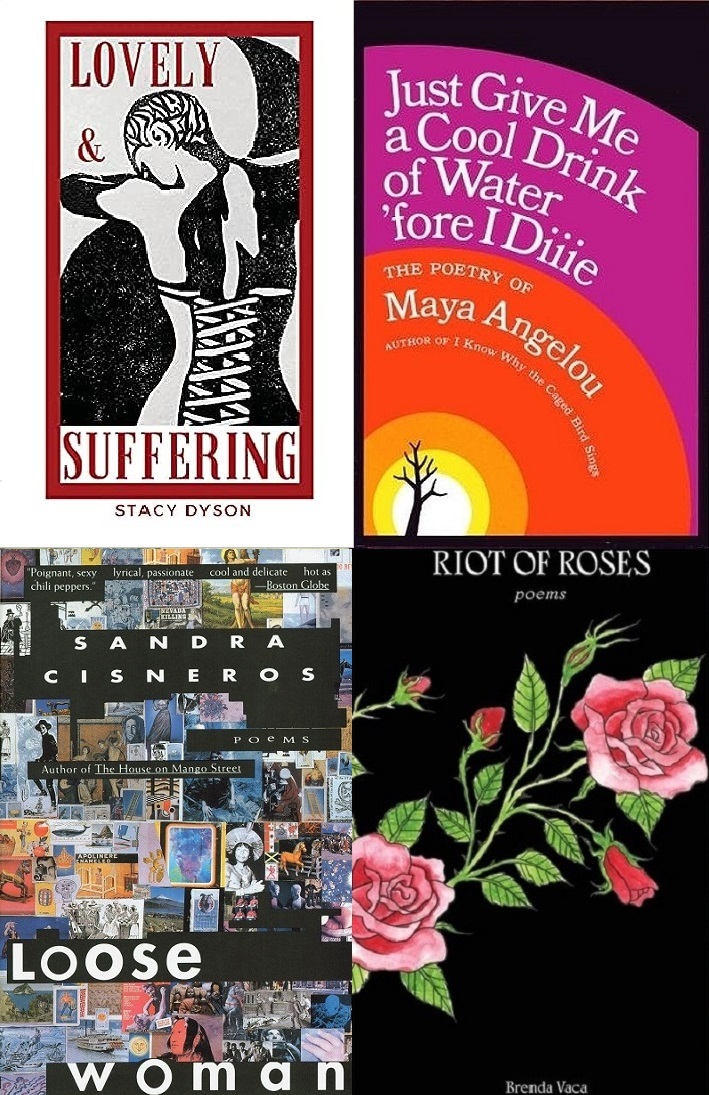
Xochiquetzalcóatl: Sandra Cisneros is one of my favorites because in her poetry, she took it there…she broke that taboo. Of being woman, being able to talk about lovers, being able to talk about her passion, her sensuality. I love Marquez’s magic realism, which resonates in my own reality.
Dyson: Women have been writing about this for a million and half years…So, are you talking about a taboo as far as women of color?
Xochiquetzalcóatl: Yes.
Dyson: That’s who you read…who do you listen to?
Xochiquetzalcóatl: My contemporaries. Brenda Vaca, Sandy Shakes…
Dyson: Anytime I could see Nikki Giovanni, Maya Angelou, Ntozake Shange…two of those folks I was lucky enough to see in person.
Xochiquetzalcóatl: Maya Angelou…for her…I don’t want to call it a performance, because it’s not a performance; it’s her true self expressed verbally or through written word. She took her written words and spoke them to life.
Dyson: Among your contemporaries, who is it you see the announcement and say “Ooh, I gotta be on the grid with them?” Or does that person even exist?
Xochiquetzalcóatl: No, there’s a lot.
Dyson: Give me the top 4 or 5.
Xochiquetzalcóatl: As I said, Brenda Vaca, Sandy Shakes, you…
Dyson: Thank you, ma’am (modest blush and head dip)
Xochiquetzalcóatl: ALL the people that I’ve invited on the book tour…there were several people that I still want to invite to read.
Dyson: There’s always this push this necessity I think…especially as a woman…you don’t just get to speak for the ancestors, you have to speak for the folks coming after you.
Xochiquetzalcóatl: Correct.
Dyson: How much attention do you pay to that?
Xochiquetzalcóatl: A lot!
Dyson: Why?
Xochiquetzalcóatl: Because why should future generations have to continue suffering? You know, everyone. There’s this common saying that you have to keep learning the hard way. Bullshit. Why do we have to learn the hard way? Life doesn’t have to be this hard. And if our future generations can see that…We’ve been blessed; yes, sadly we’ve encountered the same bullshit our ancestors have, but to some extent it hasn’t been as bad or…
Dyson: Is it not that bad or just a different kind of bad?
Xochiquetzalcóatl: Depending in the situation, there is a different kind of bad.
Dyson: Let’s talk about a specific situation. It is currently more dangerous to be a Black woman or a woman of color. Are we saying that the situations are dictated by circumstance or by time or just the lack of other people to acknowledge?
Xochiquetzalcóatl: Society is still asleep. We were supposed to wake up [during the pandemic]…because when we go inward, we discover our true selves. It’s love, in our true selves there is no hate. It’s love. And people did not take the opportunity to go inward. People took the opportunity to blame. to go outward. People chose pent up anger instead of taking the opportunity to look inward.
Dyson: Where does love figure into all this?
Xochiquetzalcóatl: Self love?
Dyson: What you do on your own time is your business…I don’t pry. (We are cracking up so hard that we are getting looks from the manager). However, you want to define it. Let me make it easy for you…let’s start with the obvious: romantic. Is there time for the love of your life?
Xochiquetzalcóatl: No. There is no love of my life.
Dyson: Was there ever?
Xochiquetzalcóatl: There have been. They serve as muses. A lot of good content came out of that. They’re a complete distraction at this point. I’m good. I’m single by choice.
Dyson: Definitely speak to me about that, because that’s something that’s coming up with the women I speak to more and more.
Xochiquetzalcóatl: I was married once, a long time, long time ago…lasted about 5 years, but I had known him since I was 16. The minute my son was born I said, “What the hell am I doing?” It took me two years to finally get the courage to leave. I knew it was going to be a life-changing decision. I did not sign up to be a single mother. I signed up to have a child and an ideal family. So, to make the decision…so although I was promised that this person would never do what his father did, that was just another stack of lies. And so, I raised my son financially on my own. I mean, I had my parents’ support, I lived with them, but financially and emotionally…I mean, his father never came around at all.
Dyson: Do romantic entanglements get in the way? Is the trade off worth it?
Xochiquetzalcóatl: I wouldn’t trade my son for anything in the world. He was planned. I love kids, I love babies. I really wanted the whole thing…the house, etc. Only when I’ve been in love has that yearning for babies come back. I don’t think about it, I don’t want it, I don’t want a partner. But if somebody shows up and sweeps me off my feet…then I’m like ohhh yeahhh…I’m a hopeless romantic, I am. But at the heart of my voice is love. Whether it be for the craft or myself or humanity or a certain group of people.
Dyson: Okay so there’s that. Can you be a poet without acknowledging love in some form or fashion? In the immortal words of the great Tina Turner “what’s love got to do with it?”
Xochiquetzalcóatl: It has everything to do with it. Some people have called me a manhater; I’m just an egalitarian. I call ‘em as I see ‘em. Everything is fluid, everything has degrees. There are times when you love something more.
Dyson: So, what makes a poet?
Xochiquetzalcóatl: The ability to capture that moment in time. The ability to capture those feelings, that vision. My poems are like pictures. Because we take pictures expecting them to be around forever. Just as a photographer hopes his craft is permanent, so do I.
Dyson: I had somebody tell me once there’s no such thing as men or women’s poetry. Yes or no?

Xochiquetzalcóatl: The audience is different, the perspectives are different. I’ve written poems to women with a man’s perspective; sometimes people misconstrue that. So, it’s the perspective. The majority of my poetry deals with women’s issues or the female perspective or the Goddess; I use that lens in almost all of my poetry.
Dyson: Has there been a time when that held you back?
Xochiquetzalcóatl: No, no. It’s empowered. There are still these taboos. You said before that women have been writing about sexuality forever. Yes, but in my world, still, still, it’s a taboo. Growing up Mesxicana, all the different layers culturally. I still have the indigenous feeling of having someone read a poem and saying, “Oh my God, that’s going to get [me] excommunicated.” But I just go ahead and write the poem and let the chips fall where they may. I like writing, and writing between the lines. I like to blur the lines. I just don’t like lines.
Dyson: You have mentioned a few times that you’re a Libra. How seriously does that affect what you do? Or does it?
Xochiquetzalcóatl: It drives me. When you take those journeys inward, get to know yourself…it doesn’t define me, but I understand how it moves me. There’s a lot of movement in my way of thinking, in my way of living. Anyone who knows me knows I get up and move every so often. Can I define myself as a poet without that factor of movement? I doubt it. For me as a poet, I didn’t pick poetry up; it picked ME up. I’m a hitchhiker and I can’t ever get out of its car…it’s always going. Motion, movement is crucial…the books take me. I have this little seed and I don’t know where it ends up going.
Dyson: Do you see yourself as timetraveler?
Xochiquetzalcóatl: Absolutely. We live in multiple dimensions all the time. In Toltec there are dreamers who are time travelers in the dreamworld. So, there’s no line between me jumping the worlds and dreaming. It’s a spiral. That’s what drives me.
Dyson: So, that goes to what motivates you. If you’re doing this for money…
Xochiquetzalcóatl: (Laughing) If you’re doing this for money, good luck and God bless!
Dyson: There are people who do it for love, or to honor, to explain an experience, to chronicle an entire lifetime…what you’re telling me is that your driving force is keeping your balance or…?
Xochiquetzalcóatl: It’s a balance of all of that. It’s possible to attempt to achieve a balance. That’s all we strive for. But are we in balance? All of these lenses that you talked about, I’m thinking about different poems. I have poems that try and explain me, supernatural occurrences, documenting what’s happening in society, chronicling human existence…you’re saying this and I’m thinking of poems that fit those categories. Who am I without that? Without that dancing back and forth between obligation and desire and duty I’m just an average human, living an average existence. A zombie…someone with no experience, no vision…we’re here for a purpose.
Dyson: Do poets really create anything? Or is the poem already out there and you just have to get to it?
Xochiquetzalcóatl: The poem is already there…it’s a thought or a vision, we just have to manifest it. The creation is putting those words in the right order. My grandmother was a fashion designer. She created her own patterns, and then she’d cut and then she’d sew…so we put it together. A poem is a physical thing.
Dyson: Really? Sure about that?
Xochiquetzalcóatl: When it’s written, it becomes physical. We have a hand in making that a physical manifestation. Otherwise, it would just stay…air.

 Los Angeles Literature