

Mike Sonksen is one of the most L.Á. people you’ll ever meet. He knows more L.Á. history than the city itself and his poetry and journalism infuse so much of it into his lines and sentences, it feels like it’s a history lesson at the same time it’s art.
On Saturday, May 27th, along the L.Á. River, in Frogtown, people came out to celebrate the release of the second edition of Sonksen’s book Letters To My City, which includes a teaching guide to help educators incorporate the book into their curriculum.
Though the event was to celebrate Sonksen and his work exploring the history and people of Los Ángeles, as per usual, he turned the focus on everyone else who performed that night.
Poet and musician AK Toney, poet Lee Boek, poet Nicole Favors, Dez Hope, ER Sanchez, myself, poet and LAist journalist Adolfo Guzman-Lopez and DJ Peter Woods.
The poets, writers and musicians of the city were not limited to the performers but included audience members. Poet Jeff Rogers, Writer and Editor-in-Chief of L.Á. Parent Magazine Cassandra Lane, poet Juan Amador, Monique Mitchell…
What sent the most chills through my body that night, connected me most to the city of my birth, was Adolfo Guzman-Lopez’s performance. He repurposed the interviews he conducted for an old article he wrote about a huge gathering of local poets at Beyond Baroque c. 2001. As his professional bio states: “Over the last 20-plus years I’ve covered a lot of what makes L.A. L.A. — transportation, K-12 education, municipal politics and art, and I’ve profiled many of our most creative visual and performing artists…I was born in Mexico City and grew up in Tijuana and San Diego. I’ve spent a lot of time keeping up my Spanish and that’s helped me stay connected to my Mexican culture, and the cultures of Latin America.”
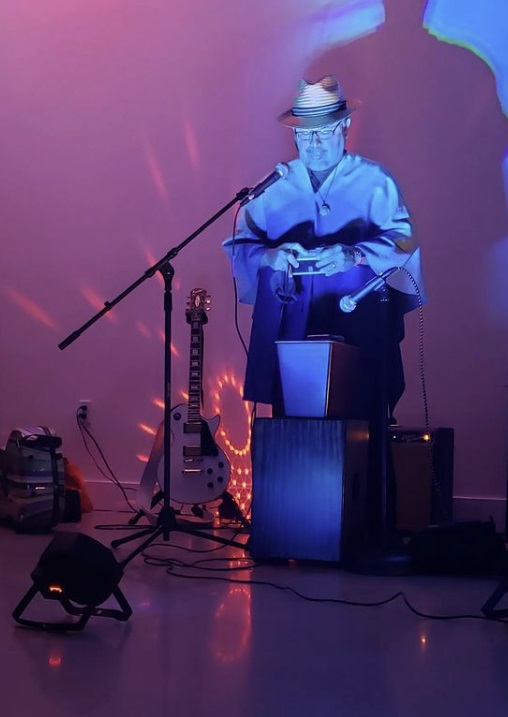
Guzman-Lopez set up two microphones, one to project the interview recordings he played, that functioned as the majority of his performance. He let the poets speak for themselves. Three legends in the community—Wanda Coleman, Lewis McAdams and Kamau Daáood—addressed Guzman-Lopez’s questions.
It was eerie and historically powerful to hear both Wanda Coleman and Lewis McAdams talk about what that large gathering of local poets meant to them, Los Ángeles and to the state of poetry in the United States more generally. To hear the voices of two powerful local poets no longer with us. To hear Coleman’s distinctive voice that commands the room, even in a simple conversation.
Named “the unofficial Poet Laureate of Los Angeles,” Coleman was born and raised in Watts in the 1950s and 60s. Through her life experience, her fiction, essays and poetry bring to light the country’s social and racial inequities.
Being along the L.Á. River, the river Lewis McAdams was dedicated to reviving, transforming it back into the natural flowing river it once was, from the concrete channel man had turned it into, founding Friends of the Los Angeles River in 1985, hearing McAdams’ voice added to a night already dedicated to his memory. To hear him speak on poetry’s important truth-telling role in society, was hauntingly relevant.
At night’s end, Sonksen orated two poems into the night that spoke to who Los Ángeles is. He read “Arrival Stories” which begins:
     If you listen they will tell you:
                  I was born in Vancouver, which is a beautiful city
                  We came from Paraguay, in South America.
                  I was born in Seoul, Korea. We lived there until I was five.
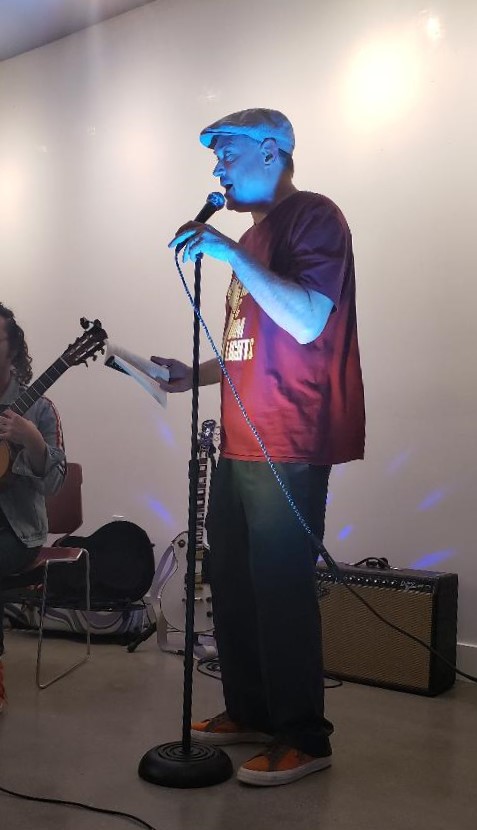
A city of immigrants. It’s how Los Ángeles grew to be the diverse city it’s known as. And Sonksen knows how to capture these stories while retaining the voices of the people who told them to him. But, what drew everyone to rapt attention was when Sonksen began his iconic poem “I’m Alive In Los Angeles.”
           I'm alive in Los Angeles!
           I'm alive in Los Angeles!
 Here in the wild, wild west…
 The warm wind hits my face,
 I walk across stained concrete,
 Cry tears of joy on Flower Street…
With that, the performances came to a close. The second edition of Letters To My City was now out in the world.

 Los Angeles Literature