
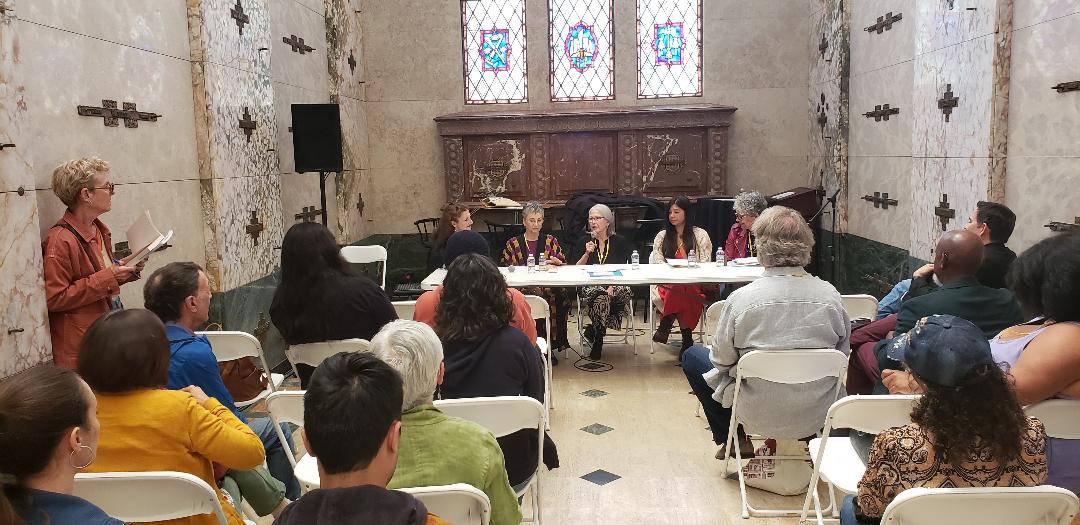
The 11th Annual LitFest in the Dena took place last weekend at the Mountain View Mausoleum, in Altadena, just over the city line from Pasadena, the home of LitFest for its first nine years.
Panel discussions and readings took place among the dearly departed, each inch of marbled wall space filled with graves. Inside the long halls and high ceilings, writers and poets’ voices echoed through a building built as an extension to the cemetery established in 1882. And according to its website, resting in the cemetery, “are the remains of Pasadena’s pioneer families, California statesmen, and other historically significant personalities.”
This year’ s LitFest theme was “books that make a difference” and each panel and reading spoke to that in different ways, obvious and subtle. They ranged from such panels and readings as “Queer Writers Tracing Literary Ancestries” featuring local writers Vickie Vértiz, Angela Penaredondo and Cynthia Dewi Oka to “The Ovary Office” featuring Pam Ward, bridgette bianca, V. Kali and Jaha Zainabu to “In the Belly of the Beast: Understanding Los Angeles” featuring Mike Sonksen, Natashia Deón and Rosecrans Baldwin.
On Saturday at the “Queer Writers” panel, three LGBTQIA poets discussed their personal queer literary lineage and spoke about how these lineages are often inaccessible, rare, and at times, nonexistent to young LGBTQIA folks and writers. The literary lineage they each spoke about, celebrated their queer literary elders who have inspired and emboldened them to write, share and change the binary stories of this world. Or in Cynthia Dewi Oka’s case, as a queer Indonesian, she spoke about how her literary lineage doesn’t yet exist as the LGBTQIA community in Indonesia is decades behind where it is in the United States. They are still fighting for their right to exist, much less to be seen, heard and accepted as queer. They are still forced to hide in the shadows in fear for their safety and life. Due to this reality, Oka said, when she moved to the United States she found her queer community and lineage through the writing of queer Black scholars and writers such as Audre Lorde. Oka was able to find a queer literary lineage she connected with. A chosen one.
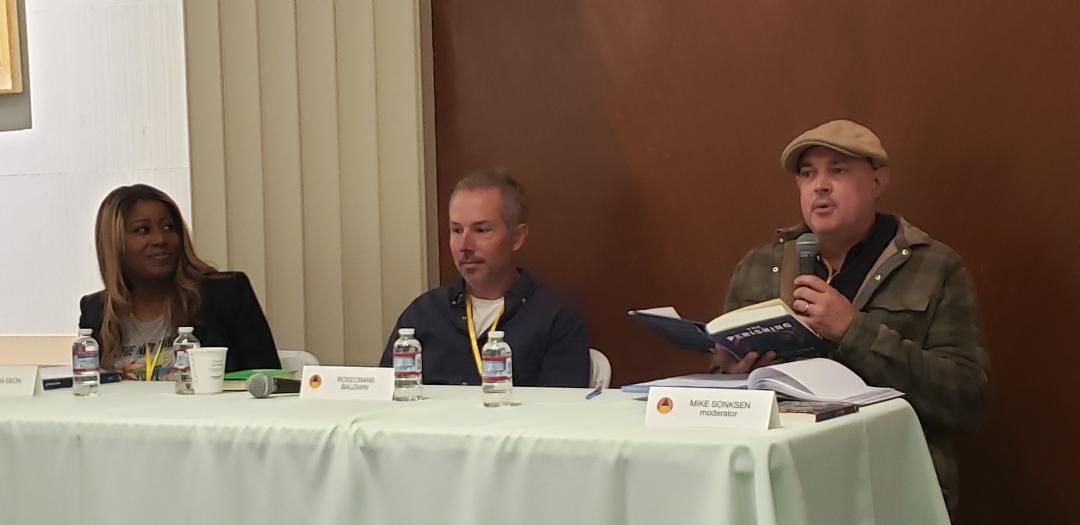
Yet, not all panels were heavy. Sunday’s “In the Belly of the Beast: Understanding Los Angeles” explored what L.Á. is. Rosecrans Baldwin, Natashia Deón and Mike Sonsken—witnesses, dissectors and analysts—discussed the city’s identity, dug beneath its iconic stereotypes and spoke on the influence living in L.Á. has had on them and their writing. At one point Baldwin shared his experiences encountering people who still hold these stereotypes—notions of what a city is, for example—at book festivals and conferences. Especially New Yorkers who can’t see past their city.
Los Angeles doesn’t function as a typical city or region, Baldwin said. There are so many different centers—famously said to be made up of 88 different cites—that one can’t perceive it head-on, understand it linearly. And, instead of books, authors were mentioned, such as Mike Davis, or musicians like Horace Tapscott, as people who were influential to them in understanding Los Ángeles.
One enters the Mountain View Mausoleum and drives down a long asphalt driveway before they park, a driveway reminiscent of one found at an English estate. The mausoleum’s location is beautiful as its website indicates. “Nestled below the picturesque San Gabriel Mountains above Pasadena.” And though it’s description of the building is a bit hyperbolic and meant to help sell it to the public and potential customers, it still captures the quality of and beauty of its architecture. “It’s long corridors, arched ceilings, marble surfaces, and intricate stained-glass windows spill rainbows of light onto the walls and floors.”
I had not attended LitFest when it was first held at the mausoleum last year and I had not seen any pictures of it. In my head I pictured it as a regular Catholic church built along a typical urban street. Instead, the property is surrounded by a low-slung brick wall topped with chain-link, trees, shrubs and palm trees, that separate it from the surrounding quiet middle class neighborhood and the cemetery directly across from its entrance.
As a result, LitFest in the Dena felt at a remove from its mission to connect “the Pasadena, Altadena and greater Los [Á]ngeles communities with literature and local authors through this free, community-based literary festival for lovers of the written word.” LitFest’s original location in the heart of Pasadena’s Playhouse District, along and adjacent to busy Colorado Blvd., anchored by Vroman’s, Southern California’s oldest and one of its most iconic independent bookstores, and the Pasadena Playhouse, allowed the public to stumble across its outdoor readings along El Molino Ave. and its panels in Vroman’s courtyard.
This easy, organic opportunity for the public to engage with literature and connect with authors with seemingly no barriers, was gone. The festival was no longer out in the public eye.
Funding for literary events in the United States is difficult to come by. The country, public and private, does a poor job supporting the literary arts. That’s why it was a boon that LitFest was able to connect with Mountain View Mausoleum. The venue offered itself to the annual literary festival free of charge. Despite the location’s shortcomings, Litfest is able to continue on.
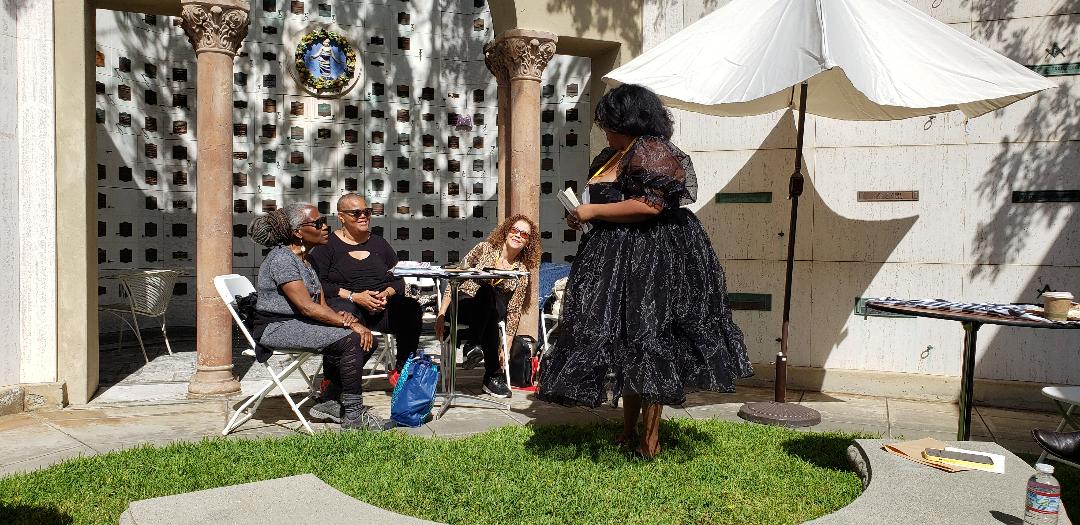
Saturday, outside in the Courtyard Nook, four strong Black women read poetry. The sun was warm and soothing across my skin. A welcome relief to the cold inside the mausoleum. “The Ovary Office” featured bridgette bianca, V. Kali, Pam Ward and Jaha Zainabu. They used a court-like setting to read work inspired by the recent assault on women’ s rights and power over their bodies. Their poems were written in tough, no-holds-barred voices, attacking their subjects head on. Pam Ward acted as the judge, using a makeshift gavel to quiet everyone down after each poet’s turn.
Ward has been an active part of the Los Ángeles literary community since the 1980s. Not only is she a poet and writer, Ward is a graphic designer and UCLA graduate, who grew up in the Crenshaw District. When she landed her “dream job running a design studio downtown at…The Women’s Building,” she said in a VoyageLA interview, “…a big red brick building on San Pedro near China[town]…[it] was like [she] was working in a frat house for artists. The place was filled with smart, brilliant, multicultural women where [she] could work and continue [her] pursuit of design and writing. Wanda Coleman, a renowned poet, put out an anthology called Women of All Season’s and [Ward] designed the cover and published [her] very first short story, called ‘Mama Dear.’”
One poem Ward read was “The Yellow Children of Monticello” with the epigraph “for my cousins, Sally Hemings and Jefferson’s descendants.”
Maybe Sally was fed up with all the laundry, sex and lies.
Sick of the broken promises, maybe Sally finally snapped
like an overseer whipping a child’s back.
Maybe Sally had to go “all Monica” on them all.
She wouldn’t be the first to topple a president.
Plantation life takes its toll.
So maybe Sally took out Jefferson herself
having that one final pillow-talk at last.
Out behind the Courtyard Nook on tables lined up in a row, Flintridge Bookstore sold the featured authors’ books. Sold the books of each and every panelist last weekend, ensuring the exchange of ideas would continue long after LitFest in the Dena took its year-long hiatus.

 Los Angeles Literature