
When I arrived at Page Against the Machine on Thursday, minutes before the reading “Celebrating Black Voices” that I was hosting, other than the owner Chris Giaco, only two people were present. It appeared with only a week to promote the reading, there had not been enough time to attract an audience.
That sudden fear, it turned out, was baseless. In Long Beach, it was the region’s stereotypically late arriving crowd, caused by its famous stop and go traffic, that caused the solid-sized crowd to matriculate after 7pm. I waited a half hour before I began.
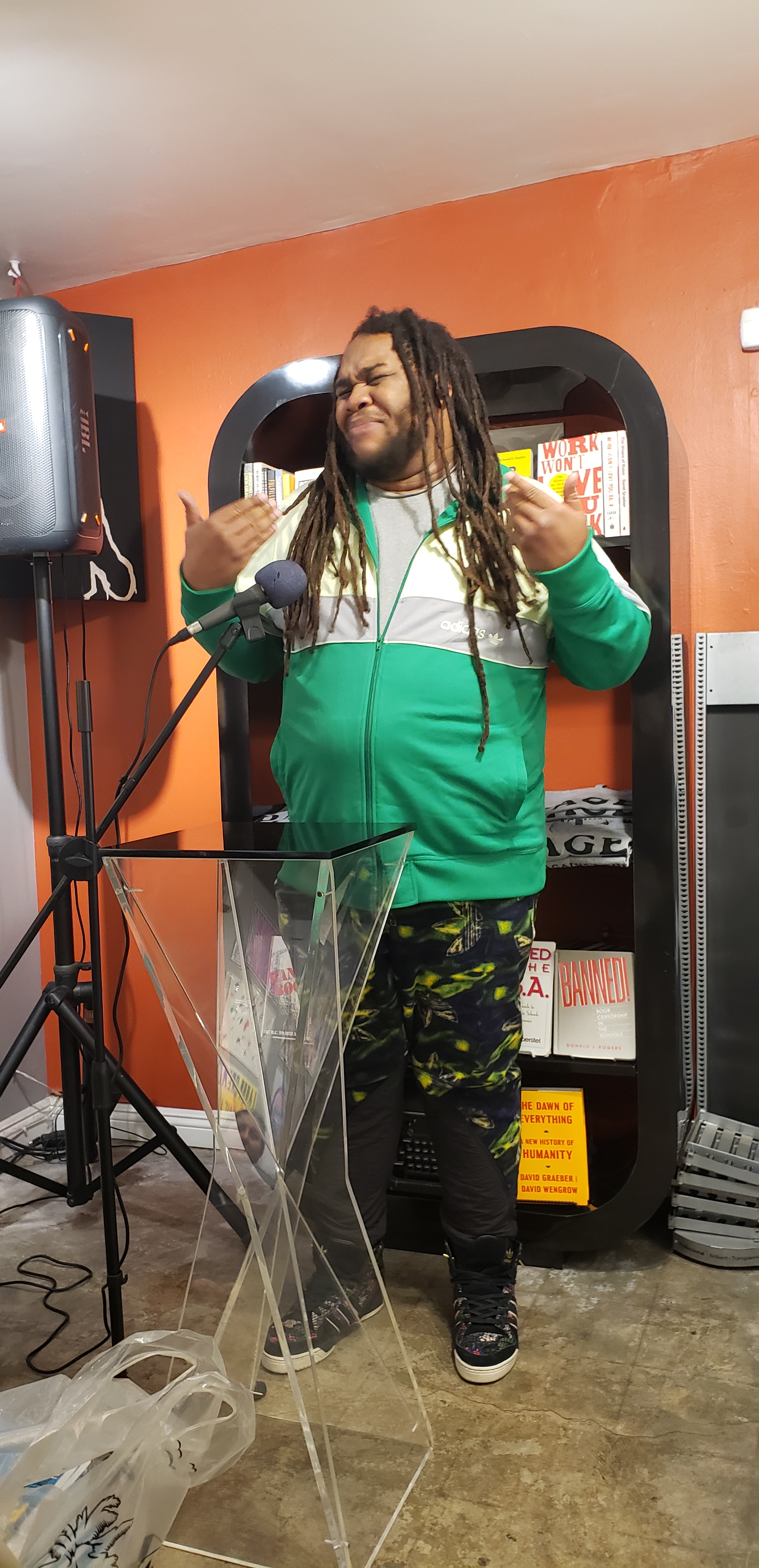
The reading was mixed. Featuring was F. Douglas Brown, African American Literature teacher at Loyola High School and academic poet; Cassandra Lane, Editor-in-Chief of L.A. Parent Magazine and prose writer; and Kuahmel, host of Under Mic Influence and a performance poet. Many in the crowd, as well as Cassandra Lane and Kuahmel, had not heard of this activist bookstore before the reading. I overheard several audience members express their appreciation for Giaco’s mission to offer “Fightin’ words for mass defiance, empowerment, and self-reliance.” Poets whose paths don’t often cross, like Derrek D. Brown and F. Douglas Brown caught up.
This was a reading celebrating the diversity of Black Voices. In style. In content.
The F in F. Douglas Brown stands for Frederick as in Douglas, after the prominent activist, author and public speaker who escaped slavery in Maryland in 1838. He’s most famous for writing the autobiography Narrative of the Life of Frederick Douglas, an American Slave, written by himself.
Brown has had to carry the weight and legacy of Douglas with him wherever he goes. He wrestles with this legacy and legacy itself in his 2018 poetry collection Icon. He does so through ekphrasis and multitudes of historical insights and forms as he expands on the portrait of Douglas and other Black Americans. During his reading, Brown read the poem “Mr. Covey, Shall We Dance?” from Icon, about the time Douglas stood up to his master. In the last stanza is where Brown writes what happened when Douglas won the fight:
The shame blurs
your vision. We wrestle like this
for two hours, but for the rest of my
life, no one beats me again.
Cassandra Lane is from the small Louisiana town of DeRidder. Coming from the rural and economically poor town her family had lived in and near for generations, she fell in love with the snippets of family history she learned. That love of her stories eventually lead Lane to become a journalist, first at the newspaper in northern Louisiana where she had done her college internship, eventually leading to New Orleans and the Times-Picayune.
In Long Beach, Lane read the editorial she published several weeks prior in the Los Angeles Times, “Why We Need Stories of Both Black Pain—and Joy.” The editorial discusses what stories we tell about ourselves, our people and our communities and which of those stories we deem appropriate to pen, through her personal example of Black America. She discussed it in the context of writing her memoir We Are Bridges, chronicling her family’s history, starting with her grandfather who was hung for being too “uppity.”
Kuahmel was the evening’s orator. His spoken words were sharp, his wordplay fluid and vivid. From Gardena, two poems in particular spoke to the complete and full portrayal and understanding of Black L.Á. and its history. In one, Kuahmel called out the stereotypical portrayals of South Central directly, of the neighborhood being void of culture and activities before launching into a memory of crusin down Crenshaw Blvd.
As a writer of place, I’m a sucker for authentic portrayals of Los Ángeles, where I not only can see, but feel these familiar versions of our city—Kuahmel mentioned the Fox Hills Mall were I’ve shopped at off and on my entire life, for example—that re not mine.
As everyone gathered headed home, in the unusually cold February night, my hosting duties complete, these three distinct Black voices expanded and bridged the literary community that had shown up at Page Against the Machine.

 Los Angeles Literature