
Percival Everett’s Dr. No is more than a satire of James Bond.
By Anita Felicelli
FROM: Alta
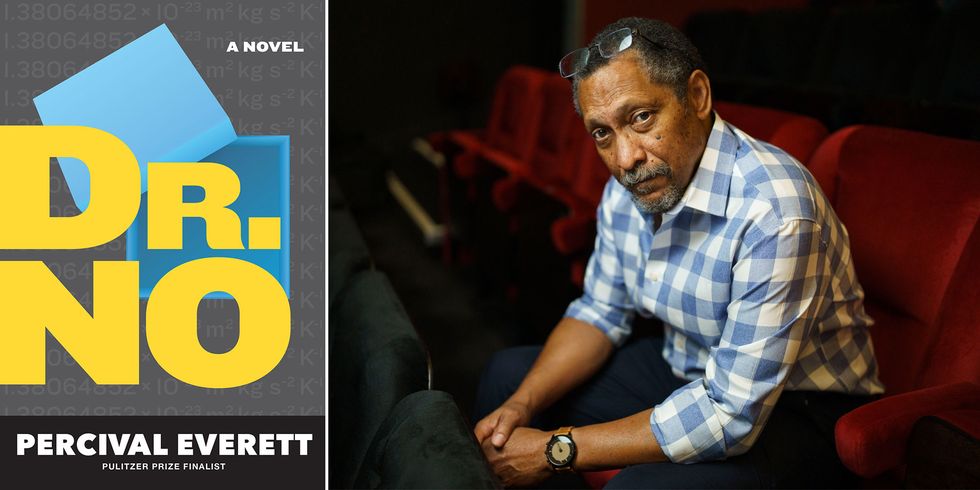
A parody of 007 movies, Percival Everett’s novel Dr. No announces itself as a highly referential screwball comedy straightaway. The narrator tells us that his name is Wala Kitu. “Wala” means “nothing” in Tagalog, and “Kitu” also means “nothing,” but in Swahili. The name, then, appears to be “nothing-nothing”—a mock double zero, or negative of a negative. Yet as he’s wont to do, Everett quickly upends these assumptions when he reveals that the narrator’s real name is Ralph Townsend. He’s a Black mathematics professor, a later-day version of the kidnapped genius-baby who narrates Everett’s 1999 novel, Glyph.
Because of his mathematical expertise in “nothing,” Kitu is engaged by the billionaire John Milton Bradley Sill, a self-styled Bond wannabe. Sill’s ambition is to break past the legendary gold-guardian security and steal a shoebox of nothing from Fort Knox. And yet even this is complicated. He became a villain, after all, not for villainy’s sake but rather for revenge. His father was killed by a fictionalized version of James Earl Ray, who was convicted of assassinating Martin Luther King Jr. A white chief of police killed his mother. In a prison scene that echoes the 1997 confrontation of Ray by King’s son Dexter—the family has said they believe Ray was part of a conspiracy—Sill questions the fictional shooter about his father’s murder. “I won’t take your life,” he concludes. “That doesn’t have much value. I’m going to take your world.”
Such revenge is, in some sense, empty, but also deadly serious: Sill means to stand against a white supremacist society. Because he likes to surround himself with people smarter than he is, he cajoles Kitu into an ongoing consultation. “When I open the vault,” he asks, “and I will, how will I know that nothing is there? It’s a big vault. If it is full of nothing, then how will I move it? How does one transport such a thing? Does it need to be refrigerated at minus 273 degrees Celsius?”
The premise suggests a kind of inverted version of Goldfinger—an allusion heightened by the shared use of the name Auric. Read Rest of Review Here

 Los Angeles Literature