
By Brian Dunlap
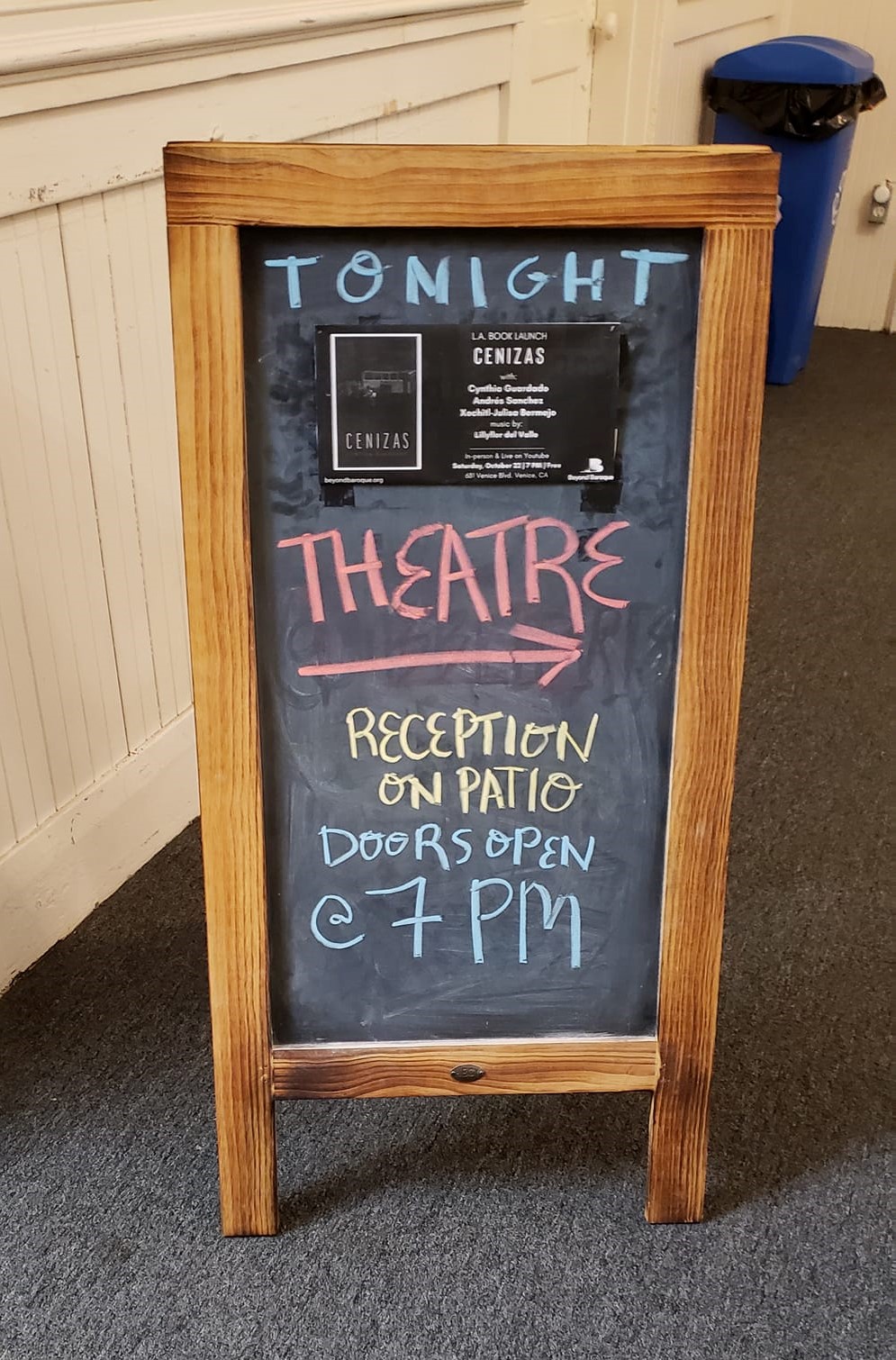
The theatre at Beyond Baroque was 70% full. The black lectern stood under a spotlight in the center of the stage area in front of a red curtain. Andrés Sanchez and Xochitl-Julisa Bermejo sat in chairs along the front wall, near the entrance, waiting for their turn to read.
Before entering the theatre, my parents and I ran into South Central poet and Santa Monica College Professor bridget bianca, in the bookstore, where we got into a discussion about the literary events we’re setting up for next year. bianca spoke about how she partnered with her city council member, Marqueece Harris-Dawson and his office, to acquire funding to put on the readings, open mics and other events in South Central and to pay the writers for featuring.
Back in the theatre, the audience had gathered for a book release party. For the release of Professor, Salvadorian American and Inglewood native, Cynthia Guardado’s, second book of poetry Cenizas. A collection of poems drenched in her Salvadorian identity, exploring the inherited past, the lived experience of a child of immigrants who continuously returns to their homeland, a “portrait of a family whose fate was shaped by global politics and conflict,” and “press[es] on the pulse of [the] exodus from El Salvador,” of its citizens due to the country’s civil war.
Cenizas took 10 years for Guardado to complete, beginning as her thesis at Fresno State. Poems were added, removed, rewritten, reordered. The manuscript was submitted to book publication contests, being a finalist for the 2019 National Poetry Series Open Competition. She took trips to El Salvador to see family and for research.
But first, Lillyflor del Valle, a first generation Salvadoreña from the San Fernando Valley, graced the stage with her music. At one point during her set, she played some son jarocho, having learned to play the requinto jarocho by taking Tía Chucha’s son jarocho class.
Each performer was better than the last. Lillyflor was followed by San Gabriel Valley poet Xochitl-Julisa Bermejo, who was followed by trans masculine and World Stage Press poet Andrés Sánchez. Sánchez read a new poem from their manuscript in progress.

Then it was Cynthia Guardado’s time to shine. Knowing her as a friend and having read her debut Endeavor, I knew the rest of the evening would be difficult and heavy in the most necessary ways. Guardado never shy’s away from the difficult truths society needs to confront. In her “Cal Me Refugee” series of poems, Guardado becomes a historian the best way she knows how, through the lens of a poet. She documents the Salvadorean civil war, its cost, the trauma it inflicted, the freedom and safety it ripped away from its citizens, far from the trauma porn lens the civil war is so often contextualized in. These poems are not for the white gaze.
Guardado’s poems sat heavy—“Below/a little girl carries her youngest brother, & no one sees her feet sift/smoke; it pulses”—put me in a place of deep contemplation, the humanness of the people she depicts, how this is what people talk about when they talk about the power of literature and the importance of using your voice to say something important. The importance of telling her people’s and her family’s stories, was punctuated when Guardado’s voice wavered and her eyes welled up mid-poem. At one point she mentioned how she couldn’t read her words. Her vision was clouded by tears.
When the reading was over, the crowd funneled out to the Poets’ Garden, where Guardado signed books, people mingled, snacks and drinks were available, and where I saw poet Michelle Brittan Rosado before a light drizzle began that drove everyone inside.
When my parents and I headed home, Cynthia Guardado’s poems still sat heavy within me. Especially her epic poem “Diaspora”—“I’ve lived in a state of permanent limbo since my birth in Boyle Heights./I was born dying…/In me grew a deep silence (I would not speak)…/I could not utter words, my spirit silently clinging/to the ashes of my ancestors—to the cells of my mother’s womb.”
NOTE: All the quotes in the article come from Cynthia Guardado’s book Cenizas.

 Los Angeles Literature