
By Brian Dunlap
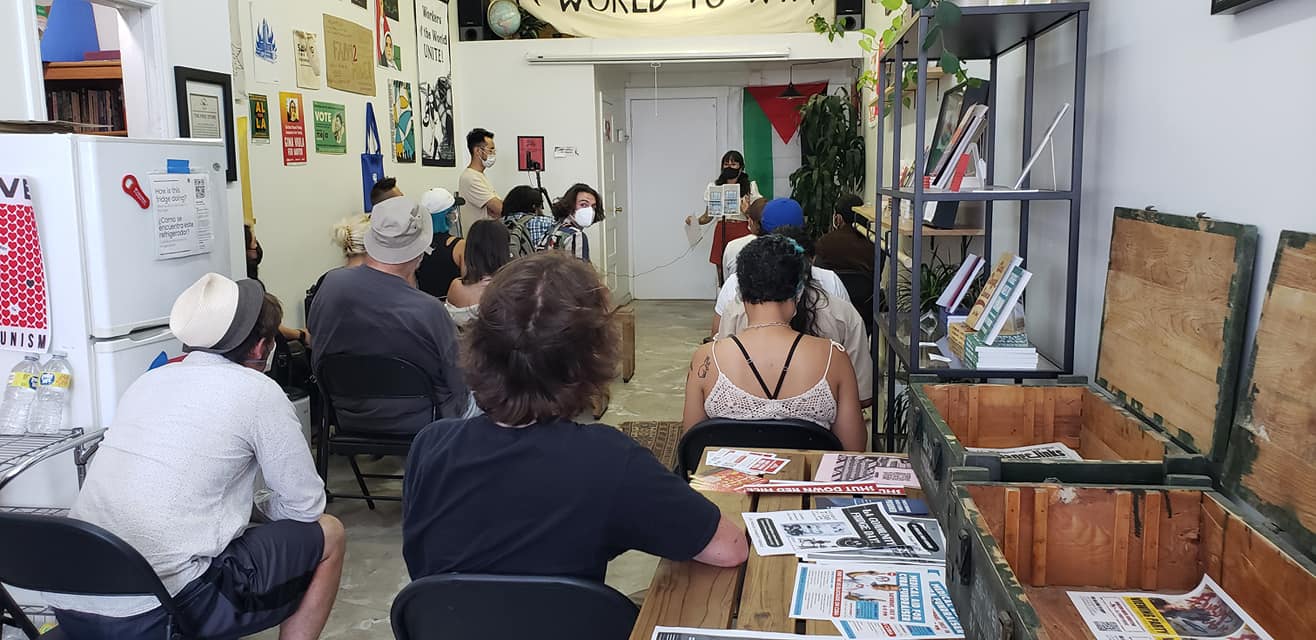
All Power Books in West Adams is easy to miss. It’s a nondescript storefront on West Adams Blvd. along a street of nondescript storefronts. But it’s importance is evident as soon as one walks in. There are a few books on the shelves—”Freedom Is A Constant Struggle” by Angela Y. Davis, “In The Red Corner” by José Carlos Mariátegui and “We Do This ‘Till We Free Us” by Mariam Kaba—among a rack of T-shirts with the words Working Class or All Power Books printed in white or black block letters on the front or back; pins that read No 4 LAPD, the 4 centered inside a pink heart and Be The Change; and prints reading Indigenous Peoples Protecting Mother Earth Since Time Immortal, an indigenous woman raising her fist in the bottom center; and a sticker reading People Over Profits in black block letters on a turquoise background, among others, displayed on a table near the front entrance. There is even a fridge stocked with free food and water for anyone who needs it. It becomes obvious that All Power Books is more community and workspace for those in need and their allies, a safe space where the left can be in community and work towards rebuilding a more humane society.
I was invited to All Power Books last Sunday by L.Á. poet and activist Briana Muños for a poetry reading in support of The Peoples Coalition, funds raised going towards their Free Grocery, Harm Reduction and Prison Writing Programs. Former Los Angeles Poet Laureate Luis J. Rodriguez, former Executive Director of Beyond Baroque Richard Modiano and Leslie Ortega, were the evenings featured poets, who read powerful, humanizing and personal political Poetry. Muñoz opened the reading by sharing a new poem criticizing the newly opened, redesigned 6th Street Bridge, arguing city funds would have been better spent on social services, among other points.
I had not heard of Leslie Ortega, whom Muños first heard read at the Sims Library of Poetry. Leslie Ortega is a young poet who read poems that spoke personally to her lived experience as a Chicanx who grew up and lives in Southern California. One she read was about MacArthur Park/Westlake, that brought to life the everyday of its vast majority Latinx population as she travels to and from work. She also brought copies of her self-published chapbook Las Venas, that includes several heartwarming, powerful and funny poems, humanizing her bus driver father.
After the reading, I found out from Kat, an energetic volunteer/ employee, that All Power Books is relatively young, a year old. She admitted it’s only a bookstore in the loosest sense. She ran back inside to give me the non-profits’ business card, a bookmark.

Richard Modiano read second. Before he read, he mentioned a collection of his poems will be published later this year. Then, he read several searing poems that held the U.S. accountable for not fully confronting the devastating human cost the bombs they dropped on Nagasaki and Hiroshima, caused. In one poem, Modiano mentioned that at a government remembrance of the dropping of the bomb, the president said no survivors were allowed to attend.
Luis J. Rodriguez was the last poet and writer to read. As a fourth reader was unable to attend, Rodriguez had plenty of time to read and he made sure to use all of it. He read a new poem about Los Ángeles that envisioned L.Á. as it should be: fair, equal and affordable to all. He then took time to read from his novel Music of the Mill, “set in the industrial boom of post–World War II Southern California, where jobs seemed plentiful, communities thrived, and racial harmony prevailed. However, while postwar prosperity seemed to supply jobs to many migrant African American, Mexican, and poor white workers, in reality there was great struggle and racial discord—low-paying, backbreaking labor and the cruel manipulation by manufacturers who pitted groups of workers against one another,” according to Amazon.
The workers in the novel are employed by the Nazareth steel mill. Rodriguez explained the plot and the history behind it, both personal (his experiences working at Bethlehem Steel in South Los Ángeles) and historical, that inspired him to write the novel. Most people don’t know Los Ángeles has deep history of manufacturing, stretching from World War II through the 1980s, more prominent in the city at its peak, than any other city in the country.
The excerpt Rodriguez read was from when the union and Klan leader, Earl Denton, has a heart attack at the mill, mere days before his retirement. Laborers move in front of Turk, who wants to help. He “knows what this means: Leave the KKK man alone. Let his death rattle be the music the mill gives back for treachery, for hate, for pain.”

Once the reading ended, I spoke to other poets who attended: Kuahmel, a poet who MCs all types of literary events from L.Á. to Long Beach; and Matt Sedillo and David Romero, who had recently returned from featuring at the first annual Elba Poetry Festival in Italy.
At the end, when I talked to Kat, she told me All Power Books are always open to literary readings. An invitation was extended to me, to host one in the future.

 Los Angeles Literature
Great post Brian! I think you really captured what the space offered that day and moving forward. It was nice meeting you! really appreciate the blurb about my poetry.
LikeLike