
By Brian Dunlap

Latinx Poets and Writers of the World Stage Press descended on Village Well Books and Coffee in Culver City last week. The evening was cool and the restaurants in downtown were crowded with dates, families and friends, conversations rising on top of each other, out over the sidewalk. Inside the bookstore, six authors—Lisbeth Coiman, Cynthia Guardado, Alex Petunia, Poet Astrid, Carolina Rivera Escimilla and Andy Sanchez—graced the mic. Six Latinx writers. Six distinct voices. No monolith here.
In the crowd sat press co-founder Hiram Sims.
These six poets wore their culture and identities—Venezuelan, Salvadoran, Mexican, multiracial, trans masculine, American—on their sleeves.
The host, Lisbeth Coiman, read first. She began by reading the opening to her self-published memoir I Asked the Blue Heron. “I was sixteen when my mother chased me with a hammer. I locked myself in the bathroom.” This was the late 1970s in Venezuela where the only place she could escape this domestic violence was “a correctional facility where there will be no distinction between a young woman running away from her angry mother and a young criminal.” After, Coiman read a few poems from her bilingual poetry collection Uprising/Alzamiento, deeply personal political poems that weave together Venezuelan history and current events with personal narrative to excavate what it means to love and grieve a homeland turmoil.
As the reading wore on, many passers-by slowed, glanced long through the windows that adorned the front of Village Well, intrigued by the voices and people inside, but never stepped in. The crowd in attendance was smaller than other events I attended at Village Well, but they all listened intently as the store was silent, except the snaps for words that rang heavy and true and claps in thanks for the authors sharing their words.
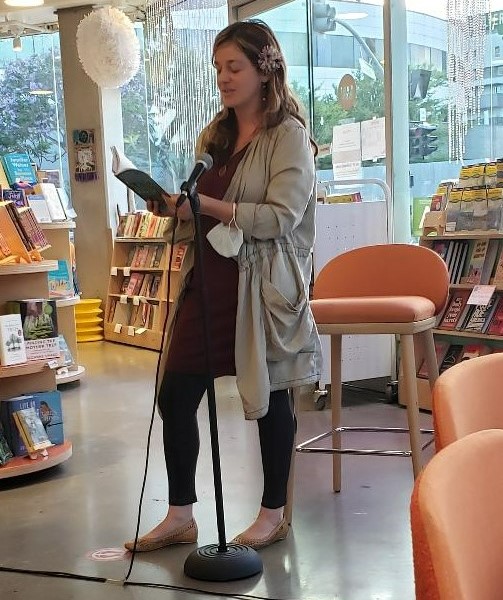
Alex Petunia read next. As a queer, multiracial, poet and nurse from Chicago, she read poems from her debut collection Tending My Wild. Poems on cultivating self-worth and deepening her purpose after the childhood trauma of living with a drunken father. The poem that stuck out to me, was the heart-warming “Family Tongues,” that came out of a Community Literature Initiative prompt about capturing the way you the poet, and your community speak.
          If I could have all my people for one meal together
          this is the crazy love you would feel
                        Besos on every cheek…
                        A hearty serving of “How’s my girl?”
                        From mom…
          There’d be tias and titis,
          uncles and aunties,
          grandparents and grandkids,
          Welo and Wela…
The poem is an authentic blend of Petunia’s white and Mexican family and her Chicago roots.
Andy Sanchez read next. This trans masculine poet from Mexico City again read from their collection This Body, about their personal coming out story as a queer/trans person of color. They read the poem that stuck out to me the last time I head Sanchez read, in Long Beach. How they never felt at home, never felt they belonged, growing up in the Southland, in Santa Ana and other Orange County cities, where in one they got hit in the head by a rock thrown at them because of who they are.
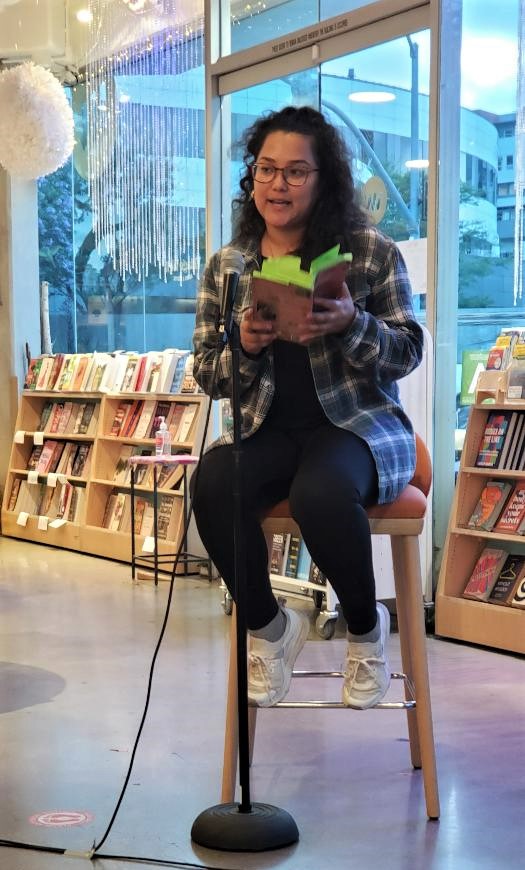
After, Salvadoran American poet, journalist and L.Á. native Poet Astrid graced the mic. She got into poetry while studying Business Administration at Cal State Dominguez Hills, becoming caption of the slam poetry team and president of the poetry club, F.L.O.W. Since, she’s published her debut poetry collection Through the Soil in My Skin, as she said in a Shoutout L.A. interview, is about, “cultivating self-worth from the perspective of my personal, spiritual journey and uproots the depths of love through my romantic relationships and absent father.”
In-between poets, Lisbeth Coiman proposed a lightning round, once all features had read, each poet reading a poem each, to end the night.
The last two poets who read were Salvadoran American. Carolina Rivera Escamilla grew up in an El Salvador of social, economic and political repression, resulting in the Salvadoran Civil War, fought between the military-lead dictatorship backed by the U.S. and a coalition of left-wing guerrilla groups. Still, she was able to find life full of magical experiences, according to her website, within the intimate life of extended family. Her father, the master builder, who taught Escamilla and her siblings to mombo, dancing alongside them, remembering to celebrate life in a time of war, and her mother who filled them with stories. Then, in the mid-80s, Escamilla went into exile in Canada: to escape the rape; disappearance of fellow citizens, especially young people like her, for any preconceived criticism of the government; and the spying by soldiers, that ran more and more rampant, before settling in L.Á. in 1990.
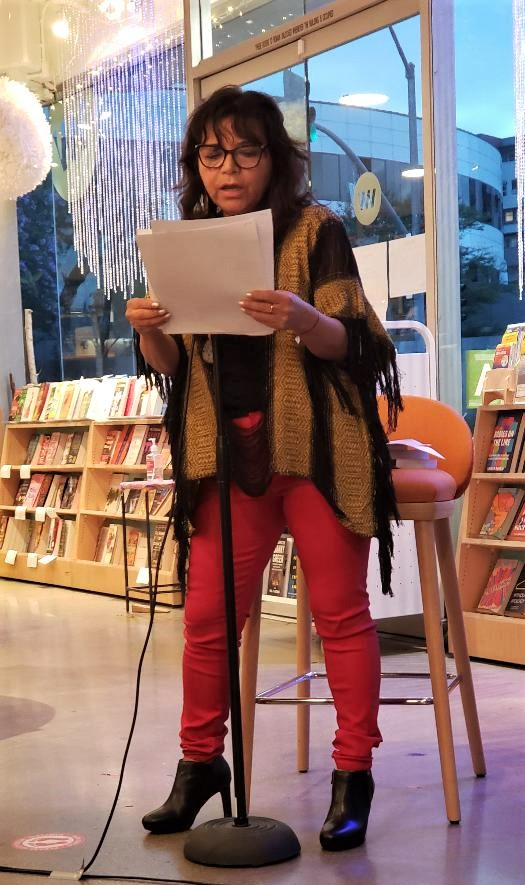
Escamilla read from her novel in stories, …after…, a fictionalized version of her childhood that ends with the young woman entering into exile, and newer work, several poems she’d printed out.
I’d read her book the month before and wanted to meet and thank her for writing powerful stories that explicitly explored the personal impact of the political.
Last, Cynthia Guardado read her heavy poems. Though she was born and raised in Inglewood, and attended UC Santa Cruz for undergrad and graduated a year ahead of me in Fresno State’s MFA program, her connection to El Salvador is as strong as if she was born and raised there like her parents. In a lot of her poetry, she writes about the broken country from an honest place of love and beauty, while not being afraid to examine El Salvador’s troubled past and present. Able to speak on the now.
The most overtly political poet of the evening, Guardado kicked off her reading by speaking about the current state of El Salvador and how its president governs like an authoritarian, for example, sending police and soldiers to arrest gang members to decrease the murder rate, on as little as rumors of gang affiliation, delaying due process once in jail. After reading “This Burning Earth” dedicated to Rufina Amaya—December 11, 1981, from her debut collection Endeavor, Guardado read several from her upcoming collection, Cenizas, portraying a Salvadoran family whose lives have been shaped by the upheavals of global politics. At the end of the evening, the lightning round again demonstrated the distinct Latinx Voices of the World Stage Press. A poem about good times with family, another about going to the club with your girls on a Friday night. Then, back out into the cool Culver City evening, Village Well Books and Coffee now dark.

 Los Angeles Literature