
In “Dear Memory,” Chang experiments with the grammar of loss, addressing letters to those who will never respond, and finding meaning in their silence.
By Kamran Javadizadeh
FROM: New Yorker
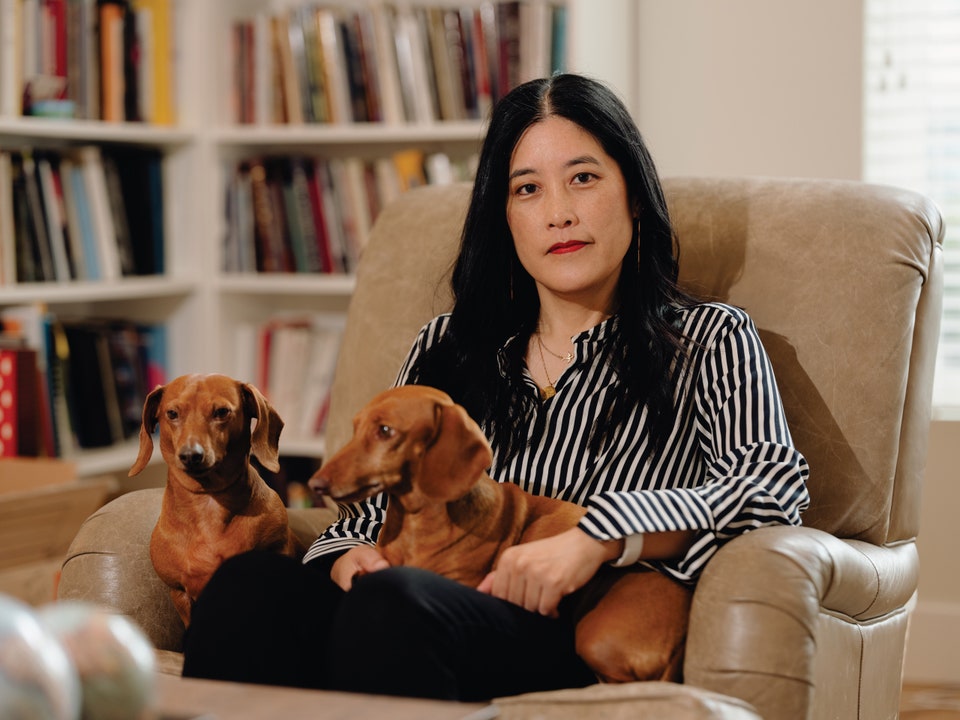
Certain losses change your grammar. The writer Victoria Chang lost her mother six years ago, to pulmonary fibrosis. Six years before that, her father had a stroke, then slid into dementia—there but not there, another kind of lost. In “Obit” (2020), a book of poems written in the form of newspaper obituaries, Chang observes the effect of these absences on language: “The second person dies when a mother dies, reborn as third person as my mother.” The lost loved one is no longer a “you”; she is someone Chang can describe but can never again address.
“Obit” accepts this transformation of grammar as generative poetic constraint: the obituary is defined by the remove of the third person, the brisk objectivity of someone writing about death on a deadline. The book is a catalogue of losses, from the obviously traumatic (“My Mother,””My Father’s Frontal Lobe”) to the seemingly trivial (“Voice Mail,” “Similes”). Chang has said that she chose the obit form because she “didn’t want to write elegies.” The elegy, poetry’s traditional response to death, is a genre for mourning, usually in the first-person singular. By contrast, an obituary measures; it yields a public record of a completed life. Chang’s poems, too, attempt to contain loss. Occasionally—beautifully—those attempts falter. The book includes four obituaries for “Victoria Chang.”
A year after publishing “Obit,” Chang is still writing about her grief. Now, however, she is speaking not only of loss but also to it: her new book, “Dear Memory” (Milkweed), is made up of letters—to the dead and the living, to family and friends, to teachers, and, ultimately, to the reader. She has given up the authority of the third person for the vulnerability of direct address. If “Obit” sought a container for loss, “Dear Memory” is a messier formal experiment, an open-ended inquiry not of a bounded life but of an ongoing present, full of longing and imperfection. Read Rest of Article Here

 Los Angeles Literature