
By Sean Hooks
FROM: Full Stop
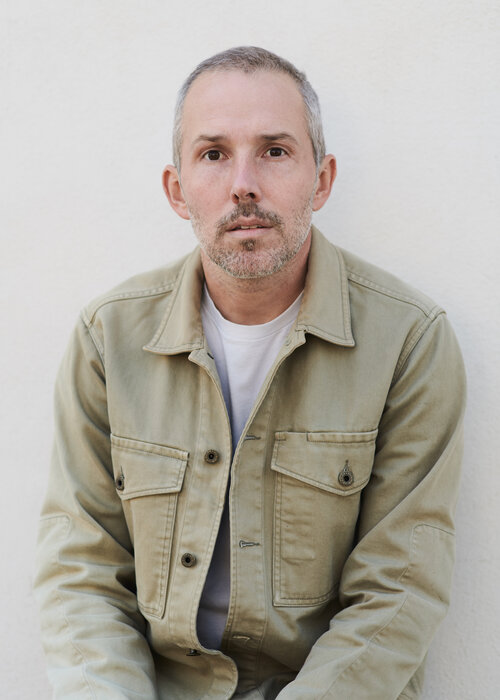
Author of articles and essays in The New York Times, Los Angeles Times, Wall Street Journal, The Guardian, GQ, Esquire, Salon, and Slate, Rosecrans Baldwin has published the novels You Lost Me There (2010) and The Last Kid Left (2017), and the nonfiction titles Paris, I Love You but You’re Bringing Me Down (2012) and his newest release Everything Now: Lessons from the City-State of Los Angeles, published by MCD/FSG. It’s replete with cultists, wildfires, earthquake lore, working-class thespians, DIY survivalists, Border Angels, gamer collectives, labor trafficking survivors, and assorted Angelenos who could be said to be vagabonds (or wastrels). Despite reckoning with a litany of contemporary apocalypses, it remains a book levied with humor, including an inventive appropriation of Charles Bukowski’s character Henry Chinaski, an exposé of the lampoonable greed of investment trusts that view human suffering as a once-in-a-lifetime opportunity to “buy low,” and a hilarious depiction of a screenwriting team’s meeting with Hollywood producers gone awry.
Sean Hooks: Let’s start with the dystopian aspects of Los Angeles: Erewhons and Whole Foods abutting massive homeless encampments, the Stepford Wives quality of planned communities like Lakewood, Panorama City, and Irvine (not to mention Playa Vista and the sprawling techno-plutocracy of Silicon Beach), The Atlantic reporting that schools in neighborhoods like Santa Monica and Beverly Hills have vaccination rates (for traditional vaccines) as low as Chad and South Sudan, and of course the noxious air quality hovering over low-wage serfs who scry the city’s sci-fi-like post-Covid quadrants to deliver squiring and food services to their modern-day feudalist lords. Near the end of your book, you state that “depictions continue to be overly optimistic or pessimistic” and quote local columnist Steve Lopez on how L.A. is “in greater need of critics than defenders.” While Everything Now eschews easy responses by etching a series of persuasive and diverse engravings of the city-state, I’d wager that most who ingest the whole of your text will say that the negatives seem to outweigh the positives. Is this a fair reading?
Rosecrans Baldwin: I think it’s fair. I don’t know if the moral universe bends to justice, but I try to take the long view on most things. At the same time, it’s a grind when it seems like every overpass within a hundred miles of where I live includes an encampment. Some of Los Angeles’s biggest problems are in plain view: housing, mental illness, drug addiction, environmental blight. And some problems are harder to detect: income inequality, racism, our prisons and law enforcement, our educational failures. Los Angeles is full of fissures. People fall through the cracks constantly. At the same time, at least for the moment, I’m not interested in living anywhere else, at least not in the United States. There’s just so much here to fight for, to relish, to keep you on your toes. I was talking to the painter Friedrich Kunath recently and he made the point that Los Angeles is a broken promise, an unfulfilled promise, but that just means there’s an opportunity to fix it, to fill it, and I thought that was pretty good.
SH: I’m interested in your book’s title and framing. A city-state is a particular way that homo sapiens organize themselves, different from a cosmopolis, megalopolis, conurbation, or metroplex. Wikipedia notes that “unlike most metropolitan areas, regional identity remains a contentious issue in the Greater Los Angeles area, with many residents not acknowledging any association with the region as a whole.” One of your interview subjects, deputy city manager in Lakewood turned author D.J. Waldie, says: “People who live here make a distinction between the municipal boundaries of the City of Los Angeles and the bigger thing called L.A., which extends into Orange County, out almost into the desert. We know we live in L.A., but we also know we don’t live in Los Angeles.” And you and I could talk endlessly about economic fragmentation, the permutations of class and gentrification (a la historian Mike Davis, one of the surfeit of sources you draw from, and the one most singularly close to a spirit animal, I’d argue), and the various regional distinctions — The OC, Long Beach, Pasadena, DTLA, Venice, Inglewood — but I most want to hear how you perceive the post-Covid, post-Biden scene and allow you to start by speaking to L.A.’s present incarnation and its evolving reputation in the hyper-present “now” alluded to in this book’s title.
RB: The city-state model works best for me as a frame of understanding L.A. because it addresses size and scope and the feudal class structure, that sense of shared feeling and stressors and destiny, no matter the kaleidoscopic diversity of humans and built environment. But the model is more metaphor than fact; Los Angeles is still a city in the United States. And yet that doesn’t sit quite right in my understanding, factually, especially when I drive around and talk to people.
To your point about Waldie’s comment, it’s funny, there’s a moment in Los Angeles Plays Itself, Thom Andersen’s great film about L.A.’s role in the movies, where Andersen talks about (if I’m remembering this correctly) disliking the term “L.A.” in lieu of “Los Angeles.” That the diminutive is belittling, silly, more branding than true identity. And I used to agree with him, but I think I’ve come around, I kind of love it as the best name — as Waldie alludes to — to describe the great morass that is the many counties’ spread. It’s certainly better than “The Southland.”
I don’t know yet what post-Covid L.A. will look like, of course, but Covid-era Los Angeles has felt and feels very city-state-like to me. The wealthy (and healthy) serviced by the non-wealthy (and exposed). The image of Garcetti’s face on our televisions, on the giant video billboards at Dodger Stadium’s testing/vaccination site, while his ministers and the county supervisors mix their messaging. We’re still too close to the pandemic to know L.A.’s experience in bigger terms than case counts and deaths and nurses’ testimonials, but we’ll have it soon. Read Rest of Interview Here

 Los Angeles Literature