
By Michael C. Baradi
FROM: LAPL Blog
I used to be a Messenger Clerk at the Cahuenga Branch Library many years ago, still undecided about being a librarian. Back then, my favorite pit stop before my shift was over was the 979.41 area, where my book truck occasionally blocked the aisle, as I browsed through anything devoted to the history of Los Ángeles, anything with photographs. I probably came across the name Charles Fletcher Lummis on those detours, that he was the City Librarian in 1905, and helped increase library use by implementing outreach programs. But before Charles became a librarian, before becoming an author at Scribner’s, and before becoming the first City Editor at the L.A. Times, Charles had published a poetry collection, while still a student at Harvard. The library owns two reference copies of Birch Bark Poems.
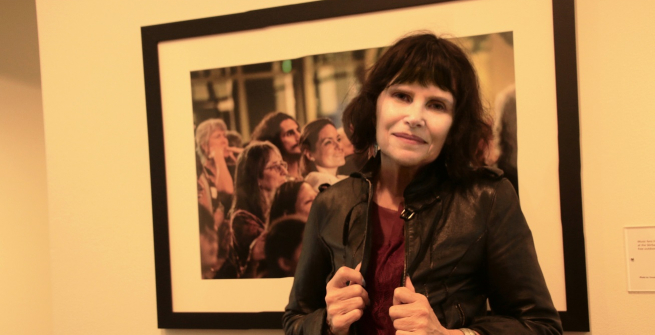
Now while Charles didn’t devote his writing-life to poetry—since he had many interests—one could argue that poetry runs deep in the Lummis blood. The subject of this interview is his granddaughter, Los Ángeles poet Suzanne Lummis. Suzanne earned her MA in English in 1978 at California State University-Fresno, where she studied under Philip Levine, Peter Everwine, and Chuck Hanzlicek. At Fresno, Suzanne absorbed the poetic sensibilities of the Fresno school of poetry, which is “characterized by a direct personal voice, a language both lyrical and colloquial, and an image-based fidelity to the tangible world, whether rural or urban,” to borrow Suzanne’s words from her website.
Suzanne is also associated with another school of poetry based in Los Ángeles: Stand-Up Poetry, which embraces the energy of performance poetry; the term was coined in the 1980s by another Los Ángeles poet Charles Harper Webb, who collaborated with Suzanne to assemble an anthology. The library owns a few copies of that anthology, Stand Up Poetry: The Poetry of Los Angeles and Beyond (1990). Suzanne also edited Wide Awake: Poetry of Los Angeles and Beyond (2015). In 2013, her third full-length poetry collection Open 24 Hours won the Blue Lynx Prize for poetry. Her first full-length collection was Idiosyncrasies (1994). Suzanne has been teaching poetry at the UCLA Extension Writers’ Program, since 1991.
After reading In Danger during lockdown—Suzanne’s second full-length collection—I nurtured an interest to interview her. I love her wit and humor. But more so, she was refreshingly candid about many things in this interview, from where she used to live on Vermont Ave, to Bukowski, Marilyn Monroe, and her grandfather, Charles Fletcher Lummis. Now at one point, I read some of Suzanne’s poems on my iPhone at a Kaiser Permanente waiting room, when I drove my parents for the second dose of the Moderna vaccine. One of those poems was published in The New Yorker in 2014. I started the interview on that poem.
* * * * *
Back in 2014, The New Yorker published your poem “How I Didn’t Get Myself to a Nunnery.” The poem talks about—from my perspective, at least—a great escape. Was there an element of escape, when you chose to devote your life to poetry, early on, before going to grad school in Fresno? Was it always poetry, as opposed to, say, fiction or theatre, even the sciences?
I decided on poetry in elementary school, I’d been attracted to acting even before that. I’d hardly seen any movies; we never owned a TV, ‘till I was into my teens. My first experience of a non-animated movie was The Seventh Voyage of Sinbad, special effects—I now know—by the ground-breaking Ray Harryhausen. I wanted to escape then, yes. I wanted to be an actress, to beat fate by living more than one life, to beat death (almost), and—above all—to inhabit magical realms.
Of course, I didn’t know how movies were made, really. I didn’t know actors spend most of their hours waiting in trailers—that is, trailers if they’re the stars, waiting somewhere else if they’re less important. I believed you really got to step into these other worlds, where magic lived, where heroes defeated monsters, and everyone could be the hero of her own, his own, story. What can I say? I was very young.
Today, we probably consume special effects, in film, at a level that Ray Harryhausen could never have imagined, when he was pioneering it. The numbers prove it for Netflix during the lockdown, the tremendous increase in viewership because of social distancing protocols, the need to escape, and, in many ways the need “to beat death […] and inhabit magical realms,” to borrow your words. Now one can argue that you’ve been inhabiting more than one life, through writing itself, in poetry, like the persona you inhabited in The New Yorker poem, and other poems. Here, the magic happens the moment you work with metaphors, or seduce the reader with irony. I’d like to think that metaphor and irony are like the main apps that create the most memorable special effects in poetry. In fact, they’re probably the main tools you use to confront monsters in your work?
Tantalizing to think in terms of poetry and monsters. Does poetry fight monsters? Can one poem take on one monster approximately its own size? Could there be a David vs. Goliath match, with, of course, the poem as the underdog, the long odds? The Dark Horse. Ali versus Sonny Liston. Some thought Ali might get killed, as in—Killed. I’ve read that for that bout an ambulance lingered nearby.
Who knows? Maybe sometimes the Poem is the fall guy. Or, is Poetry itself the monster—the freak, the misfit, the oddball? Maybe, just maybe—it depends on the poem. What kinda poem are we talkin’ about here? And what, who, is its opposition? These are my questions.
I know what I’m fighting. Lies and hypocrisy. Fighting and losing, ’cause it’s a losing fight. I’ve developed an aversion to hypocrisy, which is too damn bad for me because in our age I can’t walk down the street and turn a corner without running smack into it. I loath cowardly lies—from those who don’t have the guts to face the truth, so they cower behind these manufactured conspiracy theories and other forms of lies.
Therefore, some of my poems also hate lies, for example, the poem I evolved for my COLA (City of Los Angeles) fellowship, seven-and-a-half pages of—mostly—280 character stanzas without line-breaks, “Tweets from Hell.” The poem’s spoken by a figure who’s been condemned to a netherworld, some realm where the button that calls a steward to enter with a diet coke no longer functions.
Monsters. Tony Barnstone and Michelle Mitchell-Foust edited a terrific little Knopf anthology, Monster Verse: Poems Human and Inhuman. I recommend it—not just because I’m in it but because Elizabeth Bishop, Patricia Smith, Robert Browning, Charles Harper Webb, Robert Frost, and Oscar Wilde are in it too. Oh, and Apollinaire. And Grant Hier, first poet laureate of Anaheim.
You mentioned metaphors, similes, figurative speech—yes, that matters to me. I love all that. When it works I certainly do, but best a poet not push for it if it doesn’t come naturally. If it’s selling itself as a poem, though, it better have something.
I like language that has a certain imaginative charge, an inventiveness, an element of strangeness. I like poetry shot through with details both sharp and surprising. I hear an awful lot of stuff that’s…hmmm…It’s O.K. But it lands in my ear like prose or flat speech. Sure, you’ve got poets like Frank O’Hara and Jack Gilbert who wrote in rather plain, straightforward language, but they did interesting things with it. Their poems, the good ones, had compression, and, in Gilbert’s case, a quality of understatement that suggested great emotion below the surface. O’Hara exuded energy, a sense of freedom, spontaneity, and wit.
I just the other day went over Robert Hayden’s “Those Winter Sundays” with my Deep Poetry Knowledge Zoom group. That’s now a famous poem, and it sure as heck should be. It’s among the great 14-line poems of the past, I don’t know…65 years? The poem speaks quietly without embellishment or carrying on, but, wow, the details, and wow the economy. The quality of silence. And yet—the force of it. And the absence of self-pity. Read Rest of the Interview Here

 Los Angeles Literature