
by Mike Sonksen
FROM: L.A. Taco
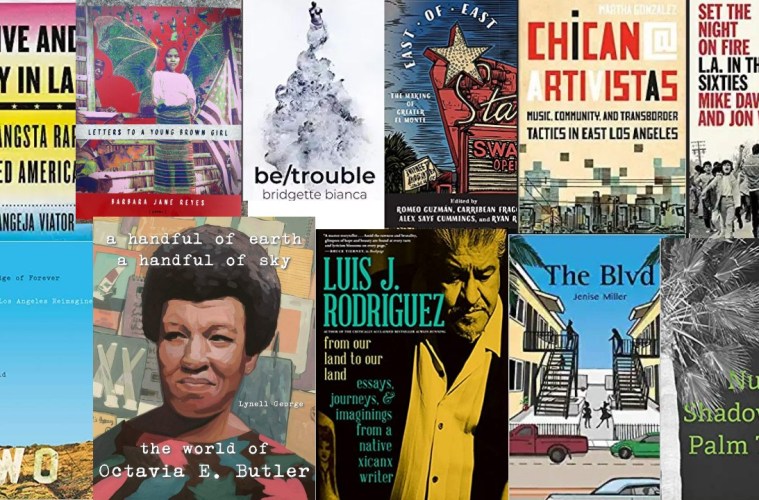
If COVID-19 was good for anything, it’s for reading. When the March rain and quarantine came, I got the chance to read all the books I wanted. This book list centers around Los Angeles and overlaps with creative nonfiction, poetry, urbanism, California history, music, and cultural studies. Most of these books came out in 2020, but a few came out at the very end of 2019. What follows are 32 books in alphabetical order by author—for the 32 years, it’s been since the Dodgers last won the World Series.
be/trouble By Bridgette Bianca
The debut book of poetry from an emerging femme heroine is literary fire from cover to cover. Bianca reminds us that “what’s understood don’t need to be explained/put some respect on our name / we are Wakanda / we ain’t never been conquered.” The South Central-born Bianca is a tenured professor at Santa Monica College that sees all. In poems like “there goes the neighborhood,” she holds everyone accountable: “south central los angeles became sola / como se dice bullshit.” She carries on the power of Wanda Coleman, Amiri Baraka, Nikki Giovanni, and Maya Angelou in these poems and remembers Sandra Bland, Trayvon Martin, Michael Brown, and Emmett Till. Imani Tolliver calls the book “a symphony of black love.” After reading this collection, you will know why she writes, “February ain’t long enough to get us right.”
Going All City By Stefano Bloch
Prolific graffiti writer turned cultural geographer and professor Stefano Bloch aka CISCO, the author of Going All City, came of age in the heyday of the early 1990s Los Angeles graffiti culture. He grew up poor in the San Fernando Valley. Writing graffiti from his very early teens, Bloch eventually went to Los Angeles Valley College, UC Santa Cruz, and then to UCLA’s Urban Planning School for his Masters and then the University of Minnesota for Ph.D. Ph.D. in Geography. As a graffiti artist in his teens, he knew the city intimately, so it makes sense he eventually excelled in geography. Bloch’s memoir is autoethnography, which goes beyond an ethnographic accounting because it includes the author in the story. Bloch’s book is a people’s history of the San Fernando Valley and one of the best memoirs of someone growing up in the 818. From being hit by a car on the freeway to being chased by police to narrowly escaping getting shot, there’s never a dull moment in this one.
Collisions at the Crossroads By Genevieve Carpio
Collisions at the Crossroads, by Genevieve Carpio, focuses on the evolution of the Inland Empire and how restrictions on free movement created segregated neighborhoods and how that shaped identity and racial hierarchies across the eastern suburbs of Los Angeles. Carpio shows how the Riverside Historical Society and many of the Inland Empire’s Route 66 historians manipulate their region’s history by remembering what they want to remember and ignoring the other accounts. The book’s subtitle “How Place and Mobility Make Race” is demonstrated repeatedly with the sections on the Chinese Massacre, Mexican American Repatriation, the rise and fall of the orange groves, Route 66, and the construction of the Federal Highway System.
Your House Will Pay By Steph Cha
Winner of both a Los Angeles Times Book Prize and the California Book Award, this novel is loosely based on the 1991 murder of Latasha Harlins. After almost 30 years, the book begins with the Westwood riot in 1991 when New Jack City was released. Centered on two families, the plot travels from South Central to Granada Hills to Lancaster and Palmdale, weaving a narrative of Black and Korean relations that grapples with murder, racial tension, repentance, and the difficulty of forgiveness. The book’s title was taken from a lyric in the 1985 Toddy Tee song “Batterram,” about the LAPD’s armored metal tank used to bash into crack houses. Filled with a reversal and unexpected plot twists, Cha’s book is as contemporary of an L.A. novel as it gets. Read Rest of Article Here

 Los Angeles Literature