
By Mike Sonksen
FROM: Pleaides: Literature in Context
 The recipient of both the National Book Award and MacArthur Genius Grant, Terrance Hayes is undoubtedly one of the most progressive Poets writing today. His latest book, American Sonnets for My Past and Future Assassin recently published by Penguin Poets is more contemporary than tomorrow. Composed during the first six months of the Trump presidency, Hayes meditates on America’s past, present and future with deep insight, sarcasm and compassion in 70 American sonnets. (More on what makes an American Sonnet in a few paragraphs.).
Hayes’s American Sonnets masterfully disrupt form and riff with a tenor more relentless than a bullet train: “You are beautiful because of your sadness,” Hayes writes, “but / You would be more beautiful without your fear.” The book begins with three lines from the late great Los Angeles poet Wanda Coleman: “bring me / to where / my blood runs.”
Hayes credits Coleman and her three decade project of writing American Sonnets as the inspiration for his new collection. Though this essay will focus even more on Coleman, Terrance Hayes’s poetic prowess carries on her innovative spirit forcefully. Furthermore, they both code switch and change registers within their poems with profound dexterity.
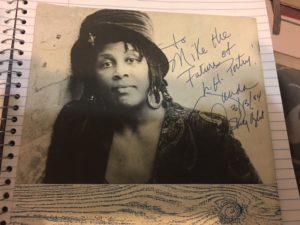
Wanda Coleman’s lyrical register, like Terrance Hayes, is as versatile as it gets. Born Wanda Evans in Watts in the South-Central section of Los Angeles in 1946, Coleman published over 1,000 poems in 20 books of poetry, fiction and journalism while sharing stages with Jayne Cortez, Amiri Baraka, Ray Bradbury, Alice Coltrane, Charles Bukowski, the Watts Prophets, Allen Ginsberg, and many others. Not only is Coleman one of the most significant poets in Los Angeles lore, she is also among the most influential American voices of the second half of the 20th Century.
Her accomplishments are that much more meaningful because Coleman is an African-American woman that persevered in the face of racism, 4,500 rejection slips, two divorces and years as a single parent. To say Coleman paid her dues is an understatement. Though she died in November 2013, her legacy continues to grow. She was called the Unofficial Poet Laureate of Los Angeles, but she was much more than this. Coleman wrote about the real Los Angeles, not the false representation shown by Hollywood. She mapped L.A. through poetry and captured the voices of each neighborhood. I met Coleman in 2002 and interviewed her in 2003 and 2013 in addition to seeing her read live dozens of times. This account synthesizes excerpts from conversations with Coleman, her poetry and prose and thoughts from writers who knew her.
Terrance Hayes recently told me, “I think her reputation will grow exponentially in the coming years. More and more folks are going to realize she can’t be replaced. She was a walking legend.” As stated earlier, Hayes was especially influenced by Coleman’s 1994 book, American Sonnets. Read Rest of Article Here

 Los Angeles Literature