
Seven Books to Help Understand Judith Baca’s Great Wall of Los Angeles and L.A. Itself
By Mike Sonksen
From: KCET.org
Judy Baca paints to interrogate
whose monument where?
Whose story do we tell?
Baca paints public history
Inventory in the inner city
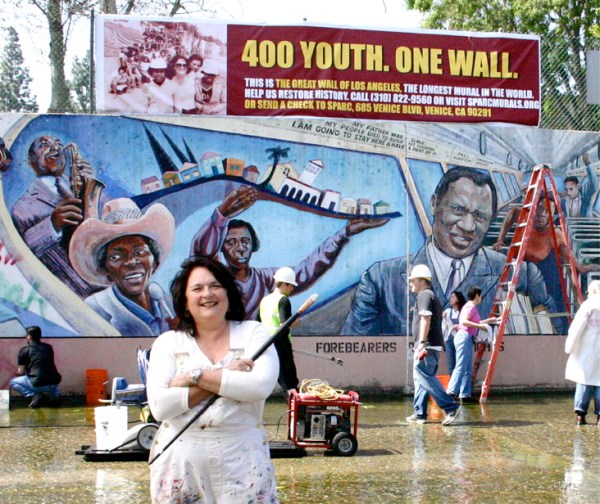
Recently, I wrote the poem “Whose Story Do We Tell?” as a homage to the muralist Judith Baca and her magnum opus, the 2,800-foot-long mural, Great Wall of Los Angeles. Located adjacent to Coldwater Canyon Avenue in the Valley Glen neighborhood of the San Fernando Valley, the Great Wall of Los Angeles is a 10,000-year history of Los Angeles that pays special attention to underrepresented stories and lesser-known ethnic history.
Painted over five summers between 1976 to 1983, the mural’s extensive history and how Baca conceived of the project is told masterfully in the book, “BACA: Art, Collaboration & Mural Making.” Edited by Mario Ontiveros, the book includes essays by Ontiveros, Baca and four other writers. Inspired by the work of Mexico’s Los Tres Grandes — the three greats — José Clemente Orozco, Diego Rivera and David Alfaro Siqueiros — Baca’s oeuvre carries on the spirit of these pioneering mural makers and takes it further by collaborating with hundreds of international artists and mentoring hundreds of students.
Baca has painted scores of murals all over the world. The Neighborhood Pride program she started under former Los Angeles Mayor Tom Bradley helped in the painting of over 105 murals across Southern California. In 2010, the Los Angeles Unified School District named an elementary school after Baca. The Judith F. Baca Arts Academy is on 89th Street and Compton Avenue in the Florence-Firestone neighborhood just north of Watts. She visits the school often and attends graduation ceremonies there every year.
Baca believes in the educational power of murals and her 50-year career testifies to this. In 1976, she co-founded the Social and Public Art Resource Center(SPARC) which still operates to this day. Carlos Rogel writes, “Establishing SPARC gave Baca a means to share institutional knowledge, document progress and improve complex art programming.” Read the Rest of the Article Here

 Los Angeles Literature