
By Nathan Deuel
FROM: Los Angeles Times
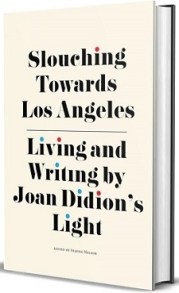 Joan Didion is inescapable, an icon, and so essential to California’s story of itself that some even call her Los Angeles’ first public intellectual. It requires a certain bravery to tackle her legacy.
“Slouching Towards Los Angeles” is, as the collection’s editor Steffie Nelson writes, a “celebration and an investigation of Didion’s ongoing claim on California and its writers—because she in turn belongs to us.” There are so many exciting facets of this ownership, among them Didion’s gender, which, Nelson writes, “was at once revolutionary and irrelevant; she wasn’t playing a man’s game—she created her own game.” (Twenty of the book’s 25 contributors are female.)
Many know Didion’s seemingly effortless style, her dinner parties, the husband she wrote movies with, the move from Malibu to New York City. But this collection, at its best, adds new information to the swirling, decades-long accumulation of gossip, legend and close reading.
In one of the most revelatory pieces, Michelle Chihara draws on her dissertation to look closely at property records that make it clear how complicated this native daughter’s story actually is. In essays and books, Didion has grappled with how completely she was smitten with the pioneer mythology of early California and the role her proud clan played in the state’s early days. But it’s an uglier moment, Chihara writes, when Didion readily criticizes others’ decisions about how to deal, responsibly or not, with a legacy of colonization and land use. Even as Didion ridiculed other California families for succumbing to developers and oil men, she and her brother quietly subdivided portions of their own inheritance to make room for Taco Bells and Walmarts. One plot, in the family’s hands since 1850, was sold in 1985 to become a McDonald’s. Read Rest of Article Here

 Los Angeles Literature