
By John Birdsall
FROM: L.A. Times
 I had a favorite study carrel at UC Berkeley: third-floor Moffitt Library, northeast corner. The bathroom — folded within an interior wall, set off, secluded — was weird, though. Someone had taken the time to punch a raw opening through the metal partition separating two stalls. It was as big in diameter as a Coke can, sometimes lined with wadded toilet paper, and framed with scrawled hieroglyphics (arrows, initials). I dismissed it as crazy, an elaborate work of vandalism, but it nagged at me. While I studied James Joyce and Virginia Woolf and stressed about my senior thesis, the men’s room was undergoing a silent and illogical transformation.
I probably don’t need to explain how my awareness of sex was evolving, how I was still managing my lust for men in secret while declaring outwardly that I liked women. I was still a virgin with men, still figuring it out. I’d never heard of glory holes or hookups in bathrooms, or of a queer culture of desire that ripples inaudibly through public spaces like an ultrasonic whistle only some of us were born to hear. I was just trying to work out the puzzle of that brazen hole on third-floor Moffitt.
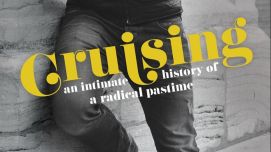
In “Cruising,” L.A. author Alex Espinoza offers a cultural history of gay hookup sex in public spaces. The book’s subtitle, “An Intimate History of a Radical Pastime,” roots the author’s argument in terms of power. Cruising, Espinoza argues, is the signal act of resistance at the heart of queerness (male queerness, anyway). The book’s epigraph is from John Rechy’s “The Sexual Outlaw”: “The promiscuous homosexual is a sexual revolutionary. Each moment of his outlaw existence he confronts repressive laws, repressive ‘morality.’ Parks, alleys, subway tunnels, garages, streets — these are the battlefields.”
In Espinoza’s argument, oral sex in some public bathroom isn’t just an expression of physical need or a personal act of horniness. It’s an act of insurrection against straightness, a transgressive remaking of the dominant hetero commons. Espinoza suggests that, as an act of nonconformity, of perseverance across generations, and an almost spiritual need for connection, glory-hole sex might be the iconic expression of gay culture. Read Rest of Review Here

 Los Angeles Literature