
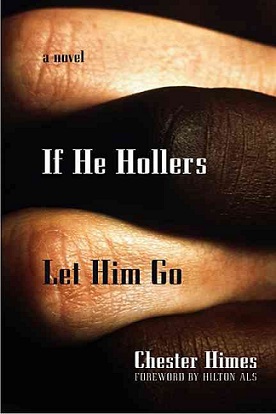
 NOTE: In honor of Black History Month, Los Angeles Literature is highlighting the city’s literature written by black writers. They have all left an indelible mark on the city of Angels. In the first installment, Los Angeles Literature is highlighting If He Hollers Let Him Go by Chester Himes.
If He Hollers Let Him Go by Chester Himes was published in 1945. The plot is set in war time Los Ángeles of the early 1940s. It takes place all across Los Ángeles, from the shipyards of San Pedro to the Dunbar Hotel to the Lincoln Theater on Central Avenue to the wealthy black neighborhood of West Adams and Sepulveda Boulevard on the City’s Westside. From the first word to the last, the book’s black protagonist, Bob Jones, a shipyard worker, is relentlessly plagued by the effects of World War II racism,” Mike Sonksen says in his article “Mapping Chester Himes.”
Chester Himes “Explores [and] destroys, the racist attitudes of white Angelenos…but that doesn’t mean he points the narrator in gentle strokes,” Sarah Fenske says in a 2013 L.A. Weekly article. And the reader sees the way Jones is treated and his interior monologue as he reacts to the world he inhabits. Jones says at one point, “I could feel race trouble, serious trouble never more than two feet off. Nobody bothered me. Nobody said a word. But I was tensed every moment to spring.”
It’s Himes’ blatant, incisive social criticisms on race and racism in Los Ángeles—largely absent from much of Los Ángeles Literature—that make If He Hollers Let Him Go, a classic of the city’s literature. L.A. was a far cry from the Jim Crow south, on opposite sides of the country, and is today known as a deeply democratic bastion, so people don’t realize it has a dark racist past. Plus, Himes speaks for minorities and the working class in L.A., historically absent from the literature of Los Ángeles and largely ignored by the city’s most iconic literature.

 Los Angeles Literature