
THE BELOVED WRITER ON DEFYING EXPECTATIONS AND TRYING NEW THINGS
By Zan Romanoff
From: Lithub
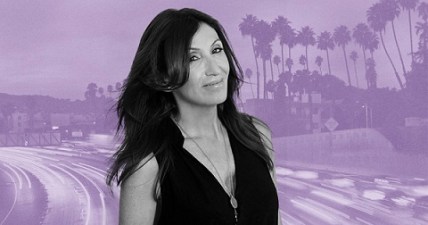 I can’t help myself: I dress up to go see her. It’s 9 am on a Thursday morning when I leave my house, 50-some degrees in Los Angeles and so windy that palm trees are curved and swaying, my car trembling with exertion on the freeway.
It’s the wrong day, hour, and weather for a white lace minidress and a long, bone-colored shearling vest, but the memory of my 12-year-old-self, clutching a paperback and dazed with visions of girls in vintage silk kimonos, combat boots, fairy wings, and Gaultier sunglasses, is insistent. You don’t go to Francesca Lia Block’s house in jeans and a t-shirt. You just don’t.
Like many women of my generation, I first encountered Block via the books in her Weetzie Bat series: a collection of novellas about a girl—at first teenaged, eventually a twentysomething mother of two—navigating the wilds of 1980s Los Angeles, which Block figures as a punk wonderland of kitsch and glamour, “a canyon where Jim Morrison and Houdini used to live, and all-night potato knishes at Canter’s, and . . . Venice, with columns, and canals, even, like the real Venice but maybe cooler because of the surfers.”
Those books remain her most famous, but she’s continued publishing steadily in the nearly 30 years since, amassing 40-some titles, which include everything from fiction to poetry to Wood Nymph Seeks Centaur: A Mythological Dating Guide.
Her latest, The Thorn Necklace, which came out from Seal Press last week, is a hybrid: equal parts a book of creative advice and a memoir. In it, Block writes intimately about growing up in the shadow of her artist father and his muse, her mother. Her father, Irving, helped create special effects for 50s B-movies, and eventually worked as a professor at California State University Northridge; he was well-known enough to merit an LA Times obituary when he died.
But the book isn’t strictly autobiographical: it also offers itself as something of a creative guide, structured by the twelve questions Block has developed to help get herself and her writing students through the wilds of their work.
“With this one, more than any novel, it’s so personal,” Block tells me. “So I’m more nervous than I’ve been before with a book coming out. I feel like everything’s right out there; there’s not even any scrim.” We’re sitting the couch in her living room, facing in towards one another; only my phone, recording between us, punctures the illusion that this is merely a conversation between friends. Read Rest of Article Here

 Los Angeles Literature