
by Daniel Cano
From: Labloga
 In the spring of 2015, I received a telephone call from the Santa Monica College Foundation asking if I would present the SMC distinguished alumna award to writer Michele Serros, who had been a former student of mine.
“Of course,” I replied, sadly. I knew Michele had been fighting cancer, and she was putting up a courageous battle.
We’d kept in touch over the years. As her writing career blossomed, I would ask her to visit my creative writing classes. We’d also meet at different literary functions. One time, we laughed as we found ourselves standing on the same stage receiving awards for our work. She always called me Professor Cano.
“Michele, we’ve known each other fifteen years. Call me Daniel. You aren’t my student anymore,” I’d tell her.
“But I always see you as my teacher,” she would say or something to that effect.
She did stop calling me Professor Cano and called me Mr. Cano–the closest she could get to my first name.
When I heard the SMC Foundation had invited Michele to campus to receive her award, I was looking forward to seeing her, and I hoped that she’d be well enough to read from her stories and poems. Actually, Michele didn’t read. She performed, always holding a book in hand. Michele had become a successful businesswoman, as well as a writer. I don’t doubt that she wanted her audience to see the book’s cover and title. She was her own P.R. machine, a difficult role for many creative people. But Michele was always up for a challenge.
When I saw her at another function, she said, “Mr. Cano, can you believe it? I’m writing for George Lopez. And I got to meet Cheech Marin.”
She never lost her sense of wonder. She sounded like a little girl getting to play with her new toys.
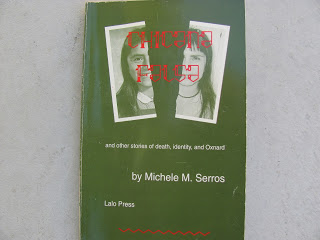
Her first book, Chicana Falsa, and Other Stories of Death, Identify, and Oxnard, published when she was a Santa Monica College student, by Santa Monica College’s Lalo Press, received excellent reviews. But when she realized bookstores wouldn’t place her book on their shelves, she loaded her boxes of books in her car and drove wherever she could read and sell her books, fine-tuning her performing skills.
A few years after she’d transformed her readings into performance art, she told me she had accepted an invitation to join the Lollapalooza music festival to read her work.
“Michele, you realize that’s an alternative rock tour, like the Chili Peppers and Suicidal Tendency-type bands?”
“Yeah, I think it will be exciting,” she told me.
Undaunted, Michele took her boxes of books and set off like she was running away to join the circus.
She knew it would be difficult. But she also knew that her name–and the title of her book– would be splashed on flyers and posters across the country. She was right.
I followed her progress during the tour in newspaper reviews and read that Michele had won over the prickly– and probably very stoned–alt-rockers. The next time I saw her, I asked her how it went.
“Professor Cano, you wouldn’t believe it,” she said, using a very girlish, embarrassed tone. “It was awful,” she laughed. “I’d be reading my poems and all the guys would be yelling, ‘Hey, babe, take off your top. Let’s see what you got underneath.’ Oh, my God!”
I wasn’t surprised at her success. She was softer and much less obscene, but just as accessible, as Charles Bukowski. Like his characters, hers were real: her family, uncles and aunts, college friends, and, of course—Oxnard. She wrote humorously, yet thoughtfully about the difficulties they faced in life. Their pain and laughter were also ours.
In fact, the scary thing about knowing Michele was that you never knew if you were going to pop up in one of her stories and how she’d portray you, as one of my colleagues learned when he failed to make good on an honorarium he had promised her. Read Rest of Article Here

 Los Angeles Literature