
by Michael Sedano
From: Labloga.com
Summers from Junior High through the year I left home for college, I laid cement slabs for patios, pool edges, walkways, and the like, under tutelage of my Dad.
We checked the book he got in CCC before the war for the mix. Shovel 3-3-1sand, gravel, cement into the wheelbarrow, eyeball the water and mix to the right consistency. Haul the mezcla to the hole and pour. Work the surface with a two-by-four then trowels. A well-laid slab glistening against a setting sun is about as satisfying a sight as a worker can enjoy.
It will be there forever.
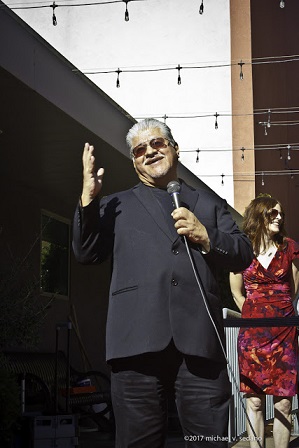
Some of that’s why I’m looking at the Mexican doing all the work while the honchos stand around and the audience bunches up chatting, awaiting Luis J. Rodriguez’ arrival to immortalize his handprints in the finely textured mezcla the essential Mexican worker packs into the sunken frame. It’s a special mix and the vato has done a perfect job.
The fellow drawing the finishing trowel across the wet surface wears a necktie. I’ve never seen that before. He’s Cement Artist Sassan Shakoori. He tells me he’s done Grauman’s Chinese Theater for 40 years.
Workers packed the mix tightly against the perimeter barrier. When they’ve added and patted, Shakoori kneels in to finish the perimeter then smooth the surface. All now lies ready for the cement artist to work Rodriguez’ hands into and out of the mud, leaving a clean, sharp impression.
First the handprints, then the signature. There’s a process. The bed of cement has a plasticity and density to push back against the embedding hands, form around the fingers and palm. The impression will fail unless the hands rise straight up.
Someone in the crowd calls out “You’ve done that before!” “A ten-print!” another observes, as Shakoori presses each digit into the accepting mud. “I’m familiar with the process!” Luis retorts. Read Rest of Article Here

 Los Angeles Literature