
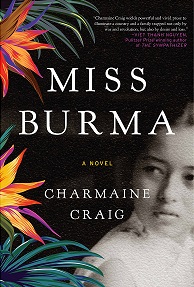
In its opening paragraph, the lights of Charmaine Craig’s epic new novel, “Miss Burma,” come up on Louisa, who is based on the author’s mother, taking the pageant stage. Louisa Benson Craig, a woman who after being crowned went on to become a political revolutionary with a price on her head, is one of many fictionalized characters whose lives are so full of loss and perseverance and incident that to follow their story is to follow the history of the country itself. The sweeping, multi-generational story of a family belonging to the Karen ethnic minority, “Miss Burma” charts both a political history and a deeply personal one — and of those incendiary moments when private and public motivations overlap.
Craig, a former actress who lives in Los Angeles and teaches at UC Riverside, met me at cafe to talk about “Miss Burma”; our conversation carried over to a walk around Echo Park Lake. We discussed the literary bias against so-called historical novels, her relationship with her mother, who died of ovarian cancer in 2010, type-casting in Hollywood and why the near decade that Craig spent working on a book about her family became less about excising the story from herself than excising herself from the story. This interview has beenedited for clarity and length.
When did you first discover that your mother had been both Miss Burma and a political revolutionary?
I can’t remember a time when I didn’t know. My American dad was a dreamer, and he painted my mother in these oversized terms — she was Miss Burma, she was the most famous actress in Burma for a time, she was a woman warrior. So I knew all of that. But as I was writing the book, I would put pieces together in an almost journalistic way, and I would figure out how her story fit into a bigger political picture. It was almost like having a conversation with the dead.
“Miss Burma” is based on the lives of your mother and grandparents; it’s a story that is, in somesense, a real part of you. What was it like to get that story out and onto the page?
I should tell you that the first version of the book was much more about myself and my mother. It was first person, it was much more of the expected immigrant story. I wrote an entire version of that book as my mother became sick, and it was cathartic to write that version, which was so much about the traumas she had lived through and how I inherited some of that, and about her conflict over giving herself over to motherhood in the United States when I think she felt, to some extent, that she had abandoned the call of a whole people back in Burma, what’s now Myanmar. What became clear to me after I finished that book was given the fact that I was writing this for a Western readership I had been too solipsistic in my approach. The book wasn’t about me, it needed to be about a country and a people and a family, and I needed to exist in the margins of the story and get myself out of the way. Read Rest of Interview Here

 Los Angeles Literature