
 BY TONY MOSTROM
Los Angeles suffers from (or enjoys) a kind of historical amnesia. In the popular mind, there’s an almost complete lack of an “origin story” for the city. That isn’t unusual as cities go, of course, but hey, Los Angeles is famous, L.A. has personality, and that implies, you would think, a generally known and worthy life story that everyone is hip to. The vague (and lazy) assumption that the birth of the movie industry and the birth of L.A. were one and the same obviously doesn’t cut any ice; we’ve all seen the year 1781 right there on the city’s official seal. The cliché that L.A. doesn’t care about its history seems like a self-fulfilling prophecy long fulfilled.
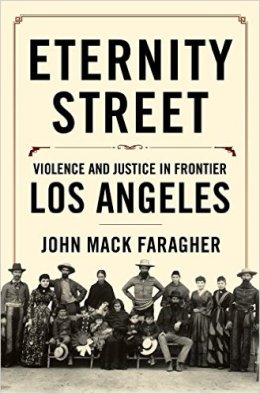
John Mack Faragher’s new book, Eternity Street: Violence and Justice in Frontier Los Angeles ($35, W.W. Norton), clears some of the fog to reveal what laid slumbering for centuries in the archives: a record of pure, unrelenting bloody horror. L.A.’s history after statehood was one nasty business. “In the 1850s,” the book jacket warns us, “the City of Angels was infamous as one of the most murderous societies in America.” L.A. was nationally notorious, “a terrible place for murders,” as one prominent San Franciscan warned his fellow citizens. Taking its title from Calle de Eternidad, one of the original streets of the old pueblo, this book is a lean-and-mean slab of history at its most brutal. As a pure chronicle of criminality, Eternity Street pretty much qualifies as a true-crime book. More importantly, it is probably the most violent “origin story” of an American city that you will ever read.
With the Gold Rush up north in full swing, Los Angeles County (with a population of about 6,000) was overrun with hotheaded and violent single young men; soon enough, L.A. tabbed a higher murder rate than New York City. Read Rest of Article Here

 Los Angeles Literature