
by Olga García Echeverría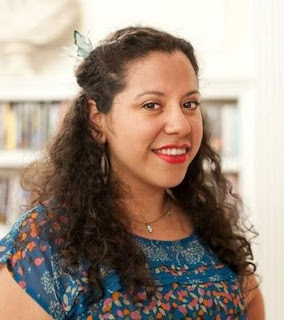
of Chavez Ravine and collect trinkets for my desk:
a hawk feather, a sun-bleached snail shell,
a rusted nail sitting within the brick base
ruins of a house. I imagine great-aunt Susana
collecting herbs from the hills hugging Teocaltiche.
In the afternoon, Uncle Manny recalls remedies
she concocted and the tiny quail eggs she fried
for breakfast with handmade tortillas the shape of boats.
My finicky father never ate from her table,
but Uncle Manny has had too many Budweisers
and is spilling memories of his favorite tia this 4th of July.
“She used to put me on her shoulders and carry me
across the river,” he says dreamily. This was before L.A.,
hair products, Ford cars, and the church youth group
where he met my aunt, and my dad met my mother.
By dusk, tears dig into the creases of his face
like a stone creek. He hushes only to watch my cousins
launch bottle rockets from the street. Smoke tails up
and sparks shoot out over our heads. Colors flash bright
and disappear into the air like my uncle’s sobriety,
like Tia Susana, like the houses of Chavez Ravine.
—Xochitl-Julisa Bermejo
If you’re an Angelino with your eye on the literary scene, then most likely you’ve heard of Xochitl-Julisa Bermejo. She’s shared her award-winning poetry with audiences throughout LA and beyond. She is the creator and curated of the quarterly reading series HITCHED, formerly held at Beyond Baroque and now being hosted at Holy Grounds.
Another important and exciting LA-based literary project is Women Who Submit, which Bermejo co-founded. This group encourages and supports women writers in the submission process for publication. When Xochitl isn’t organizing, submitting her work or encouraging others to submit, she’s teaching, grading, and reading articles on the pedagogy of working with English language learners.
Her writing essentials? Música and a laptop. A source of inspiration she keeps returning to? Long walks in nature.
Although Xochitl says she did not become serious about her writing until her mid-twenties when she pursued her MFA, it is obvious that the creative word has been brewing inside her since she was a chiquilla. At six, she wrote her first poem, and at 11 she not only wrote a western, she also won a Knott’s Berry Farm contest with her submission.
Bueno, there is so much to say about Bermejo, but we’ll let her say it herself. Here is our featured and estimada poeta sharing her insights on writing, publishing, building community, going beyond AWP drama/trauma, and talking about the importance of following our hearts and honoring our stories.
Welcome, Xochitl. Let’s get right into it. I’ve been writing a lot about my parents lately, and as a result re-discovering ways in which they influenced my writing. I’m curious, ¿Qué dicen tus padres about you being a poet, and how have they influenced your creative journey?
No, I didn’t always use Spanish in my work. In graduate school, I had little sprinklings of Spanish here and there when I would write about my family, and that was the first time I had people telling me I had to italicize those words. I had never heard that because I hadn’t really studied writing academically before.
It wasn’t until I went to Las Dos Brujas writing retreat in New Mexico that I started to understand the wider conversation of using Spanish and other languages in writing. Las Dos Brujas was organized by Cristina Garcia. The mentors were Cristina, Juan Felipe Herrera, Chris Abani, Denise Chavez, and Kimiko Hahn. LDB was the first time I had ever experienced being in a workshop with a majority of writers of color, and it was the first time I felt I had connected with a mentor of color. LDB really opened my eyes to what had already been going on within the community for some time. A book that really struck me was Slow Lightning by Eduardo C. Corral. I was really amazed by how much Spanish he used. Nearly whole poems in Slow Lightning were in Spanish. His book really opened my eyes to how far it can go.
As a teacher myself, I know how difficult it is to write during the school year, especially because we take so much work home. What helps keep you on track with your writing during the school year?
The best thing I have to keep me writing at this time is a regular workshop group I have on Wednesday nights. There are three of us. We are all women, and we are all workshopping early drafts of novels. We each take turns reading 5-10 pages aloud for feedback. Thankfully, I generated like crazy over the summer, so all I have to do is show up, bring something I’ve already written, and be ready to listen. It feels low-pressure, and it keeps me thinking about writing in the week. And then I have something to work on when the weekend comes. This group has been a life preserver. It’s definitely keeping me afloat writing-wise.

 Los Angeles Literature