
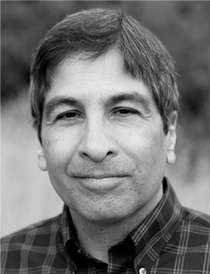
 Stephen Gutierrez writes about the facts of freeways and being a troubled kid, the studious type derailed by sickness in the family. In his latest book, “The Mexican in His Backyard,” the people and places of southeast Los Angeles — his eternal backyard — come through with heat and lyric: the bare truth of the everyday.
A professor at Cal State East Bay, with an MFA from Cornell and a trilogy of books, Gutierrez was born, raised, and educated in southeast Los Angeles. His collections are replete with short stories and essays that frequently feature portraits of life in Commerce, Bell Gardens, Montebello, and East L.A.
In his first book, “Elements,” Gutierrez writes that City of Commerce was:
In close proximity to East Los Angeles which we were warned to stay away from, suburbs which teased us with their influence, factories and warehouses all around us which hired us […] We were a working-class town.
If you have ever driven through Commerce on Interstate 5 (I-5), the main interstate highway on the West Coast of the United States, you need to know Stephen Gutierrez’s books. If you’re lucky, you will meet him in person and split some guava churros from the Lucero Bakery in Bell Gardens.
He wrote this about himself in “Elements”: “Grew up in the City of Commerce, six miles outside of Los Angeles, the spires of downtown visible on smogless days. We never saw them.” But Gutierrez could see the stories of his home, his block, that metropolis that surrounds Los Angeles.
He was “Born on the same day as Charles Bukowski […] only 39 years later,” and the same grit and blemished truths can be found in his stories as you might find in Bukowski’s work. That’s because Gutierrez has spent the majority of his creative life right next door to the Santa Fe Railroad train yard and the Citadel along the 5 Freeway.
The Biggest Bow on Earth
The day I met Stephen in person, it was in the “fancy” section of Commerce: Rosewood Park. For some of us who grew up in southeast L.A., Commerce was known for being a “rich” area, meaning they had more money than we did; not exactly rich, but rich to us. Stephen is a character from his books, with buen humor and easy going, quick to smile and smirk; he shook my hand hard and we started the day.
“The thing about Commerce is that the city has resources,” he added. “But the people? Not necessarily.” The Rosewood area had been dubbed by its first inhabitants, mostly working class whites and Mexican-Americans, “The Beverly Hills of Commerce.” Some things had changed since he’d last been around. The Citadel used to be the Samson/Uniroyal Tire Factory, and it still bears the Assyrian castle facade seen from the Five Freeway. Across the river of traffic sit the quaint houses in Rosewood.
The morning I met Gutierrez for a drive around Commerce, the Citadel was dressed up for the holidays — multiple giant televisions advertised designer goods; its roof tops adorned with over-sized trimmings.
“That’s the biggest bow on earth!” Gutierrez wasn’t ready for so much consumer festivity. He was also not ready for the new pool at Rosewood Park.
The Brenda Villa Aquatic Center is gorgeous and modern — glass, concrete, and skylights. The old pool we swam in has been demolished. The city has had a free bus and a free summer camp for its residents for several decades. For Southeast cities like ours where many landowners have addresses in Redondo Beach, tax dollars rarely reach public infrastructure and resources, so a free bus and summer camp seemed like a dream for us. For people like Brenda Villa, the gold (and multiple) medal-winning water polo player from Commerce, an Olympic-sized pool and summer camps can be and were life-changing.
Did graduate school change Gutierrez’s life? Definitely. And so did his first book. “Elements” won the Charles H. and N. Mildred Nilon Excellence in Minority Fiction Award. He was at Cornell, however, long before Helena Maria Viramontes began teaching there, her long line of work and voices from places like where we grew up coming with her into the classroom of the Ivy Leagues. One can only imagine the contents of this essay, “Bombing Out…Memories from an M.F.A. Program.” Gutierrez likely sat in workshops where people recommended that his characters speak less Spanish, unable to identify the Caló they thought was, at best, “Spanglish.” But the writer stayed focused on capturing the voices he heard growing up in southeast L.A: the boys from Commerce with dark, neat hair and glasses, or the ones who shot hoops under the Long Beach Freeway at Bandini Park. Read Rest of Article Here

 Los Angeles Literature